OnlineKhabar
Passport supply confusion deepens as stock runs low
Kathmandu, July 1
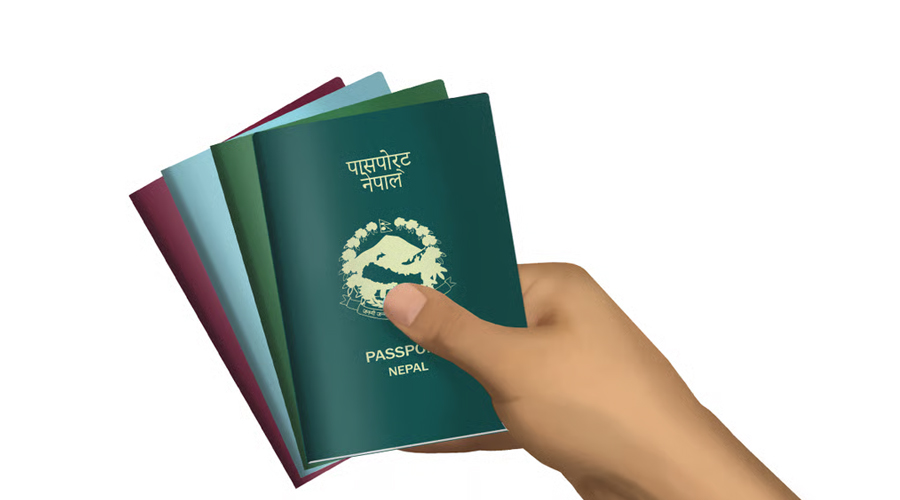
With only about two weeks’ worth of stock remaining, confusion has emerged over the printing of new passports.
Currently, the passport department has around 50,000 booklets in stock. Although daily demand is around 6,000, the government is currently distributing only around 3,000 to 4,000 passports a day.
Based on this supply-and-demand data, the current stock appears sufficient for only about two more weeks. Beyond that, the government has yet to make its position clear on how passport supply will proceed. Officials at the Department of Passports, the Ministry of Foreign Affairs, and the Prime Minister’s Office are not yet ready to comment formally on the passport contract and supply situation.
The confusion arose after the Commission for the Investigation of Abuse of Authority (CIAA) filed a corruption case against 18 people, including Passport Department Director General Tirtha Raj Aryal, alleging corruption in passport printing.
Prime Minister Balen Shah’s team has instructed department staff to cancel the passport contract, but the department has not moved forward with the cancellation process. The roughly 700,000 passport booklets procured by the Sushila Karki government are expected to run out by mid-July.
“No employee is willing to be transferred to the passport department. They are even less willing to authorise payment after the new passports are printed,” a source close to the Ministry of Foreign Affairs said. “It’s not possible to continue with the old arrangement either. There’s a great deal of uncertainty about how passports will be distributed two weeks from now.”
Contract not cancelled
Although the CIAA filed a case in the Special Court last week alleging corruption in passport procurement, it has said nothing about the passport contract itself.
The German companies awarded the contract, Muehlbauer and Veridos, have completed the passport printing work along with all equipment. The German embassy has informally warned that if the contract is cancelled, it will pursue legal recourse against the government, including compensation.
After the CIAA levelled corruption allegations, the Public Procurement Monitoring Office had said the contracting process was lawful, and the CIAA does not appear to have challenged that finding. Meanwhile, the passport contract case itself is pending before the Supreme Court.
On Monday, the hearing was postponed after Justice Sapana Pradhan Malla recused herself from the case. A Ministry of Foreign Affairs official said that with the case pending in court and the contract already approved at one level, it isn’t straightforward for passport department staff to cancel it.
“There may be a corruption allegation on one hand, but cancelling a legally awarded contract would still have to follow due legal process,” the official said.
Payment difficulties
The CIAA has made 37 separate allegations claiming corruption in passport procurement. Among them, the 15th allegation claims that bid conditions were altered to allow the purchase of substandard booklets.
“It appears the (bid) was amended in a way that reduced the cost estimate and the quality of the booklets,” the CIAA said in its charge sheet filed with the Special Court, adding that the defendants knowingly acted against the Public Procurement Act for illegal gain, causing losses of billions of rupees to the government in bad faith.
The CIAA has claimed that the booklets supplied by Muehlbauer and Veridos are of lower quality than specified. The government must pay the contractor companies based on the number of booklets they supply.
An employee at the Passport Department said that since no staff member is willing to authorise payment, passport printing itself could be affected.
“The CIAA has claimed the booklets are of lower quality than specified. If someone authorises payment for the printed booklets, there’s a chance a case could later be filed asking why payment was made for substandard material,” the employee said. “So now no one is willing to authorise payment and once payment stops, how long will the contractor keep printing passports?”
Old option even more expensive
The current contract holders, Muehlbauer and Veridos, have quoted US$8.61 per passport. Previously, under a variation order, the Sushila Karki-led government was procuring passports from France’s Idemia at US$10.13 each.
Idemia, which has been printing passports so far, had actually offered the government US$9.93 per passport in its tender bid, but according to its own claim, several other factors made that bid the cheapest overall at the time.
If the government cancels or suspends the current contract, it will have to procure passports from Idemia again through a variation order. If Idemia agrees to supply under the old variation order terms, the price per passport, at current exchange rates, would be roughly US$1.5 to $2 more expensive.
“We’re already buying the old option at a higher price,” the passport department official said. “How would it make sense to cancel the cheaper tender and sign an even costlier passport deal? Who would even sign off on that decision?”
View original source — OnlineKhabar ↗
Related stories

TASS
PoliticsJul 1, 2026 · 1 min
Senior Russian senator warns of 'joint response' if Ukraine attack Belarus
TASS

Philippine Daily Inquirer
PoliticsJul 1, 2026 · 1 min
Myanmar mourns as post-coup conflict death toll hits 100,000
Philippine Daily Inquirer
CNA
PoliticsJul 1, 2026 · 1 min
PM Lawrence Wong to meet Timor-Leste leaders on first official visit
CNA

The New York Times
PoliticsJul 1, 2026 · 1 min
Back in Congress, Tom Kean Jr. Faces a New Challenge: Staying There
The New York Times