The Next Web
Uber-backed Lime prices its IPO at $25 a share, raising about $174m
Lime has priced its US initial public offering at $25 a share, according to Bloomberg News. That is the midpoint of the $24 to $26 range the company had marketed. The offering raised roughly $174m in total.
Neutron Holdings, the corporate entity behind Lime, sold 6.68 million shares in the deal. Shareholders including chief executive Wayne Ting, president Joseph Kraus, and co-founder Brad Bao sold a further 276,731 shares between them.
The stock is set to trade on the Nasdaq under the ticker LIME. Pricing at the midpoint values the company somewhere between about $1.66bn and $1.8bn.
For a category that has spent years in retreat, a clean landing at the midpoint counts as a result. Investors did not force a discount, and Lime did not have to reach for the top of its range either.
The pricing was first reported by Bloomberg and quickly matched across financial outlets. Lime itself has not put out a valuation figure, so the numbers rest on the reported terms.
Uber is the name doing much of the heavy lifting here. The ride-hailing group already owns more than 10% of Lime and guarantees some of its debt.
That stake made Uber the anchor investor in the listing, lending it a credibility that pure micromobility plays have struggled to muster in recent years. The relationship also gives Uber a route back into two-wheeled rentals without owning the operation outright.
Lime first flagged the plan when it filed for the Nasdaq listing under the Neutron Holdings name. It framed the move as the first big micromobility IPO test in eight years.
The numbers behind the scooters
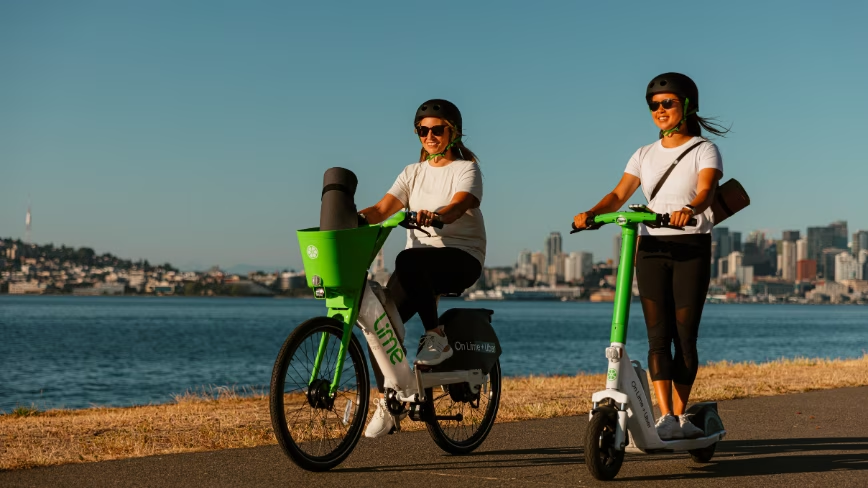
Lime was founded in 2017 and now operates in roughly 230 cities across 29 countries. Its green e-bikes and e-scooters have become a fixture in much of the market.
The business booked about $928m in revenue for the 12 months to 31 March 2026. Rider numbers have been climbing, with monthly active users up more than 20% year on year.
Profitability is the harder part of the story. Lime’s net loss widened to $59.3m in 2025, from $33.9m the year before, so the company is scaling revenue while still bleeding cash.
That tension sits at the heart of the pitch to public investors. Lime is asking the market to back a growing but loss-making operator in a sector littered with failures.
Lime is going public as one of the last venture-backed names standing in micromobility. The category burned through cash and confidence over the past few years, and several rivals folded or were sold for scrap.
A midpoint pricing therefore reads as cautious optimism rather than exuberance. The valuation is grounded, and the raise is modest by the standards of tech listings.
The listing also arrives during a thin summer IPO window, which makes any successful pricing more notable. Deal flow has been light, and a mid-range result signals steady rather than frothy demand.
Lime’s pitch leans on scale and a familiar backer rather than a path to profit. Uber’s presence gives cautious buyers a reason to look past the widening losses.
The real test comes when the shares start trading. A midpoint price sets a fair benchmark, but the first sessions on Nasdaq will show whether public investors share the appetite that got Lime this far.
For now, the company has cleared the hardest gate. It priced, it raised, and it did so without blinking on valuation.
Whether that steadiness survives contact with the open market is another question entirely. Micromobility has flattered plenty of debuts before fading, and Lime will have to prove it is the exception rather than the next cautionary tale.
View original source — The Next Web ↗
Related stories

South China Morning Post
TechnologyJul 1, 2026 · 1 min
How a ‘Chinese heart’ could get US blood pumping despite biotech decoupling
South China Morning Post

Wired
TechnologyJul 1, 2026 · 1 min
Claude Helped a Hacker Find a Way to Issue Tickets to Almost Every US Music Festival
Wired
TechRadar
TechnologyJul 1, 2026 · 1 min
No-code AI tools take a prompt in plain English (and other languages) and create a web app or other tool
TechRadar

Philippine Daily Inquirer
TechnologyJul 1, 2026 · 1 min
PBA: Rondae Hollis-Jefferson nearing return from Achilles injury
Philippine Daily Inquirer