Indian Express
Indian Express··3 min read
Know Your City: Can a museum create innovators? This Bengaluru science centre is trying
4 min readBengaluruJul 1, 2026 03:38 PM IST
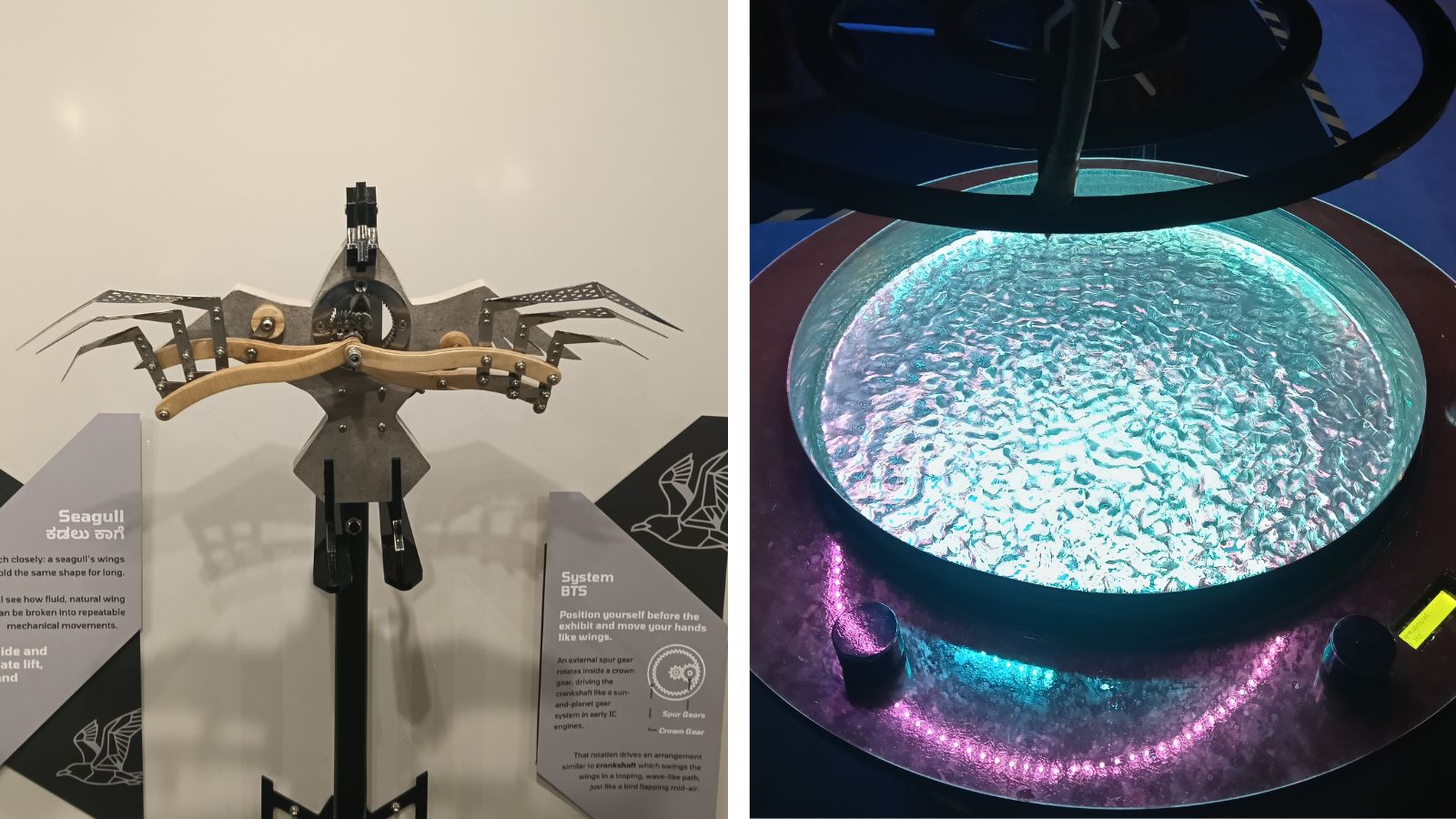
A biokinetic sculpture of a seagull; (right) sound waves visible as vibrations in water. (Express/Special Arrangement)
Lasers bouncing through prisms, sound waves rippling across water, and biokinetic devices inspired by nature are among the hands-on exhibits drawing hundreds of visitors each week to the Param Foundation’s Science Experience Centres in Bengaluru’s Jayanagar and Whitefield.
These science museums move between an artistic and interactive approach to science, blending traditional and Indian approaches to science. Exhibits are split between the themes of the five “elements” in Indian philosophy; ie; Prithvi (Earth), Jal (Water), Vayu (Wind), Agni (Fire), and Akasha (the Sky).
The interactive approach is quickly visible as soon as one enters Param’s new premises at Whitefield – in the form of a recycled-cardboard simulated submarine that displays the different parameters of the ocean at various depths – from temperature, pressure, or even the kind of fish one might expect to see on a screen.
The centre targets various demographics of those who might be interested in the scientific principles on display – from gamified and interactive elements to engage younger sections of the crowd, to more complex concepts for those more familiar with various sciences.
For instance, a visitor could engage with the differences between primary colours via a game testing their ability to distinguish increasingly subtle colours – or they could take a look at the mathematical representations of various shapes that might extend beyond four dimensions (such as a tesseract – a representation of what a cube might become with a fourth dimension beyond length, width, and height – or advanced concepts such as the Calabi-Yau manifold.)
Access to test prototypes
The centre also hosts a workshop that users can rent access to for a day, enabling them to test out prototypes of devices such as robots or create molds using a 3D printer.
Inavamsi Enaganti, one of the CEOs of the Param Foundation, spoke to The Indian Express regarding the objectives behind the Science Experience Centre projects. He said, “The dream was never just a museum – we believe anyone can innovate and our mission is transforming ordinary citizens into innovators. Every single visitor is an experiment on seeing if we can convert them into an innovator – someone who can find a problem plaguing them and try and come up with a solution.”
Going global
Story continues below this ad
Enaganti noted that a large 14 lakh square foot premises was being planned on Magadi Road, while also looking at taking the Science Centre concept to other countries as well. He added, “While we are targeting primarily the 10-25 age group or an extended 6 -35, anyone would enjoy the experience from adults to families including grandparents.”
Enaganti noted that the goal was for these centres to be an evolving experience, pointing out that each exhibit is usually designed by a different person – with many differences likely to be seen after a few months.
In many ways, the concept of interactive science in Bengaluru museums began with exhibits at the Visvesvaraya Industrial and Technological Museum, a familiar memory to Bangaloreans across the decades. Enaganti said, “While it is not a direct inspiration, it is something that we grew up with. It is definitely one of the institutions that made a lasting impact on us.”
The Science Centre premises are open on all days except Monday. Tickets at the Whitefield premises for all-day entry are priced at Rs 450 on weekdays and Rs 550 on weekends.
View original source — Indian Express ↗
Related stories

ESPN
SportsJul 1, 2026 · 1 min
Men's boxing pound-for-pound rankings: 'Boots' Enn...
ESPN

ESPN
SportsJul 1, 2026 · 1 min
From surging Marlins to slumping Braves: MLB winne...
ESPN

The Punch
NewsJul 1, 2026 · 1 min
PICTORIAL: Ex-Nollywood star Grace Bassey announces engagement
The Punch
ESPN
SportsJul 1, 2026 · 1 min
What it feels like to pull off a World Cup upset: ...
ESPN