Times of Israel
Gadi Eisenkot launches a centrist campaign tailored for the commuters of Route 4
The campaign headquarters of the Yashar Party (the name means straight, honest), led by former IDF chief of staff Gadi Eisenkot, occupies an unassuming office building directly above a Yochananof discount supermarket at the Morasha Interchange, northeast of Tel Aviv.
Situated at the exact point where Route 5 intersects with Route 4, the location offers rapid transit access from some of the most congested highways in Israel.
The campaign’s launch video, screened on Tuesday evening at the official launch event, depicts Eisenkot marching down major highways and main streets across Israel. In one scene, he ascends in the transparent glass elevator of the very building where his campaign HQ sits, overlooking the Morasha Interchange.
The launch event itself was held a few kilometers away, at the South Sharon Regional Council municipal compound, right on the suburban fringe.
If Israel’s highway system were mapped onto its political landscape, Eisenkot would be Route 4. He is out to conquer the vast middle-class heartland of suburban Israel, stretching from the northern Sharon region down to the southern Lowlands. His target audience comprises the voters living from Even Yehuda and Kfar Saba, through the Morasha Interchange, Petah Tikva, Kiryat Ono, and Holon, all the way to Rishon Lezion.
Get The Times of Israel's Daily Edition
by email and never miss our top stories
By signing up, you agree to the terms
This is the Israel of commuters who drive to work each morning, endure traffic congestion, pay off their mortgages, raise families, and manage demanding lives. This is neither the playground of the ultra-wealthy top one percent nor the ideological fringes; it is the industrious, working-and-studying Israeli center.
To extend this infrastructure analogy, former prime minister Naftali Bennett and opposition leader Yair Lapid represent Route 2, the Coastal Highway. They speak for affluent, liberal, tech-driven Israel — the people of the coastline.
Bennett, a Haifa native, and Lapid, who hails from north Tel Aviv, embody a demographic continuum that begins at Haifa’s high-tech park, looks west over the Mediterranean from the upscale enclaves of Zichron Yaakov and Caesarea, runs through Herzliya Pituah, and culminates in an electric scooter ride to the corporate glass towers of Tel Aviv and Yarkon Park.
Meanwhile, Prime Minister Benjamin Netanyahu and Likud occupy the mountain ridge line. They are Route 60, stretching from the Tapuah Junction to the West Bank settlement of Efrat, with a vital cross-cutting link to the Benzion Netanyahu Interchange — named after the prime minister’s father — where Route 50 out of Jerusalem hits Route 443.
Only recently, the prime minister, a master of political marketing, orchestrated an entire ceremony to rename the thoroughfare, rebranding Route 60 as “The Bible Highway.” This primary transit axis, which cuts through the West Bank from north to south and connects Jewish settlements to Jerusalem, was thus handed a fresh scriptural identity, drawing clear inspiration from American Evangelical voters and carrying a distinct flavor of the US Bible Belt.
Completing this infrastructure-minded analogy, the victor of the Israeli elections in October will be the leader who manages to crack Route 1 — the highway connecting Tel Aviv and Jerusalem — by bridging the modern and the ancient, the ascents and the descents, at the same time.
No fireworks, no rock ’n’ roll
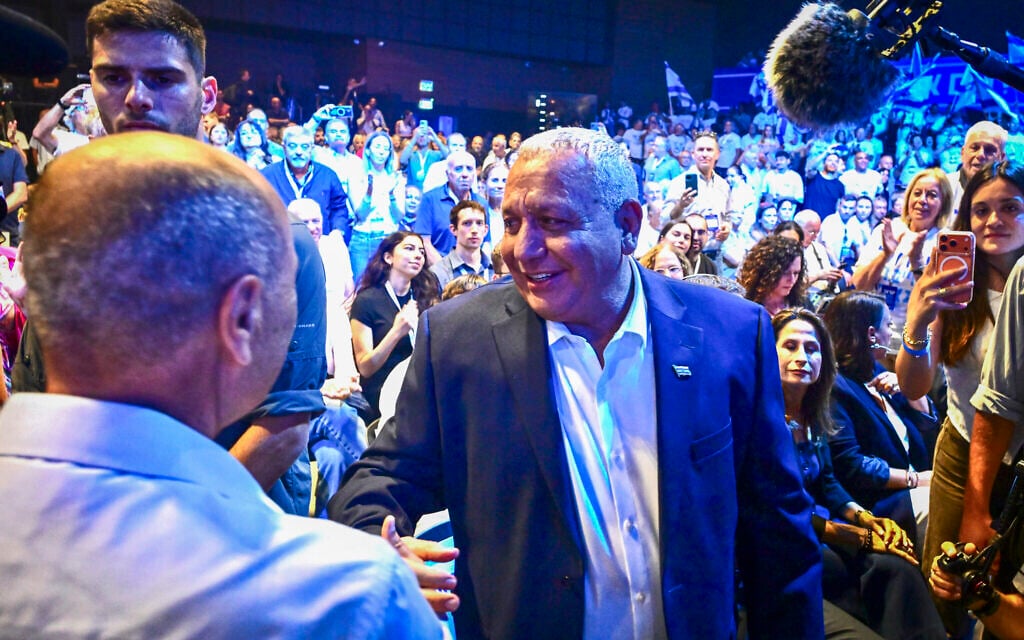
The Yashar campaign launch event ran like clockwork.
Looming behind Eisenkot was a massive, billboard-sized portrait of himself that framed the stage throughout his address. It was clear that intense preparation had been poured into every facet of the evening, particularly the speech itself.
Eisenkot passed his first real campaign test successfully, even though it was entirely evident that the public stage is still far from his natural comfort zone. He looked very much like a man who feels more at home in a military briefing room than under the glare of television spotlights.
The choice of venue was equally deliberate. It bypassed Tel Aviv, avoiding both the urban hipness of lifestyle hubs like Rothschild Boulevard and the standard political rallies at the Tel Aviv Port hangars.
By choosing the South Sharon regional compound, situated on the seam between municipal centers and sprawling suburbs, the launch broadcast the exact message the campaign intends to sell: Eisenkot is not chasing the votes of Tel Aviv liberals, nor is he appealing to the ideological settlement movement. He is aiming squarely at the Israel of Route 4.
The hall was packed to capacity, yet this was not a high-adrenaline, raucous political rally. Instead, the room hummed with a palpable sense of order, seriousness, and military-style discipline. One after another, the members of the party’s Knesset slate took to the stage to outline the core tenets of their platform in brief soundbites and sharp headlines. The party faithful applauded politely, with some wearing T-shirts emblazoned with the slogan “Yashar with Eisenkot.”
To the side of the stage, activists held Israeli flags, and the entire crowd rose to sing the anthem when the keynote address concluded. No one stood on their chairs, no one danced, and no one acted as though a charismatic political rock star had just been born.
This subdued atmosphere was entirely appropriate; the 2026 political season is shrouded in the heavy cloud of wartime grief. At the very center of this campaign stands a prominent bereaved father — Eisenkot himself, whose son, Master Sgt. (res.) Gal Meir Eisenkot, was killed in action in Gaza in late 2023 — among thousands of newly bereaved Israeli families.
Demographically, too, the campaign’s targeted messaging was unmistakable.
The crowd skewed older, lacking a young, trendy, or Instagram-friendly presence. Eisenkot has yet to find a counterpart to Yonatan Shalev, the charismatic 23-year-old co-founder of the wartime reservist movement Katef el Katef (“Shoulder to Shoulder”) recruited by Bennett to his Together slate, who can bridge the gap with voters in their early 20s.
By contrast, Bennett and Lapid have already recruited not only Shalev but also a second young veteran from that movement, Maj. (res.) Shahar Varon, recognizing the urgent need to speak directly to the generation fighting the current war.
On the other hand, the composition of Eisenkot’s slate on the stage was remarkably progressive, featuring five women and four men — a refreshing and unusually balanced picture in male-dominated Israeli politics.
Managing the opposition bloc
Once the party slates are all finalized and the high-profile campaign launches draw to a close, the most critical task ahead for those who want change will be organizing the anti-Netanyahu political bloc.
Figures within the so-called “change bloc” frequently release public statements projecting absolute confidence that Netanyahu’s grip on power is slipping.
For instance, Opposition Leader Yair Lapid spoke this week at a faction meeting of the Together party, taking direct aim at a statement Netanyahu made during a press conference on Saturday night. Netanyahu said he would form “a broad, unifying national government” after the elections.
“What are you talking about?” Lapid sniped. “You will never form another government in Israel. There will be elections and you will lose. Disasters have a price. Dysfunction has a price. Netanyahu will lose and the State of Israel will be saved.”
Naturally, the leaders of the change bloc seek to project confidence in their respective campaigns and broadcast unyielding resolve regarding their ability to form the next coalition. However, Netanyahu’s right-wing religious bloc has not yet fractured.
The change bloc needs to look realistically across the full breadth of the political arena, from its furthest edges to the wavering center. The heavy lifting of keeping this loose alliance aligned is currently falling on Eisenkot’s shoulders, despite the fact that Bennett and Lapid are far more politically seasoned than the former military chief, who only became a Knesset member in 2022.
If the opposition center-left does not tread carefully, the Islamist Ra’am party, which currently holds five Knesset seats representing the Arab minority, could easily fail to cross the electoral threshold. Recent polls that tested a potential merger between the joint Arab list Hadash-Ta’al and the nationalist Balad party showed that alliance securing five to six seats, with Mansour Abbas’s Ra’am barely managing four.
Ra’am’s current polling represents the support of roughly 3.4% of total survey respondents, sitting perilously close to the mandatory 3.25% electoral threshold. Consequently, if national voter turnout proves to be exceptionally high, parties flirting so close to the margins run a very real risk of falling beneath the line and being eliminated from parliament.
This scenario mirrors exactly what happened to Bennett and Ayelet Shaked’s New Right party in the April 2019 general election, when the two spent several frantic days querying the vote count and scrambling, in vain, to locate a mere 1,400 missing votes to cross the required threshold.
If Ra’am, under the leadership of Abbas, fails to clear the threshold, all center-left aspirations of unseating the current government will vanish and the entire opposition bloc will collapse.
Another factor complicating the electoral map is the sudden proliferation of self-proclaimed kingmaker candidates. A growing roster of both veteran politicians and political newcomers are announcing their entry into the arena with the explicit objective of forcing a broad coalition between Likud, Yashar, and/or Together.
These figures consciously avoid using the term “national unity government,” because they are not envisioning an equal power-sharing arrangement; instead, they frame their goal as a “national consensus government” or a “broad emergency coalition.”
The politicians proposing these cross-camp alliances are numerous, though it remains entirely unproven whether they possess a substantial base of actual voters.
This group includes former defense minister Benny Gantz, former UN ambassador Gilad Erdan, senior Likud MK Yuli Edelstein, former justice minister Ayelet Shaked, former communications minister Yoaz Hendel, former Fire and Rescue chief Dedy Simhi, and, in recent days, former Beit Shemesh mayor Aliza Bloch and Aspaklaria Theater director Hagai Luber, who is also a prominent wartime bereaved father.
Initial polling indicates that a combined ticket featuring Gantz, Hendel, and Simhi would capture six seats. However, a poll merely offers a snapshot of the day it is conducted and has no ability to accurately predict the actual results when voters head to the ballot boxes at the end of October.
Nevertheless, if this particular faction, in one configuration or another, manages to win Knesset seats and position itself as the ultimate kingmaker, and Likud wins more seats than any party within the change bloc, the Gantz-led alliance may very well choose to align with Netanyahu — keeping him in office as prime minister, and blocking the formation of a change government in Israel.
View original source — Times of Israel ↗
Related stories

France 24
TechnologyJul 1, 2026 · 1 min
Trump defends making over $1 billion in crypto amid conflict-of-interest criticism
France 24

Dawn
TechnologyJul 1, 2026 · 1 min
'Excited' Trump takes first flight on Qatar-gifted Air Force One
Dawn

TechRadar
TechnologyJul 1, 2026 · 1 min
Geekom's ultra-portable Apple MacBook Pro rival promises Core Ultra 9 performance and up to 24 hours of battery life
TechRadar

Lovin Malta
TechnologyJul 1, 2026 · 1 min
The People You Need To Know In Yorgen Fenech’s Trial
Lovin Malta