The Guardian
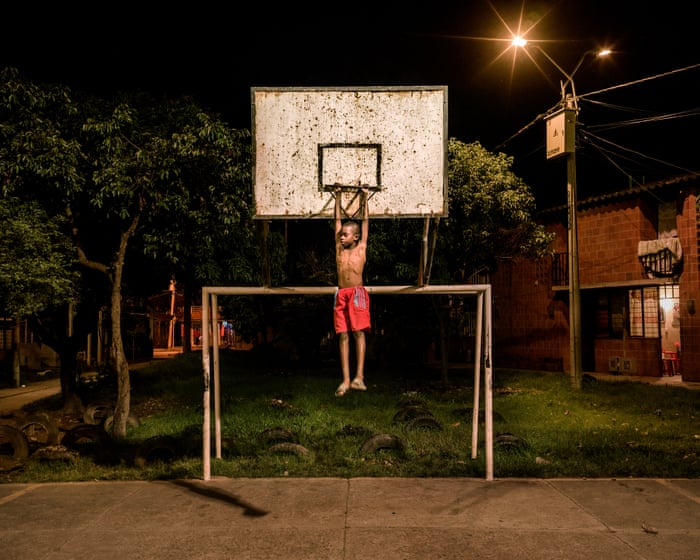
A boy clowning around on a basketball court in a Colombian cocaine corridor: Mads Nissen’s best photograph
I fell in love with photography when I was 19, while studying Spanish and doing voluntary work in Venezuela. Having grown up in the quite boring countryside of Denmark, I was curious about the rest of the world and had become socially and politically engaged. Walking down a street in Mérida with an old camera in my hand, I realised this was the perfect medium to push for the values I believed in, to try to make a change in the world.
This was when I also became fascinated by the neighbouring country of Colombia, where civil war was causing great instability. I would later travel there for a project about the Amazon rainforest, and in 2016 I was commissioned by the Nobel Peace Center to cover the final stages of the peace process. I also focused on the millions of people who had been displaced within the country due to the conflict, but it felt like I couldn’t talk about turmoil and inequality in Columbia without looking at how its problems were influenced by the country’s production of cocaine.
I didn’t want to produce more work blaming or stigmatising the country, which I think has been the narrative of the past – and still is today. Ask any Colombian about the jokes they hear at airport security when they travel abroad. I wanted to look at the entire chain of the cocaine business, which meant talking to and photographing farmers who grow the coca, labourers who harvest it, those who run the labs that process the leaves – and the police, soldiers, gangsters and cartel members embroiled in the ongoing hostilities.
The area where this photograph was taken is Potrero Grande, one of the most complicated neighbourhoods in Colombia. It’s a suburb of the southern city of Cali, and a very important corridor for the movement of cocaine, as it’s where some of the main roads and the Cauca River join. I was hanging out in a square speaking with a young woman who was selling small amounts of cocaine when I saw this boy, Didiller Angulo, playing nearby in a basketball court. As you can see, it was late in the evening, and I couldn’t help thinking he should be at home getting ready for school the next day.
In areas like this there are many households without fathers or healthy male figures. For role models, young boys and teenagers often turn to the gang leaders who are taking over the streets. When I speak to these kids, their only plan to create a route for themselves out of poverty is to become a professional football player, which concerns me. What are the chances of someone like Didiller achieving that? If it doesn’t happen, what is he going to do? Obviously the gangs offer a different dream – enough money to give to your family and live the life you see on your phone.
I took this in 2017, when Didiller was nine. A few years ago I returned to Potrero Grande and asked about him, but I couldn’t find him. Someone told me he had been killed, though I cannot confirm it. Still, I hope it comes across that, despite how dangerous the neighbourhood could be – and it even had houses where gangs tortured and killed their victims – there was also a lot I liked about it. Everyday life still went on. That’s the sense I wanted to give here.
For many of the people I met, their role in this business is simply a means of surviving. Some spoke to me at some risk to themselves. Meanwhile in Europe, which is the main consumer of cocaine right now, it’s much harder to find people who are willing to show the same courage as the farmers and gang members I photographed. People will happily talk about how common cocaine use is, not only at parties but in daily life. Then, when it comes to taking a picture, the conversation completely closes down.
Sangre Blanca: The Lost War on Cocaine by Mads Nissen is published by Gost
Mads Nissen’s CV
Born: Denmark, 1979
High point: Winning the main prize at World Press Photo three times, as well as POY International’s Photographer of the Year. But personally, the important and memorable moments have happened far from the spotlight – on the ground, with people who chose to trust me with their grief, fear, love or vulnerability. Those are the moments that remind me why I became a photographer
Top tip: Empathy, closeness, intimacy. That is what really matters. That is the power of photography. The best photography isn’t just about seeing. It’s about feeling – feeling the place, the people, the story beneath the surface. And using ourselves and our cameras to pass that experience on to the viewer. It may sound like a paradox, but I believe the deeper our own understanding becomes, the more honestly and unfiltered we can bring viewers into it. So if our pictures are not good enough, it’s probably because we are not emotionally close enough
View original source — The Guardian ↗
Related stories

Rolling Stone
EntertainmentJul 1, 2026 · 1 min
Right-Wingers Throw Ethnonationalist Fit Over Birthright Citizenship Ruling
Rolling Stone

Portugal Resident
EntertainmentJul 1, 2026 · 1 min
But when Danny turns one of Rick’s songs into the hit that reignites his career, Rick sets out to reclaim the…
Portugal Resident

Variety
EntertainmentJul 1, 2026 · 1 min
‘Got Milk?’ Docuseries, Looking at Impact of Iconic Marketing Campaign, Acquired by Documentary+ (EXCLUSIVE)
Variety

E! Online
EntertainmentJul 1, 2026 · 1 min
Vicki Gunvalson Gives Engagement, Marriage Update With Michael Smith
E! Online