Indian Express
UPSC Key: Birthright Citizenship, Anti-Dumping and Akal Takht
In setback for Trump, US top court upholds birthright citizenship
Syllabus:
Preliminary Examination: Current events of national and international importance.
Mains Examination: General Studies II: Effect of policies and politics of developed and developing countries on India’s interests, Indian diaspora.
What’s the ongoing story: The US Supreme Court on Tuesday (June 30) ruled that the Trump administration’s executive order outlawing birthright citizenship was unconstitutional. It reaffirmed that children born in the US are American citizens under the Fourteenth Amendment, regardless of whether their parents are in the country unlawfully or only temporarily.
Key Points to Ponder:
• What is birthright citizenship?
• Which U.S. Supreme Court case confirmed that children born in the U.S. to immigrant parents are entitled to U.S. citizenship?
• The term ‘jus soli’ refers to what?
• Which organization has filed a lawsuit challenging President Trump’s executive order on birthright citizenship?
• What are the constitutional basis of birthright citizenship in the United States?
• What is the role of the judiciary in interpreting constitutional amendments related to citizenship?
• How might the U.S. Supreme Court’s historical rulings influence the outcome of legal challenges to the executive order of birthright citizenship?
• Know the international perspective on birthright citizenship.
• What are the political and social implications of modifying birthright citizenship laws?
Key Takeaways:
• In a 6-3 decision, the court rejected the administration’s argument that such children are not “subject to the jurisdiction” of the US, holding that the executive order inconsistent with the Constitution’s Citizenship Clause and longstanding Supreme Court precedent.
• The ruling marks one of the biggest judicial setbacks to the US President’s second-term immigration agenda, and reaffirms a constitutional guarantee that has stood for over 150 years.
• Following the ruling, Trump called the decision “too bad for our country” and said his administration would continue pursuing efforts to restrict birthright citizenship. He also falsely claimed Congress could reverse the decision through legislation.
Do You Know:
• The 14th Amendment to the Constitution says, “All persons born or naturalized in the United States, and subject to the jurisdiction thereof, are citizens of the United States and of the State wherein they reside.”
• The amendment, ratified in 1868 after the American Civil War, was intended to ensure that formerly enslaved people would be recognised as US citizens.
Courts have long interpreted the provision to confer citizenship on nearly everyone born on American soil, with two longstanding exceptions:
—The children of diplomats who have allegiance to another government.
—Enemies present in the US during hostile occupation.
• The principle of birthright citizenship predates the US Constitution and draws on the English common law doctrine of jus soli, or “right of soil”, under which citizenship is determined by place of birth rather than parentage.
• In its June 30 ruling, the Supreme Court reaffirmed that the Fourteenth Amendment guarantees citizenship to nearly everyone born on US soil, regardless of their parents’ immigration status.
• Hours after beginning his second term, Trump signed an executive order denying citizenship to children born in the US to parents who were in the country illegally or temporarily. The order argued that such children are not “subject to the jurisdiction” of the United States and are therefore not entitled to citizenship under the 14th Amendment. n his first post-election interview in December 2024, Trump said, “We have to end it. We’re the only country that has it.”
That claim is inaccurate. At least 37 other countries grant citizenship to anyone born on their soil, mostly in South America and the Caribbean. India does not practice unconditional birthright citizenship, nor do several European countries.
• The issue of birthright citizenship was one of the main challenges before the framers of the Indian Constitution, to decide whether citizenship should be based on birth or descent. Some members of the Constituent Assembly, such as P S Deshmukh (Indian National Congress Member from Maharashtra), argued against birthright citizenship, stating that it would make “Indian citizenship the cheapest on earth.”
• However, other members, such as BR Ambedkar and Sardar Vallabhai Patel, favoured birthright citizenship, and it was ultimately recognised in the Constitution. Article 5 of the Constitution states that every person who was born in the territory before the commencement of the Constitution shall be a citizen of India.
• Parliament subsequently enacted the Citizenship Act, 1955, which provided birthright citizenship under Section 3 to every person born in India on or after January 26, 1950. There was an exception only for children born to “an envoy of a foreign sovereign power” who is not a citizen, and children of an “enemy alien” when the birth takes place in an area under enemy occupation.
Other Important Articles Covering the same topic:
📍Trump to end birthright citizenship, will hit Indians in US; 18 states sue
Previous year UPSC Prelims Question Covering similar theme:
1) With reference to India, consider the following statements: (UPSC CSE, 2021)
1. There is only one citizenship and one domicile.
2. A citizen by birth only can become the Head of State.
3. A foreigner once granted the citizenship cannot be deprived of it under any circumstances.
Which of the statements given above is/are correct?
(a) 1 only
(b) 2 only
(c) 1 and 3
(d) 2 and 3
Small firms panic over Govt probe at behest of JSW joint venture
Syllabus:
Preliminary Examination: Current events of national and international importance.
Mains Examination: General Studies II: Government policies and interventions for development in various sectors and issues arising out of their design and implementation.
What’s the ongoing story: An anti-dumping probe initiated by the Commerce and Industry Ministry on Cold Rolled Grain Oriented (CRGO) steel, a specialised type of steel, has sparked outrage among MSME transformer manufacturers, and also raised fears of a hike in electricity cost for consumers.
Key Points to Ponder:
• What is Cold Rolled Grain Oriented (CRGO) steel?
• What is anti-dumping?
• Why an anti-dumping probe is initiated by the Commerce and Industry Ministry on Cold Rolled Grain Oriented (CRGO) steel?
• Which Act in India governs the imposition of anti-dumping duties on foreign imports?
• What is ‘dumping’ in international trade?
• Know the role of anti-dumping duties in protecting Indian industries.
• What are the WTO-compliant safeguards that India can adopt to counter unfair trade practices while maintaining its international commitments?
• How countervailing duty is different from anti-dumping?
Key Takeaways:
• The investigation, ordered on June 22, is based on an application by one company, JSW JFE Electrical Steel Nashik Private Limited, which is a joint venture between JSW Steel Limited, India’s largest steel producer, and Japan-based JFE Steel Corporation.
• JSW JFE Electrical Steel is the only producer of CRGO steel in India, and is seen as strategically crucial for the country. It is a key input material in transformers, which forms the backbone of the electricity transmission system. The probe comes in the backdrop of a rapid expansion drive in the country’s transmission network, which is expected to spur demand for CRGO steel.
• As on date, much of the domestic demand is met through imports. JSW JFE Electrical Steel faces stiff competition on the pricing front from producers in China, Japan and European Union.
• The initiation of the probe comes soon after JSW JFE Electrical Steel became the sole producer of CRGO post the Rs 4,158-crore acquisition of Thyssenkrupp’s Nashik plant in January last year. A safeguard duty investigation initiated earlier had excluded CRGO from its scope on grounds India does not produce this specialised steel.
• A Jaipur-based MSME said CRGO is a very important raw material for transformers and it comprises about 40-50% of the cost of transformers. If the cost goes up, it will eventually be passed to consumers, said Ajay Sanghi, Managing Director, Sri Krsna Sudarshan Urja. The company manufactures distribution transformers.
• Another MSME federation head who did not wish to be named said CRGO is a key input item for small MSME transformer manufacturers. “JSW is the only beneficiary of the anti-dumping duty investigation in a sector dominated by MMSE,” the federation official said.
Do You Know:
• CRGO is used in the core of transformers to enhance their magnetic properties. As per industry estimates, 98 per cent of all CRGO steel produced goes into the transformer business. Any price increase hence raises concerns about power infrastructure costs, which would ultimately reach consumers through tariffs.
• Alekhya Datta, Fellow and Director, Electricity and Renewables Division, The Energy and Resources Institute (TERI), said CRGO typically accounts for around 15–20% of the bill of materials in standard transformers. “So a 10% rise in CRGO prices can raise transformer costs by roughly 1.5–3%, while a 20% rise can raise transformer costs by about 3–6%,” he told The Indian Express.
• The concern is larger here because India is in the middle of a major grid expansion plan over the next six years to 6.48 lakh circuit km of transmission network in 2032 from 4.91 lakh circuit km in 2024, and increase in capacity to 2,342 GVA from 1,290 GVA during the period.
• In its report announcing the initiation of the investigation, the Directorate General of Trade Remedies said JSW JFE Electrical Steel has provided prima facie evidence with respect to the injury suffered by the domestic industry due to the dumped imports. “There is evidence of price suppression and depression due to imports. The subject imports have had an adverse impact on the profitability parameters of the domestic industry,” the DGTR said.
• India’s CRGO market is highly import-dependent. While the country’s annual CRGO consumption is estimated at 400,000-450,000 tonnes, domestic production is currently estimated at only around 40,000-50,000 tonnes. Nearly 90% of India’s requirements are imported, mainly from China, Japan, South Korea and Russia.
Other Important Articles Covering the same topic:
📍This Word Means: Dumping
Previous year UPSC Prelims Question Covering similar theme:
2) The terms ‘Agreement on Agriculture’, ‘Agreement on the Application of Sanitary and Phytosanitary Measures’ and ‘Peace Clause’ appear in the news frequently in the context of the affairs of the (UPSC CSE, 2015)
(a) Food and Agriculture Organization
(b) United Nations Framework Conference on Climate Change
(c) World Trade Organization
(d) United Nations Environment Programme
The Editorial Page
The Indo-Pacific is here to stay, with or without Washington
Syllabus:
Preliminary Examination: Current events of national and international importance.
Mains Examination: General Studies II: Bilateral, regional and global groupings and agreements involving India and/or affecting India’s interests.
What’s the ongoing story: C Raja Mohan writes: Delhi need not become captive to American enthusiasm or indifference. The Indo-Pacific ultimately rests not on terminology but on Asian geography and Asian power politics.
Key Points to Ponder:
• What constitutes Indo-Pacific region?
• The Term ‘Indo-Pacific’-What does it mean? Define this term in Geopolitical and in geographical context.
• Know the importance of Indo-Pacific region for India
• India’s Indo-Pacific Strategy-Know in detail
• Long-standing spiritual affinities as well as powerful cultural and civilizational ties have been the foundation of
India and Japan’s friendship-discuss
• India-Japan Bilateral Relations and Shared Heritage-Know in detail
• What international organisations are Japan and India members of?
• India and Japan-Know Economic Relations, Cooperation in Security Fields, Cultural Relations and Bilateral Treaties
and Agreements
• G7 and G20-Compare and Contrast
• Free and Open Indo-Pacific (FOIP)-What is the rationality behind FOIP?
• What Does a ‘Free and Open Indo-Pacific’ Actually Mean?
• Do you think that the Free and Open Indo-Pacific is actually meant to contain China?
• India-Japan and China-connect the dots
Key Takeaways:
• Japanese Prime Minister Sanae Takaichi’s visit to India this week highlights one important fact — the Indo-Pacific as a geopolitical construct will live on. Whatever Washington’s reasons are for restoring the name Pacific Command, the logic of the Indo-Pacific will continue to drive key regional actors like India and Japan. Prime Minister Narendra Modi’s visit later this month to Indonesia, Australia and New Zealand will reinforce the proposition. In sum, the Indo-Pacific will remain a critical theatre of India’s national economic and security strategy.
• It was the Trump administration that officially adopted the Indo-Pacific lexicon in 2017, during its first term. At the time, many in India’s strategic community viewed the concept with deep suspicion.
• The Indo-Pacific construct, when it emerged in the early 2000s, reflected the changing distribution of economic and military power in Asia driven by China’s rise and assertion. What Americans call that reality matters less than the fact that Beijing’s neighbours have no option but to deal with it — with or without American support.
• In any case, the Indo-Pacific was not an American invention. Its modern political articulation came from Japan. In August 2007, during his historic address to the Indian Parliament, the late Shinzo Abe spoke of the “Confluence of the Two Seas”. His argument was both simple and profound: The destinies of the Indian and Pacific Oceans had become inseparable, and the democracies along their littorals needed to work together to preserve an open regional order.
• For Abe, this was not diplomatic rhetoric. It reflected Japan’s assessment that China’s rise had fundamentally altered Asia’s strategic balance. The old Cold War alliance system centred exclusively on northeast Asia would no longer suffice. Japan needed stronger partnerships with India, Australia, Southeast Asia and Europe while reinforcing its alliance with the United States. The Indo-Pacific became the organising principle for that broader strategy.
• Nearly two decades later, Prime Minister Takaichi has become the principal custodian of Abe’s vision. Rather than retreating in the face of Washington’s change of emphasis, Tokyo has doubled down. Speaking at Vietnam National University in Hanoi in May, Takaichi unveiled an updated “Free and Open Indo-Pacific” strategy, reaffirming the concept’s validity despite shifts in American policy. Her updated framework places new emphasis on resilient supply chains, critical minerals, economic security, maritime cooperation and stronger partnerships across the region.
Do You Know:
• The Indo-Pacific ultimately rests not on American terminology but on Asian geography and Asian power politics. As China expands simultaneously into the Pacific and the Indian Ocean, and as Japan emerges as an increasingly capable strategic actor, the integration of the two oceans will only deepen.
• The Indo-Pacific, then, is a structural reality of Asian politics, not a shifting American narrative. India should focus on building its own capabilities and deepening partnerships with like-minded Indo-Pacific countries to strengthen the regional balance of power.
Other Important Articles Covering the same topic:
📍Partners in tech, trade: India-Japan ties amid global disruptions
Previous year UPSC Prelims Question Covering similar theme:
3) With reference to “Look East Policy” of India, consider the following statements: (UPSC CSE, 2011)
1. India wants to establish itself as an important regional player in East Asian affairs.
2. India wants to plug the vacuum created by the termination of the Cold War.
3. India wants to restore the historical and cultural ties with its neighbours in Southeast and East Asia.
Which of the statements given above is/are correct?
(a) 1 only
(b) 1 and 3 only
(c) 3 only
(d) 1, 2 and 3
The Ideas Page
A question in wake of Great Nicobar project: is what can be justified also just?
Syllabus:
Preliminary Examination: Current events of national and international importance
Mains Examination: General Studies III: Conservation, environmental pollution and degradation, environmental impact assessment and Infrastructure: Energy, Ports, Roads, Airports, Railways etc.
What’s the ongoing story: Jay Mazoomdaar Writes-The doctrine of public trust demands that the state hold vital natural resources — such as air, water, forests, coasts — in trust for the benefit of the public, not only of the present generation but of those yet to come. That intergenerational promise must also extend to our past — or what survives of it, not because of us but despite us
Key Points to Ponder:
• Map Work-Andaman and Nicobar, Great Nicobar Island, Barren Island, Ross Island, Eastern most and southern most point
• The ‘draft master plan for Great Nicobar Island Development Area, 2047-what you know about the same?
• What tribe are in the Great Nicobar?
• What you know about Shompen and the Nicobarese?
• The ‘draft master plan for Great Nicobar Island Development Area, 2047-what you know about the same?
• What are the issues related to the Great Nicobar Island Development Area Project?
• Analyse the trade-offs between development and conservation in the Great Nicobar Island Project.
• Examine the impact of the Great Nicobar Project on the Shompen and Nicobarese tribes.
• What is the conservation status of leatherback sea turtle, long-tailed macaque, coconut crab and Nicobar megapode?
• What do you understand by the term ‘Environmental Impact Assessment’ (EIA)?
• How many islands are there in Andaman and Nicobar?
• Know the names of Eastern most and southern most point in the Andaman and Nicobar island?
• Name the water body that separates Andaman Islands from the Nicobar Islands
• What is special about Barren Island?
• What is special about Ross Island?
Key Takeaways:
Jay Mazoomdaar Writes-
• A short Bengali poem by the late Binoy Majumdar can be paraphrased thus: “When some explorers ‘discovered’ an island, they found people already living there. If the island was ‘undiscovered’, how could it be inhabited? And if people were already living there, how could the explorers ‘discover’ it?”
• Perhaps the maverick mathematician-poet was examining the colonial Doctrine of Discovery — the idea that the first European nation to “discover” a territory in the Americas acquired exclusive rights over it. Around the same time, British colonists in Australia treated hundreds of Aboriginal nations as inhabitants of terra nullius — nobody’s land.
• In India, Lord Dalhousie’s Waste Land Rules enabled the takeover of vast tracts of “unproductive” forests and commons beginning in the 1850s. The Land Acquisition Act, 1894, made the government’s decision the final word for a public purpose, pushing railways, mines and plantations across forested tribal regions, such as Chota Nagpur, Santhal Parganas and Central Provinces.
• Few would dispute that each of these policies was profoundly unjust and immoral, if not outright criminal, by today’s ethical and legal standards. Even fewer would argue that the world is worse off because of the railways, industries and cities that emerged from those interventions. But that is no reason to repeat them.
• More than a century after the colonial framing of “public purpose”, no claim of public, strategic or national interest can be exempt from the burden of justification today. Especially when a mega project is envisaged in a rainforest island that is home to several endemic wild species and to the world’s only population of fewer than 300 indigenous Shompen people.
• The Rs 90,000-crore Great Nicobar Island project spanning 166 sq km at the southernmost tip of the archipelago includes an international container trans-shipment port, an integrated township, a civil-military airport, a power plant and luxury tourism facilities.
• Many have demonstrated otherwise but, for a moment, let us accept that the defence installation’s location is non-negotiable, that the trans-shipment port can be financially viable, that the sprawling township is necessary, that the geological risks are manageable, and that the project’s strategic importance is paramount.
• But even if every justification is taken at face value, none answers the more important question: Is the project just? By its own submission, the plan requires 73 sq km of tribal reserve areas. On its balance sheet, the project has provided for adding 77 sq km of peripheral land to make up for the loss. The indigenous people are not to be dispossessed, merely displaced.
• In 1823, the US Supreme Court Chief Justice John Marshall weighed in on indigenous rights: “The rights of the original inhabitants were, in no instance, entirely disregarded; but were necessarily diminished.”
Do You Know:
Jay Mazoomdaar Writes-
• Shifting them from parts of their ancestral home will unsettle the Shompen and the Great Nicobarese, the other indigenous tribe inhabiting the coastal areas of the island. Neither have consented to the plan. The very assertion that these people can be pushed around at will disregards their traditional land use practices.
• The proposed arrangement echoes an unsettling past: “Is it supposed that the wandering savage has a stronger attachment to his home than the settled, civilised Christian?… Doubtless it will be painful to leave the graves of their fathers; but what do they more than our ancestors did or than our children are now doing?”
• Since the arrival of British settlers in the 1850s, the Great Andamanese population fell from an estimated 35,00-60,000 to fewer than 650 in just five decades. Today, less than a hundred survive on Strait Island.
• A similar fate befell the Onge on Little Andaman. The hunter-gatherers could not adjust to forced settlement, and many died of alcoholism, depression and suicide.
The Jarawa resisted outside contact for much longer. But the world entered their home through the Andaman Trunk Road that cut through the heart of the Jarawa reserve in the 1990s. Today, the Jarawa face the same pitfalls of disease and alcoholism, with even their women falling victim to trafficking and abuse. Knowing this history, can we still justify exposing the Shompen to the same risks? Or are we, in our ambition to build our own “Hong Kong” at their home, echoing an anachronistic entitlement that every corner of the land must be put to productive use on our terms?
• The doctrine of public trust demands the state to hold vital natural resources — such as air, water, forests, coasts — in trust for the benefit of the public, not only of the present generation but of those yet to come. That intergenerational promise must also extend to our past — or what survives of it, not because of us but despite us. We are duty-bound to protect their right to simply exist where they are, as they are.
Other Important Articles Covering the same topic:
📍Draft master plan: Tourism, infra push for greenfield city on Gr Nicobar Island
Previous year UPSC Prelims Question Covering similar theme:
4) Which one of the following pairs of islands is separated from each other by the ‘Ten Degree Channel’? (UPSC CSE, 2014)
(a) Andaman and Nicobar
(b) Nicobar and Sumatra
(c) Maldives and Lakshadweep
(d) Sumatra and Java
Previous year UPSC main Question Covering similar theme:
📍Environmental impact assessment studies are increasingly undertaken before the project is cleared by the government. Discuss the environmental impacts of coal- fired thermal plants located at Pitheads. (2023)
Nation
Year after UMEED, waqf database shows 11% applications rejected, a third from UP
Syllabus:
Preliminary Examination: Indian Polity and Governance-Constitution, Political System, Panchayati Raj, Public Policy, Rights Issues, etc.
Main Examination: General Studies II: Government policies and interventions for development in various sectors and issues arising out of their design and implementation.
What’s the ongoing story: A YEAR after the Centre launched a portal to create a digital inventory of geo-tagged waqf properties across the country, there’s a question mark on the fate of 88,571 such properties whose details for registration have been rejected after scrutiny. These account for just 11% of the total 7,95,784 waqf properties sought to be registered.
Key Points to Ponder:
• What is a Waqf Property?
• Know the historical background of Waqf.
• What is Waqf Act 1995?
• Waqf Amendment Bill 2025 which is renamed as UMEED Bill—what are the key provisions and highlights of the bill?
• UMEED Portal-how it works?
• Why Waqf (Amendment) Bill is called as Unified Management Empowerment Efficiency and Development (UMEED)?
• What is the concept of ‘waqf-by-user’?
• Representation of non-Muslims on waqf boards—what you know about the same?
• The powers of the Collector to change the status of disputed waqf land— what you know about the same?
• “Once a Waqf, Always a Waqf”—Decode the quote in the context of Waqf Act, 2025.
• What is Article 26 of the Constitution of India?
• ‘The amendments in the Waqf Act are against Article 26 of the Constitution of India’—What is your take?
Key Takeaways:
• Data available on the UMEED portal — the Unified Waqf Management, Empowerment, Efficiency and Development platform — show that a total of 5,87,804 properties or 74% of the total were approved for inclusion. The registration process is yet to be completed.
• Uttar Pradesh with 31,783 rejections accounts for almost 36% of the waqf properties nationwide that failed to find space on the UMEED portal. West Bengal with rejection of 14,134 waqf property applications accounts for 16% of the total rejections, and Rajasthan with 12,080 accounts for over 13% of total rejections. Following the non-inclusion of 88,571 properties, officials of waqf boards in several states told The Indian Express that they have “no idea” what will happen to the properties rejected by the portal.
• States that witnessed the maximum rejection of their Waqf property applications included Rajasthan (37%), Tamil Nadu (26%), Uttar Pradesh (22.23%). In absolute terms, a total of 7,95,784 waqf properties were sought to be included on the portal — 160,857 properties from Uttar Pradesh alone (20.1%) and another 1,34,545 (16.9%) from West Bengal. In Uttar Pradesh, which has two separate waqf boards for Shia and Sunni communities, 29,724 of the 1.52 lakh Sunni waqf property applications were rejected. Of the 8,171 Shia waqf property applications, 2,059 were rejected. In neighbouring Uttarakhand, 455 of the 2,468 property applications were rejected.
Do You Know:
• The Centre launched the UMEED portal on June 6, 2025, to create a digital inventory after geo-tagging all waqf properties. Details of all registered waqf properties across India were to be mandatorily uploaded within six months. On December 5 last year, when the six-month deadline for inclusion in the portal ran out, Union Minority Affairs Minister Kiren Rijiju said that there would be no penalty for those who had failed to register properties on the portal, and that they could approach the waqf tribunals in the states for an extension. Subsequently, state waqf tribunals granted extensions to upload the details. The extended deadline has already passed in some states, while it will run out in the coming days in other states.
• The process for getting a waqf property registered on the portal has three layers – initiation by maker (mutawalli or caretaker of a waqf property), a check by the “checker” (a designated district-level official or state waqf board official), and approval by the “approver” (senior waqf board officials in the state).
• In Uttar Pradesh, which has two separate waqf boards for Shia and Sunni communities, the Sunni Waqf Board saw 29,724 out of 1.52 lakh applications for properties being rejected. The Shia Waqf Board saw rejection of 2,059 properties out of 8,171 applications. Uttar Pradesh Shia Waqf Board chairman Ali Zaidi said: “As per the Waqf Act, there was no provision regarding the roadmap on what will happen to properties rejected (for inclusion) on the portal. We have received no information from the government on this.”
Other Important Articles Covering the same topic:
📍The march of uniformity
Previous year UPSC Prelims Question Covering similar theme:
5) In India, if a religious sect/community is given the status of a national minority, what special advantages it is entitled to? (UPSC CSE, 2011)
1. It can establish and administer exclusive educational institutions.
2. The President of India automatically nominates a representative of the community to Lok Sabha.
3. It can derive benefits from the Prime Minister’s 15-Point Programme.
Which of the statements given above is/ are correct?
(a) 1 only
(b) 2 and 3 only
(c) 1 and 3 only
(d) 1, 2 and 3
Explained
The Akal Takht’s lasting hold on Punjab’s politics
Syllabus:
Preliminary Examination: Current events of national and international importance.
Main Examination: General Studies I: Indian culture will cover the salient aspects of Art Forms, literature and Architecture from ancient to modern times.
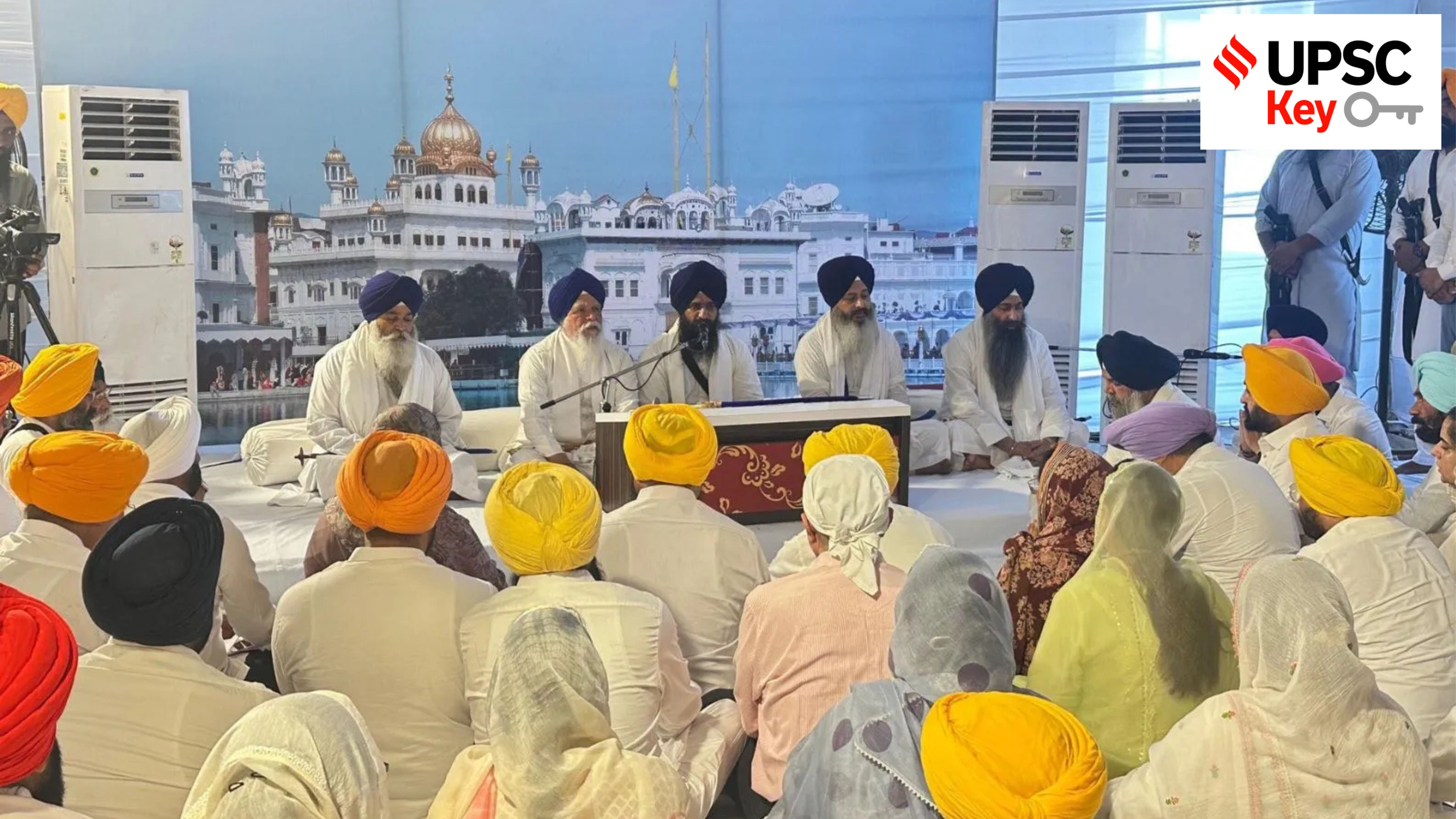
What’s the ongoing story: The Akal Takht has given the Aam Aadmi Party (AAP)-led Punjab government a month to remove certain “objectionable” clauses in its anti-sacrilege law. This came after almost all Sikh legislators cutting across party lines, including 78 MLAs and nine ministers, appeared before it on Monday in response to its summons.
Key Points to Ponder:
• What is Akal Takht?
• When and why was the Akal Takht established?
• How did the Akal Takht function after the passing of the tenth and last Guru, Guru Gobind Singh?
• What role did the Akal Takht play in Punjab before 1947?
• How did the Akal Takht, and Akali Dal, influence Punjab politics after independence?
• How is the Jathedar (head) of the Akal Takht appointed?
• Has the Akal Takht Jathedar ever faced blowback?
• How does the Akal Takht hand out religious punishment?
• What kind of ‘punishment’ does it dole out?
• What is the relationship between the Shiromani Akali Dal and the SGPC (which appoints the Akal Takht Jathedar)?
Key Takeaways:
• The Jagat Jyot Sri Guru Granth Sahib Satkar (Amendment) Act, 2026, passed on April 29, has been criticised for expanding the definition of sacrilege to include “hurt sentiments” and prescribing draconian jail terms.
• The Takht’s summons to the 78 Sikh MLAs and nine Sikh Cabinet ministers comes two weeks after it declared Chief Minister Bhagwant Mann “panth virodhi” (opposed to the panth), and issued an edict calling for his boycott over an objectionable video.
• Few institutions have shaped Sikh religious and political life as profoundly as the Akal Takht. Here is a look at what the Akal Takht is, how its authority evolved, and why its summons continues to carry weight.
• The Akal Takht, meaning “throne of the timeless one”, is the highest temporal (worldly/political) seat of the Sikhs. It’s located directly opposite the Golden Temple (Harmandir Sahib) in Amritsar.
Do You Know:
• The Akal Takht, which faces the Harmandir Sahib in the Golden Temple complex, was established by the sixth Sikh master Guru Hargobind in 1606 following the execution of his father, Guru Arjan Dev, by the Mughals.
• According to Sikh Studies scholar Amarjit Singh of Guru Nanak Dev University, Amritsar, Guru Hargobind used this platform for governance, and is believed to have issued the first directive (Hukamnama) from here, urging Sikh congregations to contribute horses and weapons to the Panth.
• The Guru is said to have requested two swords, symbolising miri (temporal power) and piri (spirituality). The sword representing miri was slightly shorter, indicating the primacy of spiritual authority over temporal power.
• The Akal Takht was also a symbol and representation of the Sikh defiance of Mughal authority. Historian Joginder Singh, a former professor at Guru Nanak Dev University, who has written extensively on Sikh history, noted that the 12-foot-high platform of the Akal Takht symbolised a challenge to the Mughal government in Agra (and later Delhi), where Emperor Jahangir (1605-27), on whose order Guru
Arjan Dev was executed, sat on an 11-foot-high throne, and forbade anyone else from doing so.
• The Akal Takht became the focal point for Sikhs during the difficult period following the execution of Banda Singh Bahadur, the general of the Khalsa army, in 1716, Prof Amarjit Singh said.
• As the Sikhs faced massive persecution from the Mughal state, members of the community would gather at the Akal Takht on Baisakhi and Diwali for Sarbat Khalsa assemblies where crucial decisions would be made.
• The tradition of the Sarbat Khalsa continued, and one of the last assemblies was convened by Maharaja Ranjit Singh (1801-39), the founder of the Sikh empire, in 1805 to deliberate on supporting the Maratha prince of Indore, Jaswant Rao Holkar, against the British.
Other Important Articles Covering the same topic:
📍The story of an hour, featuring Sukhbir Badal the guard at Golden Temple
Economy
Building water buffers a top priority, says FinMin report
Syllabus:
Preliminary Examination: Current events of national and international importance.
Mains Examination: General Studies II: Government policies and interventions for development in various sectors and issues arising out of their design and implementation.
What’s the ongoing story: Flagging India’s vulnerability to water shortages, the Ministry of Finance on Tuesday said building water buffers may be “at the top of the list” for policymakers. Meanwhile, the de-escalation of the West Asia conflict and lower crude oil and fertiliser prices has eased some of the pressures on the government’s finances, “allowing fiscal consolidation to proceed”.
Key Points to Ponder:
• What are water buffers?
• What is the main purpose of a water buffer?
• How does monsoon variability affect India’s agriculture and economy?
• Know the importance of watershed development in drought-prone regions.
• Why is groundwater management critical for India’s sustainable development?
• Know the relationship between water security, food security and economic stability.
• How can India improve irrigation efficiency while reducing pressure on groundwater resources?
Key Takeaways:
• “…the weak progress of the southwest monsoon has weighed on kharif sowing, and the monsoon rainfall deficit is a concern. Among the many things India needs to build buffers for in the coming years, water may be at the top of the list,” the finance ministry said in its Monthly Economic Review report for June.
• As on June 26, the total area sown under kharif crops was 22.7% lower than the corresponding period last year, with kharif foodgrain sowing lower by 21.1%.
• The India Meteorological Department (IMD) has forecast that this year’s monsoon will be 10% lower than the Long Period Average (LPA), with a 43% probability of below-normal rainfall over the Monsoon Core Zone, which covers a large part of India’s rainfed agricultural regions.
• On Tuesday, data from IMD showed monsoon in June was 39.8% lower than normal at 99.5 mm, making it the fifth-driest June in 125 years. In July, the weather department expects rains to be below normal. Meanwhile, data from the Central Water Commission shows that as of June 25, storage in India’s key reservoirs was 26% of total capacity, down from 36%
last year.
• However, the finance ministry took comfort in reservoir storage levels being 5.7% above normal, which it said provides a “safe buffer for irrigation”. According to the finance ministry, the West Asia conflict highlighted the need for a national policy on buffer stocks for a variety of critical raw materials and inputs. Now, water has become one of them, with rainfall patterns becoming increasingly unpredictable.
• For 2025-26, the Centre’s budget estimate for the Jal Jeevan Mission was Rs 67,000 crore. However, this was cut to just Rs 17,000 crore in the revised estimate. In 2026-27, the government expects to spend Rs 67,670 crore on the scheme.
• The finance ministry added the war and the sub-par rains “also underscore the need to reorient India’s agricultural pricing policies to incentivise the cultivation of climate-resilient crops and disincentivise water intensive ones”.
Do You Know:
• Rainwater buffers are storage systems designed to temporarily hold heavy precipitation to prevent flooding and manage water shortages. These systems are created by directing rainwater runoff from hard surfaces (like roofs and roads) into engineered collection points where the water is safely stored, slowly filtered, or allowed to seep into the ground.
• Jal Shakti Abhiyan (Catch the Rain): Focuses on creating artificial recharge structures and renovating traditional water bodies before the onset of the monsoon.
• Atal Bhujal Yojana: A community-led scheme aimed at sustainable groundwater management and the formation of ‘Water User Associations’ for strict water budgeting.
• Mission Amrit Sarovar: A national mission focused on developing and rejuvenating at least 75 water bodies in every district to boost rainwater harvesting.
Other Important Articles Covering the same topic:
📍Heatwave bakes Delhi, North India; relief hope as IMD forecasts rain
Previous year UPSC Prelims Question Covering similar theme:
6) What are the benefits of implementing the ‘Integrated Watershed Development Programme’? (UPSC CSE, 2014)
1. Prevention of soil runoff
2. Linking the country’s perennial rivers with seasonal rivers
3. Rainwater harvesting and recharge of groundwater table
4. Regeneration of natural vegetation
Select the correct answer using the code given below:
(a) 1 and 2 only
(b) 2, 3 and 4 only
(c) 1, 3 and 4 only
(d) 1, 2, 3 and 4
7) Which of the following practices can help in water conservation in agriculture? (UPSC CSE, 2017)
1. Reduced or zero tillage of the land
2. Applying gypsum before irrigating the field
3. Allowing crop residue to remain in the field
Select the correct answer using the code given below:
(a) 1 and 2 only
(b) 3 only
(c) 1 and 3 only
(d) 1, 2 and 3
Previous year UPSC main Question Covering similar theme:
📍 What is water stress? How and why does it differ regionally in India? (2019)
📍 The ideal solution to depleting ground water resources in India is water harvesting system”. How can it be made effective in urban areas? (2018)
PRELIMS ANSWER KEY
1.(a) 2.(c) 3.(d) 4.(a) 5.(c) 6.(c) 7.(c)
For any queries and feedback, contact [email protected]
Subscribe to our UPSC newsletter. Stay updated with the latest UPSC articles by joining our Telegram channel – IndianExpress UPSC Hub, and follow us on Instagram and X.
View original source — Indian Express ↗
Related stories
The Guardian
TechnologyJul 1, 2026 · 1 min
England has just had its hottest June on record, Met Office data shows
The Guardian

AllAfrica
TechnologyJul 1, 2026 · 1 min
Malawi: Chilima's Remark 'If I Die, I Will Die' Was a Vernacular Expression, Inquiry Told
AllAfrica

TechRadar
TechnologyJul 1, 2026 · 1 min
Watching England vs. DR Congo from home? Win tickets to the World Cup Final with this giveaway
TechRadar
Times of India
TechnologyJul 1, 2026 · 1 min
US stocks today: Wall Street under pressure as Nvidia, AMD & Micron lead AI stock sell-off
Times of India