Indian Express
Indian Express··6 min read
How Mughal gossip and household secrets shaped an Empire
Life stories, or Tazkiras (biographical, cultural, literary, and anecdotal compendia of famous individuals), often contemptuously dubbed “commemorative texts” by traditional historiography, spell out the ever-changing and intimidating power dynamics of pre-national notions of nationalism and territorial sovereignty in medieval India. Similarly, they go beyond showcasing individual moments of exaltation and tribulation in the idiom of eulogy and lament, and unwrap moving emotional narratives situated at the intersection of complex political dynamics, personal ambitions, and social formations.
Life narratives, frequently though erroneously perceived as straightforward factual narration or chronicle-praising patterns, offer immediate, less retrospective perspectives on individuals. Such texts, filled with mundane details of domestic life, manifest social, political, and cultural assumptions and practices that formal historical chronicles suppress. They unfailingly access the emotional register — anxiety, rivalry, jealousy, ambition, devotion, and loyalty — seldom found in administrative records. In the Mughal era, innumerable autobiographies, didactic and normative texts, memoirs, letters, anecdotal accounts, and laconic sketches of poets, scholars, saints, and authors were produced, and some Tazkiras, or biographical chronicles featuring the Mughal nobility, were also produced, providing a firsthand account of how the Mughal court functioned. With their broader sweep of social and cultural moorings, they place individuals and events in a proper socio-political context.
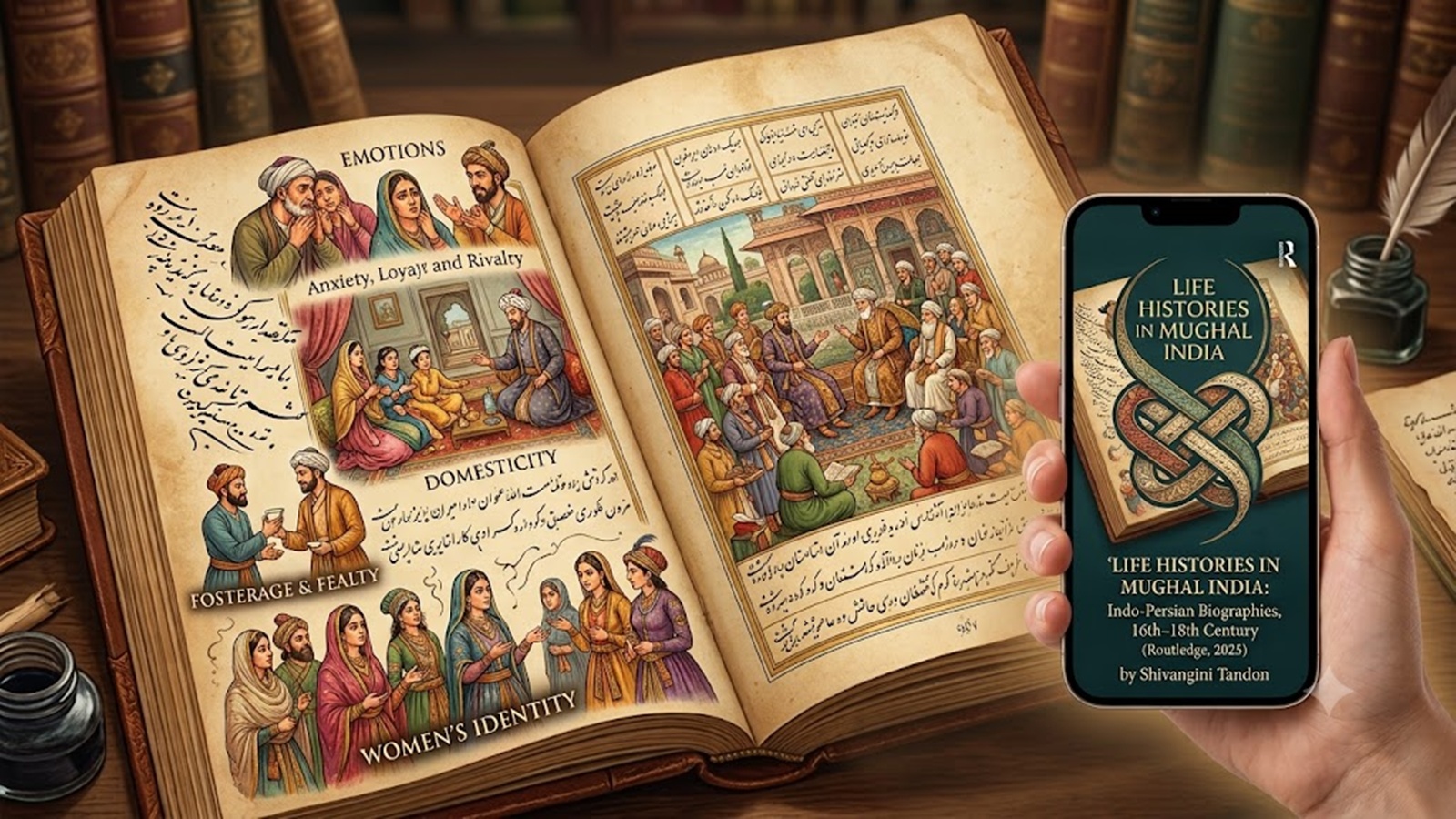
A promising historian, Shivangini Tandon, brought together three such Tazkiras with significant but less realised historiographical significance, written in the 17th and 18th centuries. For her, these are political Tazkiras that reveal the nuanced layers of the social, cultural, and political world they inhabit, and they provide a methodical, socio-cultural exploration of intricate political formations that micro-narratives of domestic and social relationships with imperial sovereignty poignantly portray. This is skilfully articulated in Shivangini Tandon’s new book, Life Histories in Mughal India: Indo-Persian Biographies, 16th–18th Century (Routledge, 2025). The study offers a gripping, non-reductive close reading of Tazkiras.
Eschewing commonplace abstractions such as nobility and peasantry, and using the household’s emotional ambience and banal details as sites of political formation, the historian examines how individuals, households, and the everyday texture of power interact. Life stories do not necessarily construct a persona; instead, they judiciously juxtapose emotional registers with social and cultural norms, thereby making them cultural and literary artefacts. The author nonchalantly pushes aside the positivist historiography that affirms the authenticity of life narratives, but casts aspersions on the constitutive literary, rhetorical, and hagiographical elements of the genre.
The Tazkira centres on the explication of social and cultural life, with a focus on the life of a particular individual, articulated through community identities and household ties. Recently, Mana Kia (Persianate Selves: Memories of Place and Origin Before Nationalism, Stanford University Press, 2020) and Katherine Butler Schofield (Music and Musicians in India: Histories of the Ephemeral, 1748–1858, Cambridge University Press, 2024) anchored their studies on the biographical, emotional, and cultural insights tantalisingly evinced in Tazkiras. Shivangini, a proponent of emotional history, seeks to bypass normative historiography by telling the story of Mughal decline through the emotional register.
At the outset, she points out, “I study life stories not merely to recover the life of a person but to see how these sources construct the narrative of that time.” This book also highlights the need to move away from an emphasis on historical chronicles, didactic texts, and even poetry, and instead focus on the genre of Tazkiras to better understand the process of early modernity. Studies of early modernity based on court chronicles are mostly flat narratives, emphasising far too much the agency of the state and ignoring the agency of the common people. The Tazkiras, however, bring structures into communication with agency, thereby highlighting how social structures influence, or emerge from, human agency, and vice versa.
Based on three Persian texts
Akbar holds a religious assembly of different faiths in the Ibadat Khana in Fatehpur Sikri.
Making three Persian texts — Zakhiratul Khawanin (Repository of the Nobles, 1650–51) by Shaikh Farid Bhakkari, Maasir al-Umra (Biographies of Contemporary Nobles, 1556–1570) by Shamsud-Daulah Shah Nawaz Khan, and Akhbar al-Akhiyar fi Asrar al-Abrar (Report of the Mysteries of the Pious, 1591) — the object of close textual analysis, the author structures her book not to furnish a dispassionate, factual account of the events and lives of individuals, but to unveil the covert layers of domesticity, selfhood, gender, civility, masculinity, and the politics of fosterage and fealty. The construction of women’s identity, and the liminal zone occupied by women in the lives of the ruling elite during Mughal rule, are also brought to light.
Story continues below this ad
In the second chapter, “Domesticity as a Political Space in the Tazkiras: Constructing the Mughal Household through Emotions, Gastronomy and Politics,” Shivangini picks holes in the widely accepted notion of a centralised, bureaucratic Mughal state, and asserts that informal alliances and intimate relations were constitutive elements of imperial sovereignty. The household emerged as an active site for political negotiations, alliances, and emotions, and the author draws on documentary evidence from three important court chronicles — the Babur Nama, the Humayun Nama, and the Ahval-i-Humayuni by Gulbadan Begum (sister of Humayun) — to show that Mughal imperial sovereignty owed much to kin networks and matrimonial connections, that relations with wives and concubines mattered politically, and that familial emotions were interwoven with political dynamics. She shows how aristocratic households became centres of patronage networks, integrating ordinary people into the system through their redistributive activities.
The three Tazkiras, described by the author as “political,” use a preachy, value-laden idiom. This becomes especially evident in the description of conjugal intimacy and erotic love, and Shivangini is alert to it. Turning to the defensive, justificatory voice of the compilers, she points out that love for a wife was termed muhabbat (love) and unsiyat (intimacy or affection, though the author reads it as endearment), while longing for a courtesan or concubine was nafs (carnal desire, which Shivangini reads as a desire for baser instincts) — a perversion that should not be allowed to bloom.
In the pre-modern era, identities were shaped by relationships, educational networks, spiritual affiliations, and social alliances; according to Natalie Zemon Davis, Tazkiras are forms of cultural articulation that shaped civility and gender relations. The third chapter, “Structuring the Body and Selfhood,” examines gender, civility, and norms of masculinity in the Mughal Tazkiras with critical acuity and cultural sensitivity. One tends to agree with the author’s observation that in the early modern period in South Asia, the body was an important site where norms and values were constructed and contested.
Much has been written about how household, concubinage, and gender relations triggered internal politics and power struggles, but milk fosterage/kinship, feasts, and fealty have hardly received profound academic scrutiny. Since Islam recognises both blood (nasab) and milk (rida’a) kinship, medieval Islamic history witnessed several strong political alliances based on milk kinship. In the Mughal dynasty, political and administrative affiliations through milk kinship flourished considerably, and the fourth chapter elucidates the political dimensions of fosterage.
Story continues below this ad
Shivangini observes that ties formed through milk fosterage were crucial, and often appeared more binding than those of blood kinship. She examines how the case of Akbar’s foster brother, Muhammad Aziz Koka, is discussed across two Tazkiras — the Zakhiratul Khawanin and the Maasir al-Umra. The fifth and sixth chapters offer a profound, alternative understanding of the pivotal role of women in structuring Mughal administration and societal norms, and of the representation of socially marginalised groups in texts written during the 17th–18th centuries. The discussion concludes memorably: service was not a source of social stigma but could also carry traces of subjection alongside attributes of privilege, honour, and manliness.
The book avoids abstraction and theoretical jargon in favour of an accessible idiom. The author does well to restore visibility to the marginal or forgotten actors whose life stories offer a window into the political dynamics of medieval India.
(Shafey Kidwai, a bilingual critic, is the director of Sir Syed Academy, Aligarh Muslim University, Aligarh)
View original source — Indian Express ↗
Related stories

The Punch
PoliticsJul 1, 2026 · 1 min
Five Nigerians rescued from Côte d’Ivoire prison arrive Abuja
The Punch

ESPN
SportsJul 1, 2026 · 1 min
Captain, Hischier signs Devils' $58.5M extension
ESPN
The Punch
NewsJul 1, 2026 · 1 min
Kogi assembly seeks to stop arbitrary rent hikes, landlord exploitation
The Punch
The Punch
NewsJul 1, 2026 · 1 min
NMDPRA warns marketers against fuel profiteering as crude prices fall
The Punch