Times of Israel
Gaza border communities attract 5,000 new residents amid post-Oct. 7 rehabilitation
The Tekuma Directorate, tasked with rehabilitating the Gaza border area in the wake of the deadly Hamas invasion on October 7, 2023, issued a progress report on Wednesday to mark 1,000 days since the massacre.
Some 1,200 people were slaughtered when thousands of terrorists poured over the border early in the morning. Thousands more were wounded, and 251 were kidnapped to the Gaza Strip. Of the latter, all have since been returned, either dead or alive.
The state directorate is operating with a NIS 17 billion ($5.7 billion) budget spread over five years, from 2024 to 2028.
By the end of 2025, it had spent NIS 11.6 billion ($3.9 billion), representing about 67% of the total. The current year’s budget stands at NIS 2.8 billion ($940 million).
Over 92% of the region’s residents are back home, joined by more than 5,000 new residents, the directorate reported.
Get The Times of Israel's Daily Edition
by email and never miss our top stories
By signing up, you agree to the terms
It cited the Central Bureau of Statistics, which reported in December that there were 65,000 residents in the region, compared to about 62,000 on the eve of the October 7 attack.
The state aims to reach 124,000 residents by 2030.
More than 92 percent of Kibbutz Kissufim residents went home earlier this week, leaving their temporary residences in the Beersheba suburb of Omer.
At this stage, 43 out of the 47 communities evacuated after the massacre have returned home, with the kibbutzim Holit and Kfar Aza expected to start going back in August and Be’eri slated to commence the return at the end of December. Nir Oz, which only agreed on its financial package in August last year, will return sometime in 2027.
Aviad Friedman, who heads the directorate, said, “Alongside the memory, pain, and loss that have been with us since that day, we see the communities returning and renewing, the settlements being rebuilt, and the trust in the future of the Gaza Envelope.”
The directorate said it had already implemented over 1,000 projects.
The main projects it is focusing on for the current year include strengthening security, expanding services for community health and resilience, investing capital into agriculture, and offering incentives to factories to move to the region. It is also working on finishing the new police station in the city of Sderot, which Israeli forces bulldozed to end a brutal standoff with gunmen; boosting education; retaining social workers and incentivizing additional social workers to move to the area; building student dormitories and housing for youth; and encouraging revenue-generating projects in local authorities.
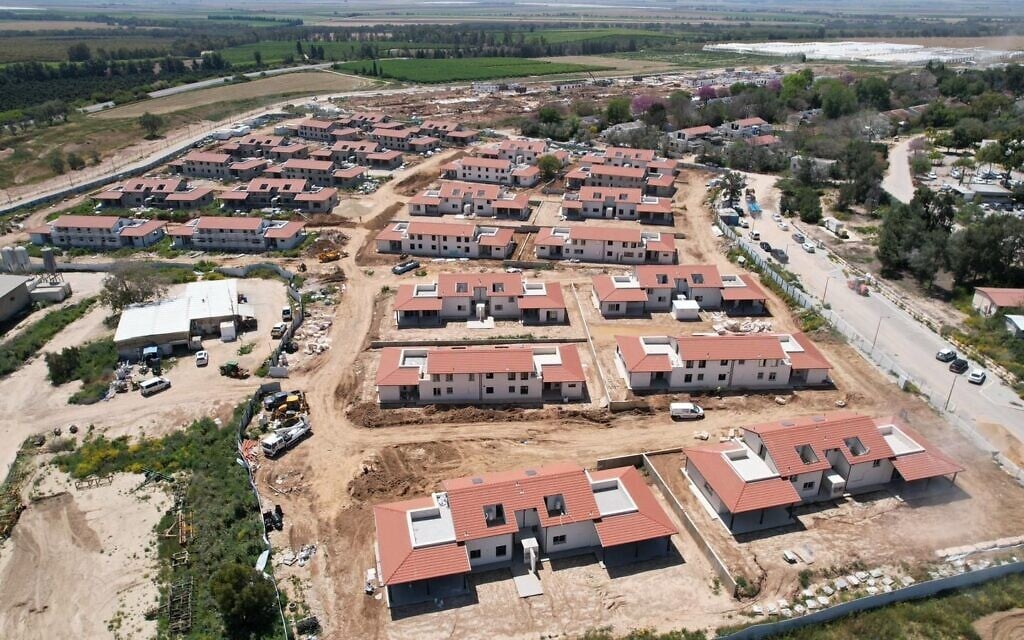
At Kibbutz Kissufim, about 180 residential and public buildings have already been or are still being renovated, and 20 residential buildings are being rebuilt, at a cost of NIS 85 million ($28.5 million). An additional NIS 9 million ($3 million) is being invested to upgrade and adapt water, sewage, path, road, and public space infrastructure. On October 7, Hamas gunmen slaughtered 14 out of 270 residents, as well as six foreign workers.
Around NIS 57 million ($19 million) is being invested in rehabilitating the tiny Kibbutz Holit, with 48 percent of that amount already spent. There, a tenth of the residents were murdered on October 7 — 15 out of 150.
The kibbutz’s rehabilitation program includes renovating 110 residential and public buildings.
In consultation with the families, it was agreed to undertake deep renovation of eight seriously damaged residential buildings, and to demolish and rebuild a further ten.
Upgrades are also being carried out on the infrastructure.
The residents of Kibbutz Kfar Aza, one of the worst affected by the Hamas invasion, will start going home on August 31. Hamas terrorists slaughtered 64 of the kibbutz’s 787 residents and abducted 19 to the Gaza Strip on October 7.
The rehabilitation budget there stands at NIS 211 million ($70.9 million), with 45% spent to date.
The program includes the renovation of about 280 residential buildings, currently nearing completion, as well as the reconstruction of 98 housing units, with work already started on most and completion expected by the end of this year. Work on public buildings is being carried out simultaneously, while plans for a new dining hall, kindergartens, a clinic, a dental clinic, a seniors’ club, and a cultural center are advancing.
At Kibbutz Be’eri, 102 out of 1,200 people were massacred by Hamas terrorists, while 30 were abducted to Gaza. Residents’ return home is expected to commence in late December.
NIS 470 million ($158 million) has been budgeted for Be’eri, of which 37% has been spent. The program includes the renovation of 350 existing residential and public buildings, with most work expected to end by March next year, while 132 new housing units are also being built. New public buildings include a new dental clinic to replace the one in which Hamas gunmen murdered five people.
Infrastructure is also being replaced.
The rehabilitation of Kibbutz Nir Oz, which was largely destroyed on October 7, 2023, when Hamas terrorists entered all but six of over 200 homes and either murdered or kidnapped one of every four residents — 117 people out of some 400 — will take longer. That’s because residents held out until August 2025 for what they believed to be an appropriate financial agreement.
Just six percent of the NIS 232 million ($78 million) budget has been spent so far, with the return home not expected until the end of August 2027.
Demolitions are being carried out gradually at Nir Oz, in accordance with the community’s wishes. The construction of 10 new housing units has been completed, and some 30 units have been renovated as part of the Pioneer Project for those returning first. The program also includes the construction of 85 new housing units in a veteran neighborhood, as well as public buildings, including a dining hall, a general store, and educational facilities. A new eastern neighborhood of 76 homes is also being built at a cost of NIS 110 million ($37 million), with the state contributing NIS 70 million ($23.5 million) of this sum.
View original source — Times of Israel ↗
Related stories

The Punch
PoliticsJul 1, 2026 · 1 min
Five Nigerians rescued from Côte d’Ivoire prison arrive Abuja
The Punch
The Punch
PoliticsJul 1, 2026 · 1 min
Court fixes July 6 for Delta APC suit
The Punch

France 24
PoliticsJul 1, 2026 · 1 min
Why is France betting on Oman amid the Hormuz crisis?
France 24

TASS
PoliticsJul 1, 2026 · 1 min
NATO does not care Kiev uses its technologies for terrorist purposes — expert
TASS