The Next Web
Meta’s AI reads typed sentences from the brain, no surgery required
Meta says it can turn brain activity into typed sentences without opening your skull. The leap is real. So is the catch: the system learns from typing, the one thing its intended users cannot do.
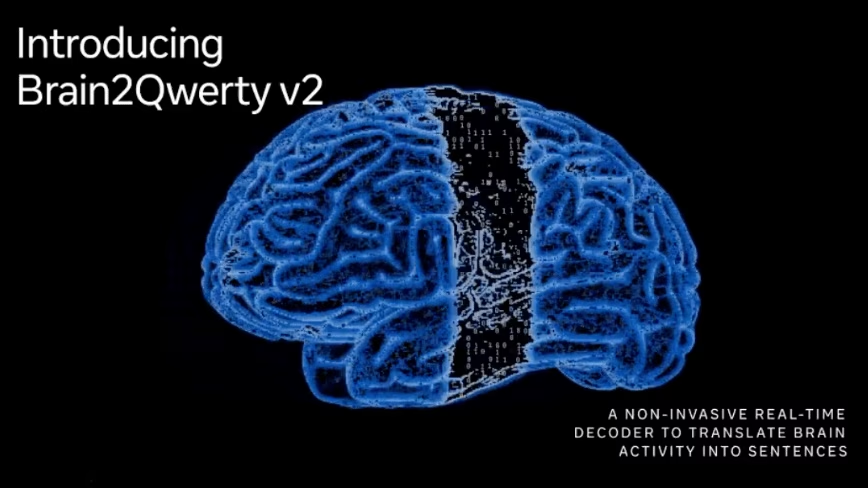
On Monday, Meta unveiled the second version of Brain2Qwerty, a system that reads the brain signals people produce while typing and reconstructs the words. It is non-invasive. There is no surgery and no implant. A volunteer wears a magnetoencephalography (MEG) scanner, a helmet-like machine that picks up the tiny magnetic fields the brain gives off. An AI pipeline does the rest.
The headline number is a real jump. Brain2Qwerty v2 hit an average word accuracy of 61 per cent, rising to 78 per cent for the best participant, Meta said. Earlier non-invasive systems managed only single digits. Last year’s v1 topped out around 48 per cent.
To get there, Meta trained the system on roughly 22,000 sentences that nine volunteers typed, each wearing the scanner for about 10 hours. Meta ran the study at a research centre in San Sebastián, Spain, Gizmodo reported.
Chatbots for the brain
The trick is the same technology behind ChatGPT. The pipeline first turns the scanner’s messy signal into characters. A second model stitches those into words. Then a large language model, fine-tuned on the brain data, uses context to guess the sentence the person meant, much like a phone predicting your next word.
Meta says this is the first time an LLM has decoded noisy brain activity into whole sentences. It even set AI agents to work refining its own decoding pipeline, though engineers made the final calls.
The choice of scanner mattered more than expected. Meta tested both MEG and the cheaper, more common EEG. MEG was far better, with a character error rate of 29 per cent against 65 per cent for EEG.
Meta has open-sourced the code and the dataset, echoing a wider push to do AI-for-science in the open. It frames the project as a way to help the millions who lose speech to brain injury or disease.
Still stuck in the lab
Then come the caveats, and they are big. The system is nowhere near a product. The MEG scanner fills a room, costs a fortune, and belongs in a hospital, not a home. It cannot work in real time either. The models need a full typing session to finish before they produce anything, so there is no live feedback.
There is a deeper problem. Brain2Qwerty learns from the brain signals of people typing. Its intended users, those locked in by paralysis or disease, cannot type at all. Meta admits as much. People with limited mobility might benefit, but the fully locked-in are unlikely to. That would take rebuilding the task around imagined movement rather than real keystrokes.
The current design even needs to know exactly when the user presses each key, and Meta calls the path to continuous, trigger-free decoding “uncertain.”
The surgeons are still ahead
For now, the invasive approach wins on results. Implanted systems reach far higher accuracy, The Register noted, with recent surgical work hitting 92 per cent sentence-level accuracy. One surgical interface let a man with ALS work a full-time job, decoding his attempted speech with near-perfect precision. Firms from Neuralink to its rivals are racing to commercialise that kind of implant.
Meta’s pitch is that it can close the gap without the drill, because accuracy climbs steadily as it feeds the models more data.
That may prove true, and doing the work in the open should help others test it. But a brain reader that fills a room, waits until you finish, and depends on you being able to type is a long way from a lifeline. Meta’s broader AI ambitions tend to arrive loud and early. This one is a real advance in the lab, and an honest reminder of how far the lab still sits from the ward.
View original source — The Next Web ↗
Related stories

TechCrunch
TechnologyJul 1, 2026 · 1 min
Even Honda is pivoting to data centers
TechCrunch

ZDNet
TechnologyJul 1, 2026 · 1 min
Why Déjà Dup and these 4 other tiny Linux tools have become essential to my daily routine
ZDNet

TechRadar
TechnologyJul 1, 2026 · 1 min
How to watch Belgium vs Senegal
TechRadar

Indian Express
TechnologyJul 1, 2026 · 1 min
Two organ donations in two days save six lives
Indian Express