Times of Israel
NYC passes law to protect schools, but not colleges, after anti-Israel protests
NEW YORK — The New York City Council on Tuesday passed a law meant to protect schools from protests, part of legislators’ broader plan to combat antisemitism in the city.
The law requires the New York Police Department to release a “transparency report” on police plans, such as establishing security perimeters, to prevent physical obstruction, injuries, intimidation and interference at schools.
NYPD Commissioner Jessica Tisch must submit an initial report to New York City Mayor Zohran Mamdani and New York City Council Speaker Julie Menin within 45 days, and a final report within 90 days. The report will be made public on the NYPD website.
The law covers childcare facilities, elementary schools, middle schools, junior high schools and nonpublic high schools.
The measure does not cover universities, where protests are far more prevalent, though. It also does not cover educational programs housed in worker training facilities, museums, libraries and teaching hospitals.
Get The Times of Israel's Daily Edition
by email and never miss our top stories
By signing up, you agree to the terms
Mamdani had vetoed the proposal in April, citing its inclusion of colleges, but the amended measure passed by a veto-proof majority.
The police transparency report will include NYPD plans for deciding on whether security perimeters are needed to protect school entrances and exits, how the perimeters will be set up, and plans to engage with educators and the public.
New York City Councilmember Eric Dinowitz, the chair of the Jewish caucus and co-chair of the Bipartisan Task Force to Combat Antisemitism, was one of the bill’s two lead sponsors.
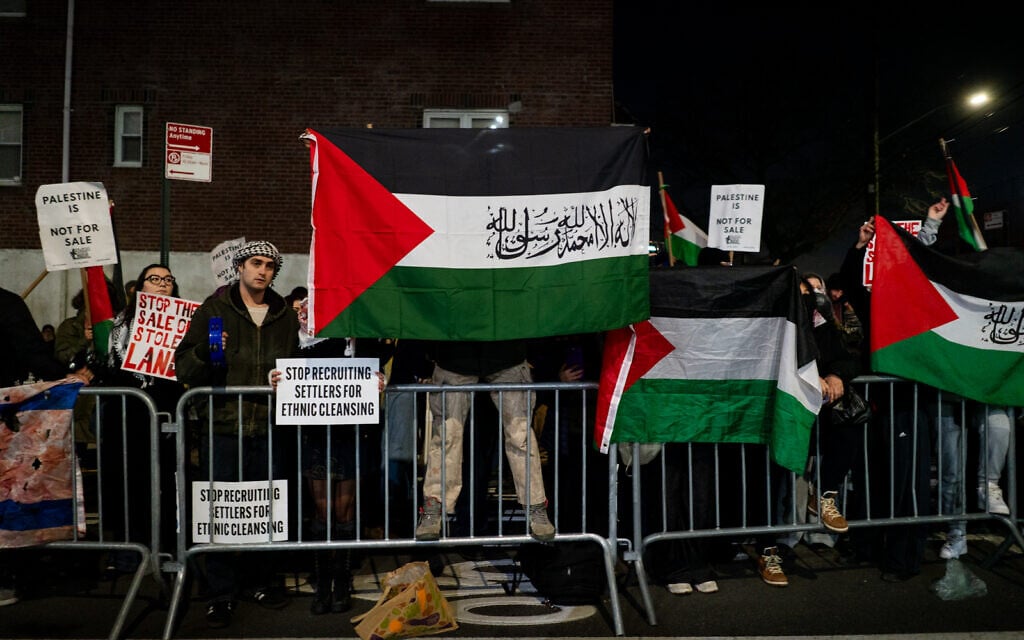
The law is the latest in a series of so-called “buffer zone” measures proposed in New York in the past year in response to caustic anti-Zionist protests.
New York City and the state government passed laws meant to protect houses of worship earlier this year.
The state’s law established 50-foot protected areas around the entrances to places of religious worship and made interference with access to a place of worship a Class B misdemeanor.
The city’s laws to protect schools and places of worship did not establish criminal penalties or set a firm distance for protest perimeters.
The bills are politically divisive because of perceived conflicts between free speech and free assembly, and freedom of religion and anti-discrimination laws.
Leftist groups, including Jewish organizations and Mamdani allies, had opposed both bills, calling the measures an attack on free expression. A law proposed in the State Assembly to form 100-foot buffer zones around abortion clinics has not drawn opposition, however.
US Rep. Tom Suozzi, a moderate Democrat from Long Island, introduced a federal buffer zone bill in April.
The push for buffer zones began after a vitriolic protest at a New York City synagogue late last year. That demonstration was followed by other protests outside synagogues in the city that saw demonstrators harass Jewish passersby, shout violent slogans, chant in support of Hamas and wave Hezbollah flags.
The protesters say they are targeting events at the synagogues linked to West Bank settlements.
One of the protests, in Queens, was also outside a school, although protests at schools are relatively rare. Those protests also generally do not target schools, but other locations proximate to schools.
Police have prevented protesters from nearing synagogue entrances in recent months.
Mamdani vetoed the initial law to protect schools, saying it could have limited protests, including against Israel, at universities, in violation of free speech protections. The law passed this week was narrower in scope because it did not apply to universities and did not mention public high schools.
A swath of Jewish groups condemned Mamdani’s initial veto as a “profound failure.”
Menin hailed the passing of the school law on Tuesday as fulfilling her five-point plan to combat antisemitism announced at the start of the year. Jews are targeted in hate crimes in the city far more than any other group.
“This legislation ensures children and families can safely access schools without fear or intimidation while protecting constitutional rights, which are sacrosanct,” Menin said in a statement.
The UJA-Federation of New York and the Jewish Community Relations Council of New York, the two leading Jewish groups in the city, also applauded the law.
As of Wednesday afternoon, Mamdani had not commented.
The measure passed alongside the city’s $126 billion budget, Mamdani’s first municipal budget since taking office at the start of the year. Mamdani and Menin agreed to the budget shortly before a deadline, after the budget was held up over funding for housing vouchers.
The agreement rolled back a commitment from Mamdani to expand the NYPD by 580 officers.
Mamdani’s far-left base had criticized the police expansion, and he said on Tuesday that he and Tisch had been able to “identify ways” to meet “all of our crime-fighting needs” without growing the police force.
Mamdani’s handling of the police has been a concern for Jewish New Yorkers due to his past hostility to law enforcement.
The mayor’s rocky relationship with the mainstream Jewish community has continued to sour in recent months after his office published a Nakba Day video that presented a one-sided account of Israel’s establishment, and due to a speech Mamdani made last month targeting the pro-Israel lobby AIPAC that Jewish groups, including progressives, said leaned into antisemitic tropes.
Mamdani helped two members of the far-left Democratic Socialists of America win their Congressional primaries last week. Both of the candidates made anti-Israel rhetoric central to their campaigns, and one attended a rally celebrating the October 7, 2023, Hamas massacre in Israel the day after it happened.
The head of Mamdani’s Office to Combat Antisemitism was heckled at a Holocaust memorial event in Brooklyn on Sunday.
View original source — Times of Israel ↗
Related stories

The Punch
PoliticsJul 1, 2026 · 1 min
Tinubu unveils fourth legacy superhighway, okays N111bn take-off funds
The Punch
The Punch
PoliticsJul 1, 2026 · 1 min
I didn’t know there is still PDP, says Akpabio
The Punch

France 24
PoliticsJul 1, 2026 · 1 min
Iran after Khamenei: What direction after Supreme Leader's funeral?
France 24
The Punch
PoliticsJul 1, 2026 · 1 min
Some causes of 1967 civil war still with us, says Obasanjo
The Punch