Times of Israel
US, Iran wrap up indirect Doha talks as Trump touts progress towards ‘denuclearization’
The US and Iran held indirect technical talks in Doha on Wednesday, which US President Donald Trump described as “very good,” as American and Iranian officials said that the participants agreed to open a communication channel to ensure the terms of the memorandum of understanding are met, amid continued disagreements over its implementation.
According to Iran, the sides agreed on a partial release of billions of dollars of frozen Iranian funds, though US officials reportedly denied that such an understanding was reached.
The effort came two weeks after the US and Iran signed the MOU, which gave them 60 days to negotiate a final deal covering Iran’s nuclear program. But talks on that final deal haven’t really begun yet, largely due to disputes over the Strait of Hormuz and Israel’s war with Hezbollah in Lebanon.
The indirect talks, mediated by Qatar and Pakistan, began on Tuesday night and continued Wednesday, an Iranian official said.
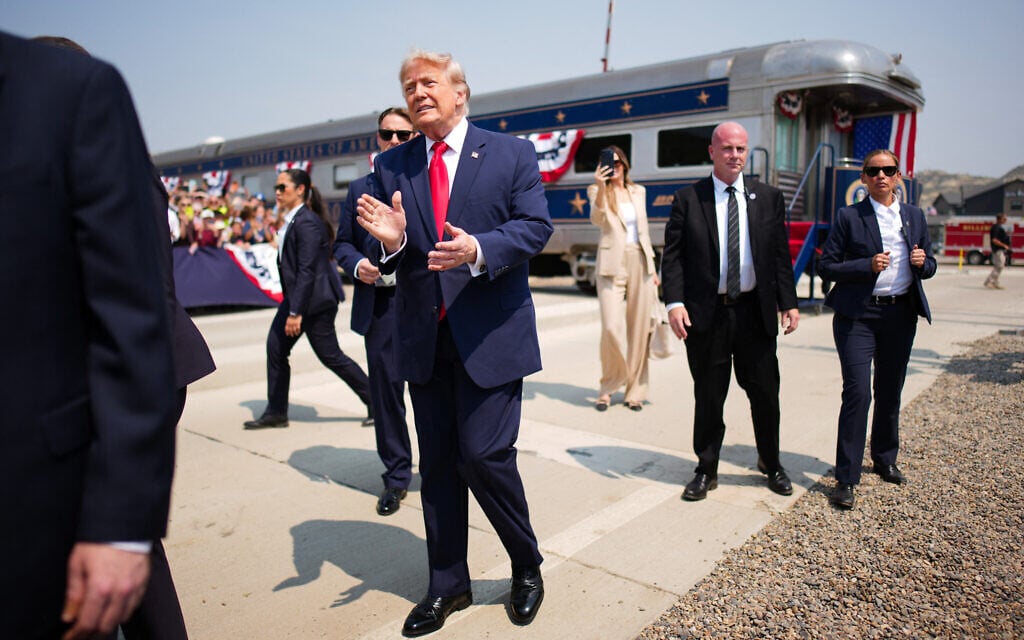
“They’ve had very good meetings, and we’ll see,” Trump told reporters before boarding the new, Qatari-gifted Air Force One. “The denuclearization of Iran is moving along well.”
Get The Times of Israel's Daily Edition
by email and never miss our top stories
By signing up, you agree to the terms
While Trump’s son-in-law Jared Kushner and envoy Steve Witkoff were in Doha, they did not attend the technical meetings, according to a source with direct knowledge of the talks, who added that the meetings were structured as sessions between chief negotiators and specialists. The two top US envoys instead met with the Qatari prime minister to lay the groundwork for the meetings, the source added.
US negotiators were reportedly seeking to convince their Iranian counterparts at the ongoing indirect technical talks in Doha to forgo plans to charge tolls in the Strait of Hormuz, arguing that Tehran would be able to make more money by following through with nuclear concessions than it would be able to generate from such fees.
According to two senior Iranian sources, Iran is determined to win international recognition of its control over the waterway and ability to levy fees on ships entering or leaving the Gulf, even if it has to do so by force.
Under this month’s interim deal with the US to end their three-month conflict, Iran agreed to let ships pass through the Strait for 60 days without charge. But it believes the wording of the agreement allows it to keep control of which ships may pass and which route they take through the narrow waterway. Iran is ready to impose its demands on the Strait through force if there is no agreement by other countries to accept its terms, the officials added, saying Tehran would not back down even if it led to renewed — and intensified — confrontation with the US.
In response to Iran’s efforts to charge tolls in Hormuz after the 60-day period expires, “the US message to Iran was ‘Think bigger,'” a US official told the Axios news site, claiming the sums Iran could generate from developing and selling oil after the US lifts sanctions under the deal “would be 100 times more valuable to them than using a gangster tactic to try and charge a toll.”
“We are pushing them to think bigger about their potential in the context of a broader nuclear and regional non-intervention deal,” the US official said.
“We have reached an understanding that we will keep things quiet for the coming week, so progress on all aspects of the MOU can be worked on in a productive environment, without missiles flying,” the official said. “The President has been clear that every time they shoot, we will shoot more — and at targets that further degrade their position in the Strait.”
After the talks ended Wednesday, Iranian Deputy Foreign Minister Kazem Gharibabadi also said that “a communication channel would be established by tomorrow” to report and record violations of the memorandum, according to quotes published by the IRNA state news agency.
Gharibabadi also said that the sides agreed that part of the $6 billion in frozen funds would be released to allow Tehran to purchase goods based on its needs.
The Saudi Al Arabiya news site reported that during Wednesday’s technical talks in Doha, the sides reached an understanding regarding the release of the first batch, $3 billion of frozen Iranian funds held by Qatar, at least some of which will come from the US market. US officials had previously claimed that all of the money would go toward buying American products.
However, US officials speaking to the outlet denied that such an agreement had been reached on the release of the Iranian funds.
Vance: US won’t attack ‘just for the sake of dropping bombs’
Touting Washington’s position in the talks, US Vice President JD Vance told troops while visiting a naval air base in Virginia on Wednesday that Trump is now “negotiating from a position of strength because of you.”
“If the Iranians try to rebuild the nuclear program, the President’s got options. If the Iranians try to threaten their neighbors or fund terrorism, we’ve got options,” he said.
“But what we must never do is drop bombs just for the sake of dropping bombs. And that is what the president will never ask you to do,” Vance continued.
“He’ll ask you to go to war, yes. But when he asks you to go to war, he’ll tell you exactly what you’re going for. And I think that is what you should expect out of your political leadership,” the vice president said.
“What I noticed about the people who are attacking the administration for negotiating is that they are the very same people who, for example, encouraged us to just go a little bit further and just drop a few more bombs in places like Afghanistan. If you go back to the mistakes that were made, those very same people refused to say what we were dropping bombs for,” he continued.
Despite Vance’s assertions, the Trump administration has come under fire for what critics say have been unclear goals in the Iran war. The administration has asserted that it launched the war primarily to prevent Iran from obtaining a nuclear weapon, even though the president has also claimed to have completely destroyed Iran’s nuclear program in strikes a year ago.
Israel had no part in negotiating the memorandum of understanding, and Prime Minister Benjamin Netanyahu has distanced himself from it. Still, the terms of the opening clause, permanently ending the war and ruling out any resumption, assert that it is binding on the US, Iran “and their allies.”
Israeli officials are bitterly opposed to the deal’s terms, which resolve none of the war’s key goals — notably, eliminating Iran’s nuclear and ballistic missile programs and creating the conditions for the collapse of the regime.
View original source — Times of Israel ↗
Related stories

The Punch
PoliticsJul 1, 2026 · 1 min
PDP stronger, difficult to beat, says Abia gov candidate
The Punch

Euronews
PoliticsJul 1, 2026 · 1 min
Committee tasked with post-war Gaza governance says Cyprus talks 'highly productive'
Euronews

TASS
PoliticsJul 1, 2026 · 1 min
West effectively at war with Russia now — Slovak PM
TASS
Times of Israel
PoliticsJul 1, 2026 · 1 min
Netanyahu claims he saved Israel from destruction as Iran ‘already obtained’ atomic bomb
Times of Israel