CNA
Jokowi's first public political tour signals he is not done trying to shape Indonesia's future
JAKARTA: Joko Widodo's first public political tour since leaving office has shown that the former Indonesian president, also known as Jokowi, is laying the groundwork for Indonesia's 2029 elections by boosting the Indonesian Solidarity Party (PSI) and safeguarding his family's political future, analysts told CNA.
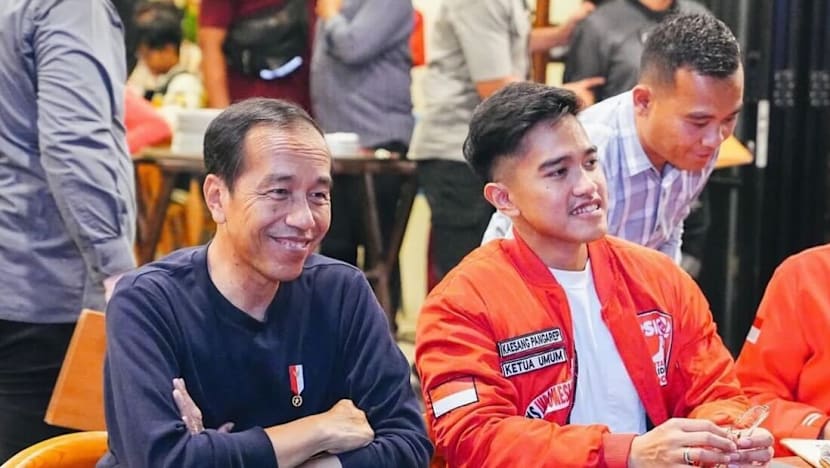
Indonesia Vice-President Gibran Rakabuming Raka is Jokowi’s elder son, while PSI chairman Kaesang Pangarep is his youngest child. Meanwhile, North Sumatra Governor Bobby Nasution is married to Jokowi’s only daughter Kahiyang Ayu.
The three-day visit to Lampung from Jun 26 to Jun 28 - where Jokowi appeared to be wearing a PSI attire and urging the public to support the party - had prompted questions about his political ambitions.
Political analyst Aditya Perdana of the University of Indonesia said that the Lampung visit - the first of what appears to be a planned multi-stop tour - was intended to raise PSI’s profile. The party has yet to secure any parliamentary representation since its founding in 2014.
“Jokowi is positioning himself to fight under PSI's banner,” Aditya told CNA, adding that the visit also sought to ensure that Gibran could continue to be President Prabowo Subianto’s running mate in the next election.
Indonesia’s next elections are not until 2029, with campaigning to begin the year prior, but Aditya stressed that beginning political outreach now is not premature as building public support requires years of sustained engagement.
Even so, analysts cautioned whether Jokowi still wields enough influence to help build the long-term political careers of his family members.
Beyond that, they noted that Jokowi’s moves have also signalled support for Gibran to team up once more with Prabowo for a second term even if the trip to Lampung is an early test of public sentiment.
KEEPING THE JOKOWI BRAND ALIVE FOR PSI
Jokowi’s Lampung trip was more than a routine post-presidential visit, said analysts.
Ray Rangkuti, executive director of Jakarta-based think-tank Lingkar Madani, said Jokowi was seeking to maintain his political influence by helping secure PSI's parliamentary future, thereby preserving his family's political prospects.
"The political fortunes of his children still depend heavily on Jokowi's popularity,” he said.
This is because Gibran and Kaesang’s popularity and, in turn, their electability ratings as politicians would be low without his endorsement, according to Ray.
He added that Jokowi’s continued involvement reflects his desire to remain an influential political figure rather than step back as a retired statesman, as the former president had claimed he would.
Wasisto Raharjo Jati, a political researcher at Indonesia's National Research and Innovation Agency (BRIN), also viewed the Lampung tour as an effort to show that Jokowi remains politically relevant even after parting ways with the Indonesian Democratic Party of Struggle (PDI-P) in the lead-up to the 2024 elections.
Jokowi became Indonesia’s seventh president in 2014 with the endorsement of PDI-P - the country’s largest political party. Its chairwoman, Megawati Soekarnoputri, considered Jokowi a close member of her party and the duo was often photographed together.
But their relationship soured in October 2023 after Jokowi backed Gibran to run for the vice-presidency alongside Prabowo in the February 2024 presidential election instead of supporting PDI-P candidate Ganjar Pranowo, whom he had previously appeared to endorse.
Wasisto stressed that Jokowi is now attempting to leverage his decade-long record in the presidential office, including infrastructure development and government programmes, as political capital to increase PSI's support.
The party was founded in 2014, shortly during Jokowi’s first term as president. It then took part in Indonesia’s 2019 elections but failed to win a seat in the national parliament.
Kaesang joined PSI in September 2023, just about five months before the presidential and legislative elections in February 2024. He was 28 then and was appointed the party’s chairman despite having no political experience.
PSI secured 2.8 per cent of the national vote during the legislative election, still falling short of the 4 per cent required to enter parliament. Nonetheless, Kaesang was re-elected as PSI chairman in 2025.
When in Lampung, Jokowi said he is optimistic that PSI could make it into parliament in 2029.
“If the goal is simply to get into Senayan (the parliament, as it is located in the district), I'm confident we can,” Jokowi said on Jun 28.
“But the target we're aiming for is a big one. Therefore, the (election) machine must also be large and powerful.”
Despite the political proclamations, Jokowi is not a member of PSI, nor does he hold any official role in the party as of today.
But Aditya of the University of Indonesia said those were merely administrative matters, adding that what mattered more was that the two were ideologically aligned, which became clear once Kaesang became PSI chairman.
SUPPORTING PRABOWO AND GIBRAN FOR A SECOND TERM
Analysts said they believe Jokowi's political calculations extend beyond PSI to safeguarding the political longevity of his older son Gibran. Prior to the Lampung visit, Jokowi had called on PSI members to support Prabowo and Gibran for a second term in 2029.
The duo won the election in 2024 largely due Jokowi’s support, who was widely popular throughout his presidency.
Prabowo, who lost to Jokowi in the 2014 and 2019 presidential elections, was not shy on multiple occasions about thanking Jokowi for the endorsement.
But observers told CNA that even though Jokowi may prefer that Gibran run for president in 2029, he is “realistic” about his son’s electability as a presidential candidate at the moment.
According to a survey conducted in March by pollster Poltracking, Prabowo’s electability as a presidential candidate in the next election is highest at 32.9 per cent, while Gibran came in fourth with just 4.2 per cent.
In second place was West Java Governor Dedi Mulyadi - who is also a member of Prabowo’s Gerindra party - with 13.5 per cent of the vote while former 2024 presidential candidate Anies Baswedan was third with 9.2 per cent.
Aditya believes that Jokowi’s Lampung visit also serves as a vehicle to restore Gibran’s political visibility as the latter does not often appear to be given significant responsibilities within the Prabowo administration.
Aditya said there were signs that Prabowo’s camp was not entirely comfortable with Jokowi’s renewed political activities, given the brief public statements that appear to be issued “out of courtesy” for the former president.
Deputy general chairman of Prabowo’s Gerindra Party, Prasetyo Hadi - who is also the state secretary - was asked by journalists to comment on Jokowi’s tour.
“We from Gerindra, we congratulate him (Jokowi) because it means he's healthy again, as he was a bit unwell before,” Prasetyo told journalists on Jun 26.
“And as a figure and statesman, I don't think there's a problem either.”
Ray from Lingkar Madani, meanwhile, stressed that Prabowo's camp had the strongest reason to monitor these political developments closely.
He said Jokowi could be preparing multiple political scenarios for Gibran ahead of 2029, including the possibility that the vice-president could eventually run alongside another presidential candidate if Prabowo chooses a different running mate.
Gibran’s latest move - such as meeting student protesters to hear their demands amid concerns about the economy following the stock market rout and the rupiah's weakening - appears intended to gain public sympathy.
But Wasisto from BRIN cautioned against reading too much into current alignments.
He said that despite Jokowi's support for the duo for another term, there was no guarantee they would remain on the same ticket in 2029, noting that Indonesian politics can shift significantly over the course of a presidential term.
“There is no 100 per cent guarantee for that because the 2029 election contest could change drastically from current projections,” Wasisto said.
The latest moves appear to signal that Jokowi is intent on establishing dynastic politics, a trend that is pervasive in Indonesia.
Indonesia’s fifth president, Megawati, is the daughter of the country’s founding father Soekarno. Meanwhile, Megawati’s daughter Puan Maharani, is the current speaker of parliament.
Separately, Indonesia’s sixth president Susilo Bambang Yudhoyono has two sons who are also in politics.
His eldest, Agus Harimurti Yudhoyono, is the current coordinating minister for infrastructure and regional development, while his youngest, Edhie Baskoro Yudhoyono, is now serving as vice-chairman of the people's consultative assembly.
TESTING THE WATER
Jokowi’s Lampung trip may also be just a testing ground for his political outreach, experts told CNA.
Aditya said Jokowi would likely assess public and political reactions from the visit before deciding how aggressively to continue similar trips elsewhere.
This is perhaps also the reason why Jokowi eventually stayed in Lampung for three days. His original itinerary indicated he would have been there for just a day, followed by visits to West Java and East Nusa Tenggara.
Ray expects further tours to take place over the coming years, but at carefully spaced intervals designed to maximise media attention rather than generate all the publicity at once.
While in Lampung, Jokowi was inaugurated with a traditional title, and as part of the ritual, he placed his foot on the head of a dead buffalo.
A photo of the ceremony went viral on social media, with netizens reading the imagery as a sign that Jokowi wanted to step on his former party PDI-P. The party is popularly symbolised by a bull’s head and, at a glance, looked similar to the dead buffalo’s head.
Bestari Barus, PSI’s head of political affairs, told local news outlet Tempo that Jokowi attended the traditional ceremony in Lampung at the invitation of local community leaders and that PSI could not provide a more detailed explanation regarding the incident.
He said the tradition was better understood by the figures who presented Jokowi with the traditional title.
“That's our custom, part of our culture. It's impossible for Mr Jokowi to do anything outside of tradition,” Tempo reported him as saying.
Jokowi has yet to respond to the criticisms, but Ray from Lingkar Madani said any publicity about Jokowi related to PDI-P tends to bolster his image positively and harm the party of former president Megawati.
He added that Jokowi is likely aware of the comments on social media, as he is known to closely monitor public and media opinion.
Meanwhile, Wasisto similarly described the Lampung tour as an initial step to gauge public response before expanding to other provinces.
Although Jokowi was influential in securing Prabowo and Gibran’s win in the 2024 presidential election, Wasisto said that the former’s influence as a kingmaker is not absolute.
He said that, for example, in the local elections at the end of 2024, several regional heads endorsed by Jokowi lost.
This included popular former West Java Governor Ridwan Kamil, who contested the Jakarta gubernatorial election against PDI-P’s underdog candidate Pramono Anung.
The latter won with over 50.4 per cent of the vote, while Ridwan trailed behind with 39.4 per cent of the vote.
While Jokowi's future political plans and influence remain unclear, analysts said the Lampung tour signals that manoeuvring for Indonesia's 2029 election has begun well before the official campaign period.
"I think this is understandable because it takes two or three years to gain public support,” said Aditya from the University of Indonesia.
Source: CNA/ks(as)
Related stories

The Punch
PoliticsJul 2, 2026 · 1 min
Tinubu inaugurates Nasarawa underpass, 3.7km dualised township roads
The Punch
The Punch
PoliticsJul 2, 2026 · 1 min
God forbid Nigeria sees another Civil War — Obasanjo
The Punch
The Punch
PoliticsJul 1, 2026 · 1 min
N’Assembly creating safeguards against state police abuse —Bamidele
The Punch

The New York Times
PoliticsJul 1, 2026 · 1 min
Ruling on Trans Athletes Gave the G.O.P. a Win. Most Democrats Looked the Other Way.
The New York Times