VnExpress
Students of Southeast Asia's largest economy are choosing China over US
Indonesian students who once aimed for Harvard and the West are increasingly choosing China, as deepening economic ties reshape where the country trains its next generation of talent.
About 20,000 Indonesians were enrolled at Chinese institutions as of January 2026, up from around 13,000 in 2016, according to the Indonesian embassy in Beijing.
A decade ago, the double-degree programs that send students abroad for part of their studies overwhelmingly involved European, American and Australian universities. Today a growing number link Indonesian campuses to Chinese ones.
The pivot mirrors a wider realignment in Asian education. Demand for the traditional "Big Four" English-speaking destinations, the U.S., U.K., Canada and Australia, has flattened or fallen as those governments tightened student visa rules, while interest in Asian universities has climbed, according to Studyportals and British Council data compiled by ICEF Monitor. U.S. student visa issuances dropped about 36% in the summer of 2025.
At the LSPR Institute of Communication and Business in Jakarta, a visiting Chinese arts troupe recently performed Fujianese nanyin melodies alongside the Indonesian folk song Rasa Sayange, The Straits Times reported.
The private university has partnered with Shanghai University of Finance and Economics and Jilin Animation Institute, and plans to open a joint Chinese language and culture center with Sichuan International Studies University in September 2026, founder Prita Kemal Gani told the paper.
Institut Teknologi Bandung, one of Indonesia's top engineering schools, also signed an agreement with China's Central South University and Shenzhen-based recycler GEM in November 2023 to build a joint laboratory for new-energy materials and metallurgy. The lab opened at ITB's Jatinangor campus in August 2024 and now anchors a master's and doctoral program in battery materials, according to the university.
The trend reaches the top of Indonesia's university system. Universitas Indonesia, the country's highest-ranked public university, signed its own memorandum of understanding with Tsinghua in November 2025, building on an earlier partnership with Peking University, the official Antara news agency reported.
Tsinghua has also teamed up with the Indonesian telecom operator Indosat and a domestic technology alliance to open an artificial intelligence research center in the country, Asia Times reported. Earlier ties include a 2022 exchange program between Tsinghua and the Bali-based foundation United in Diversity, and a 2024 research pact between Universitas Gadjah Mada and the Chinese Academy of Sciences.
Stella Christie, Indonesia's deputy minister of higher education, science and technology, said ties with China had seen a "huge increase," particularly in higher education and industry.
Christie herself is a Harvard graduate who became a professor at Tsinghua before joining President Prabowo Subianto's cabinet.
She said Tsinghua had recently decided to reserve 50 places a year for Indonesian high-school graduates, an offer she said China had not extended to any other country.
"When I asked where they wanted to study after graduation, they didn't say Harvard or other U.S. Ivy League universities, like many would say previously. A lot of them said Tsinghua," she told The Straits Times of a recent visit to high school students in Aceh.
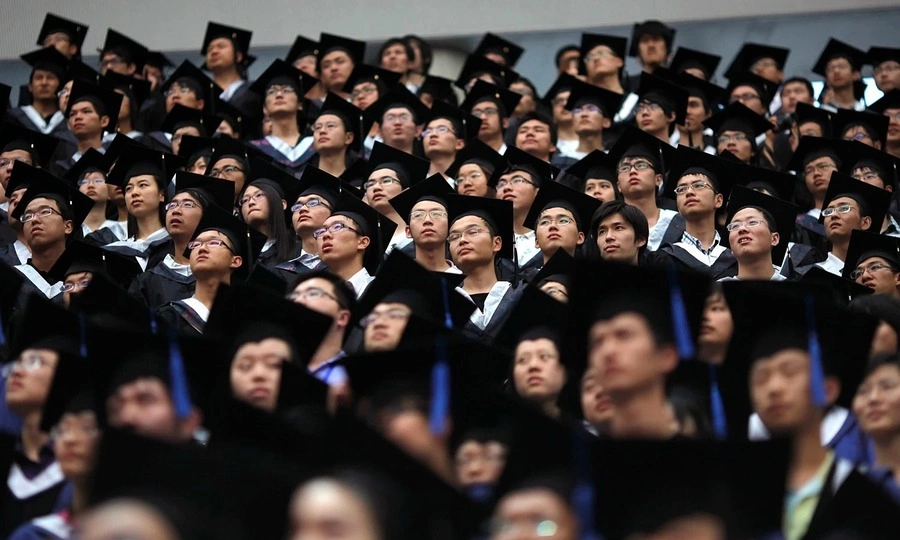
Students attend a graduation ceremony at Fudan University in Shanghai, China. Photo by Reuters
Indonesia is Southeast Asia's largest economy, with output of about US$1.45 trillion in 2025, more than double that of any other country in the region, according to International Monetary Fund data. China is now its largest trading partner and the biggest foreign investor in its mineral industries.
Indonesia's statistics agency put bilateral trade at about $135 billion in 2024, with China taking close to a quarter of the country's total trade. China's ambassador to Indonesia, Wang Lutong, told a forum on China-Indonesia relations in Jakarta on June 24 that two-way trade reached about $155 billion in 2025.
Over the past decade, China has poured more than $65 billion into Indonesian nickel and electric-vehicle battery processing, building hubs such as the Morowali park in Central Sulawesi and the Weda Bay park in North Maluku.
Those investments helped make Indonesia the world's largest nickel producer, at roughly 60% of global output, with Chinese firms controlling about three-quarters of the country's refining capacity, according to the U.S. National Bureau of Asian Research.
Those factories need skilled Indonesian workers, and the universities are where they will be trained. Wang has said even closer cooperation in higher education would help generate jobs.
Not every student is aiming for China's elite. Agnes Helena Claresta Hariyadi, 20, who finished high school in Central Java in 2024, now studies tourism management at Chongqing Jiaotong University on a partial scholarship, with classes taught in English.
"China has a massive economy, strong tourism prospects, and is a leader in the AI sector. I am hoping to secure a job here after graduation," she told The Strait Times.
The eastward turn reverses a decades-old pattern. After independence in 1945, Indonesia sent its brightest students to the U.S., Europe, Australia and Japan.
The most famous cohort, the "Berkeley Mafia," studied at the University of California, Berkeley, from the late 1950s under a Ford Foundation program and returned to design the economic policy of Suharto's New Order.
The architect of that program was Sumitro Djojohadikusumo, then dean of the University of Indonesia's economics faculty and the father of the current president, Prabowo Subianto.
View original source — VnExpress ↗
Related stories

The Punch
BusinessJul 2, 2026 · 1 min
Ministry vows stricter enforcement of seafarers’ rights
The Punch
The Punch
BusinessJul 2, 2026 · 1 min
Oil shocks pushed Nigeria’s inflation to 15.93% – Report
The Punch
The Punch
BusinessJul 2, 2026 · 1 min
CBN issues fresh guidance on troubled banks’ contract suspensions
The Punch
The Punch
BusinessJul 2, 2026 · 1 min
Wema Bank committed to nurturing future innovators — MD
The Punch