Indian Express
Indian Express··6 min read
Why Chandra Shekhar still matters: The rebel who never settled for No. 2
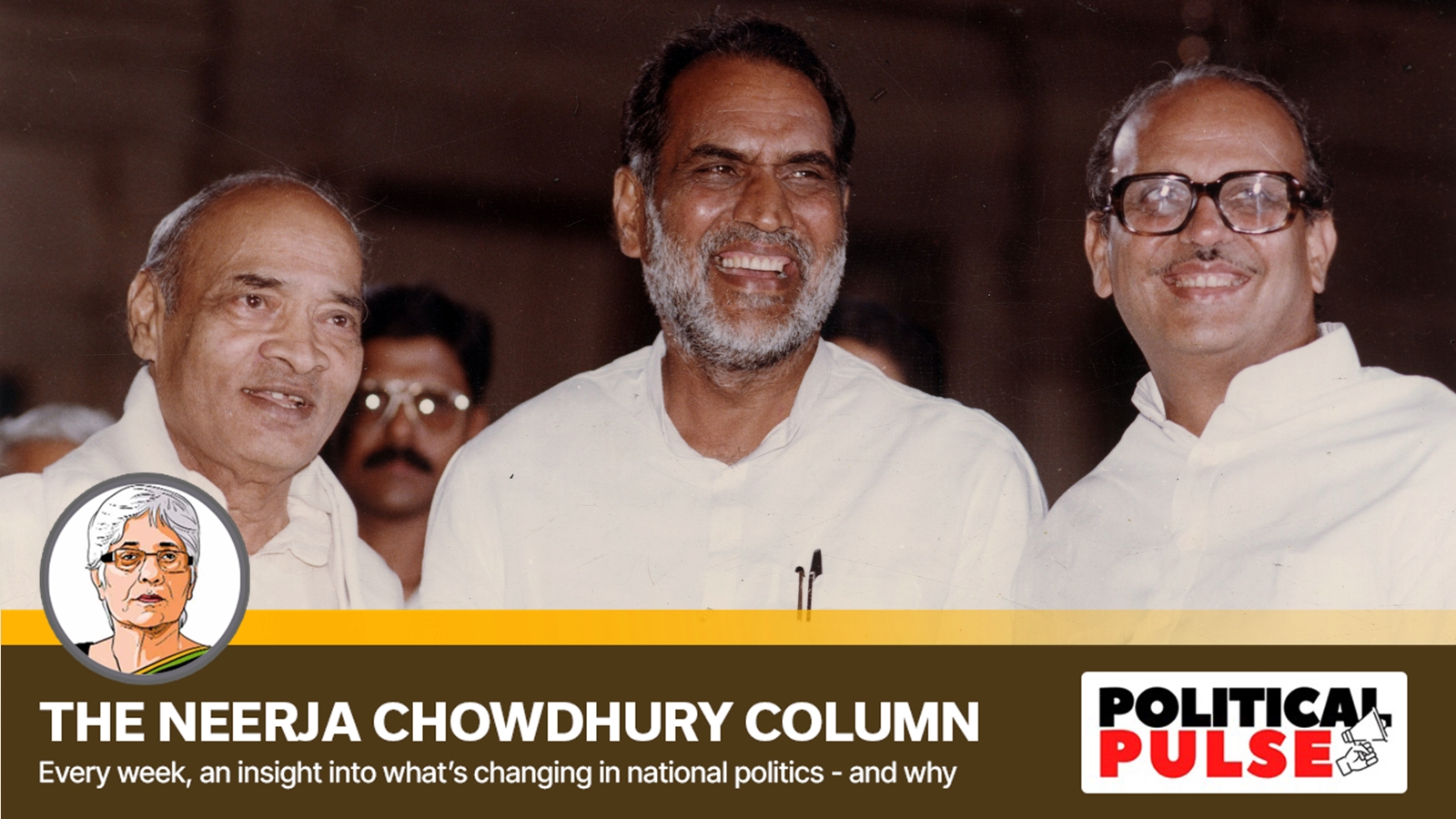
In this season of anniversaries, when everything is being celebrated — recently, Prime Minister Narendra Modi completed 12 years or 4,399 days in office, overtaking Jawaharlal Nehru as the longest-serving elected PM — there is one that few are talking about. This year marks the centenary of the country’s eighth PM Chandra Shekhar, who was born on April 17, 1927, in Ballia in present-day Uttar Pradesh.
Though some of Chandra Shekhar’s followers are organising functions in his memory, there is no coordinated, collective effort to celebrate his legacy. Even the BJP, which has gone out of its way to give many leaders their due, has not attempted to celebrate the former PM, though his younger son, Neeraj Shekhar, is a BJP MP in the Rajya Sabha.
Tributes to Chandra Shekhar, a Rajput, might have helped the BJP in UP, where Assembly polls are expected to be held early next year, particularly as the eastern part of the state is of critical importance to the ruling party.
In these days marked by frequent splits in political parties — the Trinamool Congress (TMC) and the Shiv Sena (UBT) being the latest — it is useful to remember that Chandra Shekhar came to power at the head of a 63-member rump that broke away from its parent Janata Dal led by Vishwanath Pratap Singh, and he was propped up in power as well as brought down by the more-dominant Rajiv Gandhi-headed Congress.
This was a time when the country was making a turbulent transition from the Congress’s dominance to a coalition era that was to last a quarter of a century. Chandra Shekhar played a stellar role as a Congressman leading a ginger group of “Young Turks” under Indira Gandhi’s stewardship, helping give a leftward tilt to the party and speaking against “crony capitalism”, just like Rahul Gandhi is doing today.
The defining moment for him came on June 25, 1975, when Indira Gandhi declared Emergency, arresting him along with other Opposition leaders, even though he was a member of the Congress Working Committee. This is when he made the transition to an Opposition figure. On June 25, 1983, Chandra Shekhar concluded his 4,200-km Bharat Yatra from Kanya Kumari to Delhi to go back to the people and inject a new energy into a flailing political situation and to unify the Opposition to take on Mrs Gandhi.
However, Indira Gandhi’s assassination the following year changed all that. The Opposition was routed in the elections that followed and two years down the line, it was V P Singh who quit the Congress and united virtually the entire non-Congress Opposition and replaced Rajiv Gandhi as PM. Irony of ironies, VP’s birthday, as it happened, also falls on June 25.
A ‘dhakad’ leader
One word describes Chandra Shekhar and also defines his legacy, whether as a socialist in his early years, as a Young Turk in his heyday, or as the leader of the one-man party he became in Parliament towards the end, speaking against economic liberalisation. He was one of the dying breeds of politicians, a dhakad (formidable) leader who stuck his neck out for what he believed in.
Soon after he joined the Congress in 1965, he was introduced to Indira. She was the Information and Broadcasting Minister under Lal Bahadur Shastri at the time. Current Rajya Sabha Deputy Chairperson Harivansh Singh has written in the biography of Chandra Shekhar, which he co-authored, that Mrs Gandhi asked the young leader why he had joined the party. To this, he replied that he wanted to give the Congress a socialist turn. She asked what he would do if he did not succeed, to which Chandra Shekhar said, “In that case, I will try and break the Congress.” When a stunned Mrs Gandhi asked, “Why?”, the young Chandra Shekhar said, “It has become a banyan tree under which nothing new can grow.”
But first, in 1969, he assisted Mrs Gandhi in breaking the party, freeing it from the grip of the old guard and helping her become the real Congress. She went on to become the “Durga” and he the “Young Turk”. The rejuvenation of the Congress remains as much of a live issue now as it was then.
When Rajiv Gandhi was assassinated in May 1991 — Chandrashekhar was the caretaker PM at the time — many world leaders attended the former PM’s funeral. The Pakistani Prime Minister, Nawaz Sharif, was one of them. Chandrashekhar and Sharif had a one-on-one meeting. When Chandrashekhar raised the issue of cross-border terrorism, the Pak PM said he was trying his best to put a stop to it.
“I want to tell you one thing very clearly,” Chandrashekhar told Sharif, according to Shyam Saran who was then in the PMO and was taking notes of the meeting. “Ek agar ghusega, toh ek ko marenge, dus ghusenge toh dus ko marenge, sau ghusenge toh sau ko marenge. Is mein aapko koi ashanka nahin honi chahiye (If one [terrorist] enters [the country], we will kill one. If 10 enter, we will kill 10. If a hundred enter, we will kill a hundred. You should have no doubts about that.” Sharif fell silent.
The what-ifs
In one of my conversations with Chandra Shekhar, I asked him what he would have done had he been the PM on December 6, 1992, when kar sevaks demolished the Babri Masjid. He said he would have never allowed it to happen. But when pointed out that thousands would have likely died that day if force had been used to stop the kar sevaks, he reiterated what he said. Even the officials who worked with him, such as Cabinet Secretary Naresh Chandra and Shyam Saran who later became the Foreign Secretary, believed he would have taken a tough stand.
Many believe the Congress pulled the plug on his government because he had come close to resolving the Ayodhya dispute through dialogue, which veered around building the temple at the disputed spot, but with an assurance that the Vishwa Hindu Parishad (VHP) would not raise issues like Kashi and Mathura in the future. Thirty-six years later, Mathura is being raked up again as the Ram Janmabhoomi Trust finds itself charged with “chanda chori” of crores of rupees of “charhava” donated by devotees.
Realising that his minority government might not have much time, he had reached out to both the VHP and the Babri Masjid Action Committee on the first day he took over as PM in November 1990. At the time, Rajiv Gandhi was told by his advisors that if Chandra Shekhar succeeded, he would not only become nationally popular but also make inroads into the Congress, where he enjoyed goodwill, having once been a part of it. Soon thereafter, two Haryana sub-inspectors were found “snooping” around 10 Janpath, and the Congress pulled the plug.
Implicit in Chandra Shekhar’s strength was also his weakness: he did not want to be number two under anyone. In 1977, he did not become a minister under Morarji Desai and chose to become the party chief. When Babu Jagjivan Ram exited the Congress in 1977 to form the Congress for Democracy, which supported the Janata Dal, he invited the Young Turks to join his group. But Chandra Shekhar decided against it. Had they teamed up, Jagjivan Ram’s chances of becoming the PM, instead of Desai, may have improved. When VP became the PM, Chandra Shekhar was offered the Deputy PM’s post. But he could not reconcile with working under VP, who was far junior to him in the Congress but had outpaced him.
India has had 14 PMs. And almost an equal number who came close to the pinnacle of power, but did not make it to the top. There was yet another category, like Chandra Shekhar, who attained the highest office but could not survive for long (his tenure lasted 223 days).
History is an aggregate of hits and misses. It is tantalising to think of what kind of leadership Chandra Shekhar might have provided if he had a majority on his own. Equally tantalising — and this is a question posed by some — is what he would have done had he been around now, a contemporary of the likes of Sharad Pawar, Mallikarjun Kharge, and Farooq Abdullah. My hunch is that if he were alive today, he would have poured all his energy into bringing together the fragmented Opposition on a common platform.
(Neerja Chowdhury, Contributing Editor, The Indian Express, has covered the last 11 Lok Sabha elections. She is the author of How Prime Ministers Decide.)
View original source — Indian Express ↗
Related stories

ESPN
SportsJul 2, 2026 · 1 min
USMNT player ratings: Tillman shines as U.S. books...
ESPN

ESPN
SportsJul 2, 2026 · 1 min
USMNT player ratings: Tillman shines as U.S. book ...
ESPN

ESPN
SportsJul 2, 2026 · 1 min
World Cup VAR review: Misapplied protocols leave B...
ESPN

The Punch
SportsJul 2, 2026 · 1 min
World Cup: Balogun scores, sees red as US beat Bosnia 2-0
The Punch