VnExpress
VnExpress··2 min read
Ukrainian man, woman jailed in HCMC for lending money at 792% interest
Two Ukrainians and a Vietnamese have been sentenced to prison for running a loan sharking operation that charged up to 792% interest.
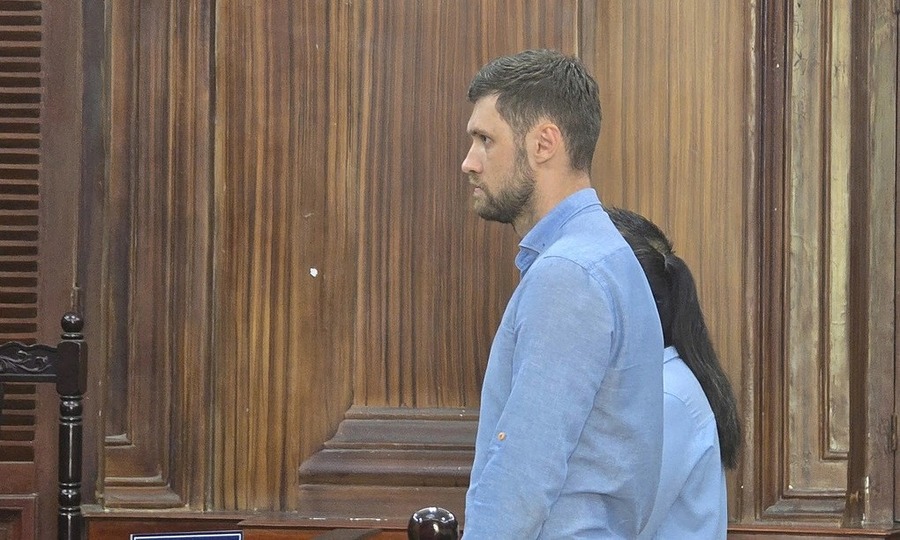
The Ho Chi Minh City People's Court on Tuesday sentenced Tymur Bugaievskvi, 36, Iryna Kravchuk, 41, and Le Thanh Huynh Cang, 54, to seven months, 29 days, and one year for "usury in civil transactions."
Tymur Bugaievskvi stands trial in HCMC, June 30, 2026. Photo by Binh Nguyen
Twenty seven others received sentences ranging from a fine of VND200 million (US$7,600) to one year and four months in prison for the same offense.
The police determined that Roman Katerynchyk, another Ukrainian man, was the mastermind behind the operation but had left the country before the ring was busted.
From 2019, through social connections, Cang became acquainted with Roman and helped him explore financial investment in Vietnam before they established multiple companies for loan sharking.
Initially, three were established: OnCredit, Loi Tin (both headquartered in HCMC’s former Phu Nhuan District), and Ixora (former District 2).
They were registered for doing various businesses but only gave usurious loans through apps and websites.
By 2023, the network faced increased scrutiny from authorities, and so reduced operations.
In April that year, OnCredit was fined by the HCMC police for operating outside its registered scope of business. Katerynchyk instructed Cang to temporarily suspend operations and left the country.
Later, he directed Cang to resume operations, prepare procedures to set up more companies, recruit personnel, and establish more companies, each responsible for a specific stage in the lending process.
Cang used relatives and acquaintances to act as nominees to establish Loc Tin, Cactus, and Vinex companies, which coordinated with Ixora to lend through the OnCredit app and Oncredit.vn and Easycash.vn websites.
Katerynchyk also sent several people from Ukraine to work in HCMC, including Bugaievskvi for developing the customer scoring software and Kravchuk for managing debt collections, business development, and supervising employees.
According to the court verdict, the lending applications and websites were created in Ukraine.
Customer data, contracts, loan records, and all transaction information were stored on servers located abroad.
Employees in Vietnam could only access and update data but not download or copy it.
To conceal the usury, the companies listed an interest rate of 0.054% per day, or 19.44% a year, within legal limits.
But borrowers had to pay various fees such as consultation, contract extension, and late payment penalties, pushing the actual interest rate to 365-792% per year depending on the loan package.
To borrow, customers had to download the app or access Oncredit.vn and Easycash.vn, provide personal information and a portrait photo, and allow the software to access their contacts and certain phone data.
The information was then entered into a scoring system programmed by Bugaievskvi to assess borrowing capacity for approving or rejecting applications.
Data from the companies' systems shows that 20 customers borrowed VND905 million nd were required to repay nearly VND1.2 billion. Of this, VND268 million went toward interest, which would have been merely VND8 million if the law had been followed.
View original source — VnExpress ↗
Related stories

The Punch
TechnologyJul 2, 2026 · 1 min
TikTok settles with US teenager ahead of social media addiction trial
The Punch
The Punch
NewsJul 2, 2026 · 1 min
Atiku appoints Kenneth Okonkwo as spokesperson
The Punch
The Punch
NewsJul 2, 2026 · 1 min
Vatican rift deepens as breakaway Catholic group defies Pope, ordains bishops
The Punch

Sky Sports
SportsJul 2, 2026 · 1 min
Leigh to show they are play-off ready in Magic Weekend clash vs Warrington
Sky Sports