Indian Express
Spot the difference: You have 30 seconds to find 5 changes in this kitchen
Think you have eagle eyes? Here’s your next spot-the-difference challenge.
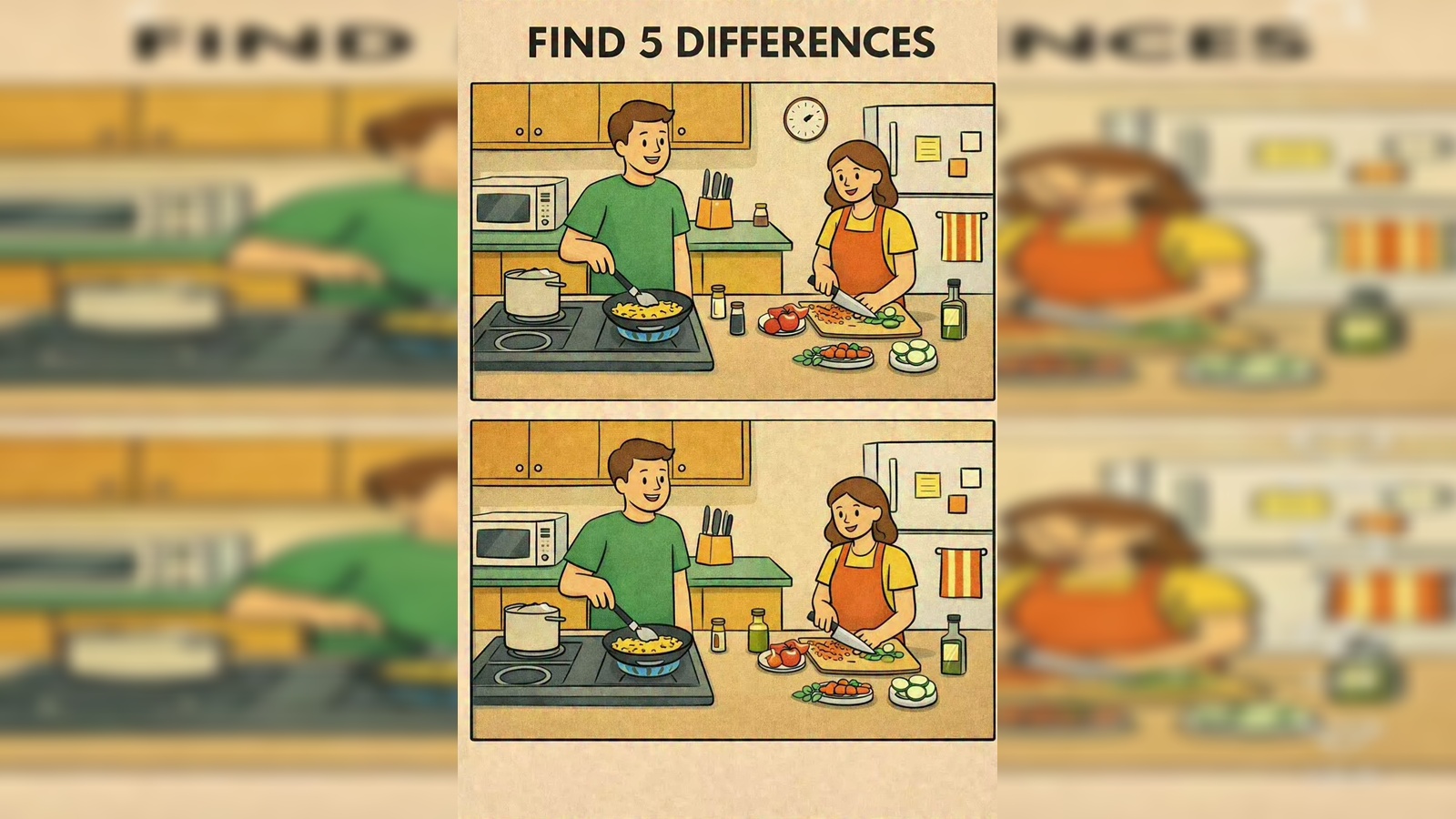
At first glance, these two kitchen scenes appear identical. A couple is busy preparing a meal, vegetables are being chopped, something is cooking on the stove, and the kitchen looks warm and inviting. But don’t be fooled — five subtle differences are hidden between the two images.
Some changes may jump out at you immediately, while others are cleverly concealed and require a much closer look. You might spot three or four differences in seconds, only to find yourself staring at the images trying to uncover the final one. That’s what makes spot-the-difference puzzles so addictive: they challenge your observation skills and attention to detail.
DISCLAIMER: This article is based on information from the public domain and/or the experts we spoke to.
If you’re struggling, try breaking the image into sections instead of looking at the whole scene at once. Check the people, then move to the countertop, cabinets, refrigerator, and cooking area. Tiny alterations can easily blend into the background when you’re focused on the bigger picture.
Need a hint? Don’t concentrate only on the couple. Some of the differences may be hiding among the kitchen accessories and appliances, so scan every corner carefully.
⏱️ Timer Challenge: Think you can find all 5 differences in just 30 seconds? Set a timer, put your observation skills to the test, and see if you can spot them before time runs out.
Ready? Your countdown starts now! 👀🔍
Story continues below this ad
Can you spot the changes? (Source: Instagram/dailyvisualpuzzle)
What missing an obvious difference reveals about the brain
Counselling psychologist Athul Raj tells indianexpress.com, “The brain is constantly filtering information because paying attention to every single detail would be impossible. It prioritises what feels relevant, familiar, or urgent, while quietly pushing everything else into the background. When someone repeatedly misses an obvious difference, it is rarely a question of intelligence. More often, the brain has already decided it understands what it is seeing. Once that sense of certainty sets in, we stop actively looking for what might be different.”
There is also a bigger story here. Raj states that many of us are living with chronically divided attention. We move from one screen to another, multitask throughout the day, and rarely give our minds the opportunity to stay with one thing for an extended period. These puzzles expose that immediately. “What they really reveal is that attention is not automatic. It is a skill that needs to be exercised. Sometimes, the difference was always visible. We simply were not present enough to notice it.”
Can spot-the-difference puzzles help maintain cognitive skills?
According to Raj, research does suggest that “regularly engaging the brain in challenging and stimulating activities can support cognitive health as we age.” Observation-based puzzles can contribute because they activate multiple systems at once, including concentration, visual processing, attention shifting, and working memory.
However, their value is often misunderstood. “They are not powerful because they help us find hidden objects faster,” mentions Raj, adding that they are powerful because they train us to sustain attention for longer than we typically do in everyday life.
Story continues below this ad
Answer to last week’s Spot the Difference challenge
How did you do on last week’s brain teaser featuring the old man sleeping on the sofa? If you found all three differences within the time limit, give yourself a pat on the back. A couple of them were easy to overlook.
The first difference was in the old man’s hands. Their arrangement was reversed between the two images, making it a subtle detail that many readers missed on their first scan.
The second change was on the dog resting beside him. In one image, the dog’s left ear was missing, a small alteration that blended naturally into the scene.
The final difference was hidden in the sofa itself. In one picture, the backrest was connected normally to the armrest, while in the other, there was a visible gap between the two sections.
If you spotted all three, congratulations! Your observation skills are clearly sharper than most. Now it’s time to put those skills to the test again with an even trickier challenge.
Think you’ve found all five differences? Keep your answers handy and resist the temptation to peek elsewhere. We’ll reveal the complete solution in next Thursday’s edition of our Spot the Difference series, along with a brand-new visual challenge to test your observation skills.
DISCLAIMER: This article is based on information from the public domain and/or the experts we spoke to.
View original source — Indian Express ↗
Related stories

Deadline
EntertainmentJul 2, 2026 · 1 min
Prime Video Adapting Ulf Kvensler’s Debut Novel ‘Sarek’ As Psychological Thriller Series Starring ‘Quicksand’ &…
Deadline

Daily Trust
EntertainmentJul 2, 2026 · 1 min
CISLAC’s Rafsanjani receives TI’s highest award
Daily Trust

Indian Express
EntertainmentJul 2, 2026 · 1 min
Ranveer Singh shares a message as Dhurandhar releases in Japan, eyes RRR’s Rs 139 cr record
Indian Express

Indian Express
EntertainmentJul 2, 2026 · 1 min
Stebin Ben defends Kriti Sanon amid marriage buzz: ‘Why rush into something so important?’
Indian Express