Indian Express
Indian Express··5 min read
Police can’t force narco, polygraph or brain mapping tests: Chhattisgarh High Court
5 min readNew DelhiJul 2, 2026 12:55 PM IST
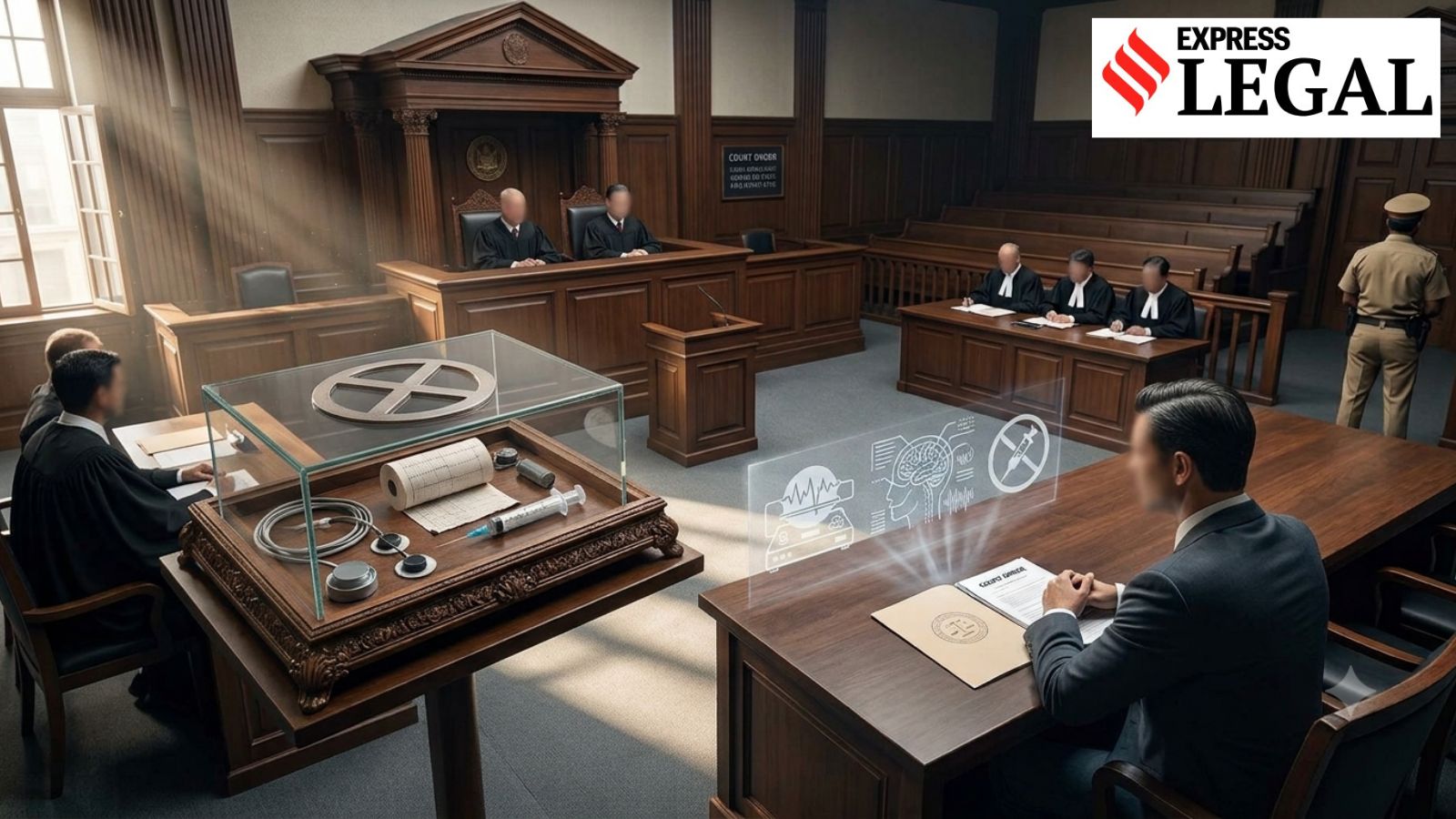
Any investigative measure involving narcoanalysis or similar scientific techniques must strictly conform to the established legal procedures, the Chhattisgarh High Court said. (AI-generated image)
Can the police force you to undergo a narco test? The Chhattisgarh High Court has ruled they cannot, saying that no person can be compelled to undergo narcoanalysis, polygraph or brain mapping tests without voluntary and informed consent.
A bench of Chief Justice Ramesh Sinha and Justice Ravindra Kumar Agrawal was hearing a writ petition filed by two Raigarh residents who alleged that the police were attempting to subject them to scientific forensic tests though they were not named in the First Information Report (FIR).
“No individual can be forcibly subjected to narco-analysis, polygraph examination, Brain Electrical Activation Profile (BEAP) test, or any similar scientific investigative technique. Such techniques may be administered only in accordance with law and with due regard to constitutional and procedural safeguards, including informed consent and judicially recognized protections,” the court held.
The case arose from a murder investigation registered at Chakradharnagar Police Station in Raigarh. The petitioners claimed they were repeatedly summoned by the police, their mobile phones were seized without following due process and they were asked to appear in Raipur for narcoanalysis, brain mapping and polygraph tests without their consent. They approached the high court seeking protection against what they described as arbitrary and coercive police action.
According to the petition, the case was registered this year against unknown persons under sections 103(1)(murder) and 238A (causing disappearance of evidence/giving false information) of the Bharatiya Nyaya Sanhita (BNS). The petitioners contended that they were neither named as accused nor was any incriminating material found against them. They relied on an investigation report dated June 16, submitted by the investigating officer before the sessions court, which recorded that no evidence had so far emerged against them.
Chief Justice Ramesh Sinha and Justice Ravindra Kumar Agrawal noted the petitioners were not named in the FIR and the investigator’s report stated that no evidence was found against them.
Despite this, they alleged that they were called to the police station for nearly 18 consecutive days, detained for prolonged periods, compelled to sign an undertaking and deprived of their mobile phones without seizure memos. They further alleged that the police directed them to undergo brain mapping, polygraph and narcoanalysis tests without judicial authorisation or their consent.
State opposed plea
The state argued that the plea was premature as the investigation was underway. The petitioners were stated to have merely been called for questioning after certain facts surfaced during the investigation. The prosecution denied the allegations of harassment, illegal detention and coercion. It also argued that no forensic examination could be conducted, except legally.
Story continues below this ad
What court said
The high court noted that the petitioners were not named in the FIR and the investigating officer’s own report acknowledged that no evidence had yet been found against them.
Any investigative measure involving narcoanalysis or similar scientific techniques must strictly conform to the established legal procedure.
Relying on the Supreme Court’s landmark judgment in Selvi vs State of Karnataka (2010), the high court reiterated that compulsory administration of narcoanalysis, polygraph and Brain Electrical Activation Profile (BEAP) tests violates the constitutional guarantee against self-incrimination under Article 20(3) as well as the right to personal liberty and mental privacy under Article 21.
The court said such tests may be conducted only after obtaining voluntary and informed consent, recording that consent before a judicial magistrate, ensuring access to legal assistance and complying with the safeguards laid down by the Supreme Court and the National Human Rights Commission.
Plea disposed of
Without expressing any opinion on the merits of the criminal case, the high court directed the investigating agency not to compel or coerce the petitioners into undergoing narcoanalysis, polygraph, brain mapping or any similar scientific investigative technique.
It clarified that such tests, if proposed, can be conducted only with the petitioners’ voluntary, informed and unequivocal consent, which must be recorded before the competent judicial magistrate after ensuring compliance with all constitutional and statutory safeguards. The writ petition was accordingly disposed of on June 29, 2026.
Significance
The judgment serves as a reminder that even during criminal investigations, police powers are subject to constitutional limits. By reiterating the Supreme Court’s ruling in Selvi v State of Karnataka, the high court has made it clear that investigative agencies cannot use narcoanalysis, polygraph or brain mapping tests as coercive tools to extract information.
The ruling reinforces the constitutional protection against self-incrimination and the right to personal liberty and mental privacy. It also underscores that any such scientific investigative technique can be used only after obtaining the person’s free and informed consent, and following the safeguards laid down by the Supreme Court and the National Human Rights Commission.
Vineet Upadhyay is an Assistant Editor with The Indian Express, where he leads specialized coverage of the Indian judicial system.
Expertise
Specialized Legal Authority: Vineet has spent the better part of his career analyzing the intricacies of the law. His expertise lies in "demystifying" judgments from the Supreme Court of India, various High Courts, and District Courts. His reporting covers a vast spectrum of legal issues, including:
Constitutional & Civil Rights: Reporting on landmark rulings regarding privacy, equality, and state accountability.
Criminal Justice & Enforcement: Detailed coverage of high-profile cases involving the Enforcement Directorate (ED), NIA, and POCSO matters.
Consumer Rights & Environmental Law: Authoritative pieces on medical negligence compensation, environmental protection (such as the "living person" status of rivers), and labor rights.
Over a Decade of Professional Experience: Prior to joining The Indian Express, he served as a Principal Correspondent/Legal Reporter for The Times of India and held significant roles at The New Indian Express. His tenure has seen him report from critical legal hubs, including Delhi and Uttarakhand. ... Read More
Tags:
brain mapping
Chhattisgarh High Court
narco analysis
polygraph test
View original source — Indian Express ↗
Related stories

The Punch
NewsJul 2, 2026 · 1 min
Soldiers bust illegal arms factory, recover five AK-47 rifles in Kebbi
The Punch
The Punch
NewsJul 2, 2026 · 1 min
Gunmen attack NIPSS again, one assailant killed
The Punch
The Punch
PoliticsJul 2, 2026 · 1 min
Accept NWC’s decision on candidates, Ondo APC elders urge members
The Punch
The Punch
NewsJul 2, 2026 · 1 min
15 burnt to death, three killed in Niger communal clash
The Punch