Indian Express
‘We are helpless’: In Gujarat’s Morbi, farmers on protest fast seek compensation for land lost to Adani power…
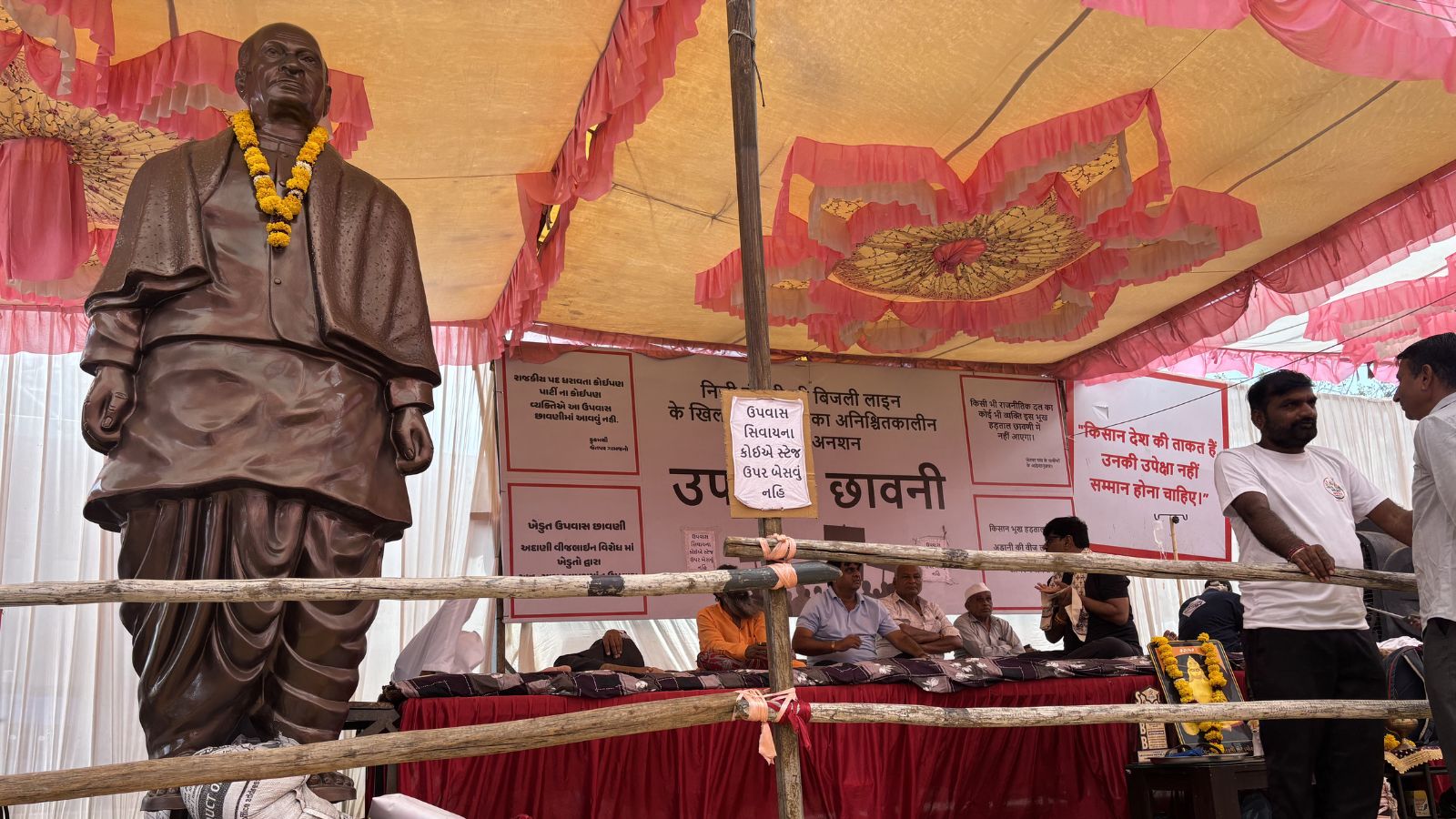
In burning 40-degree heat, about a hundred individuals, half of them women, sit under a shamiana. At the dayro, or local folk gathering, there is music and horse parades, snapshots of the culture of Gujarat’s Zalavad region, of which Morbi and Surendranagar are part.
The people in the gathering have come together to protest. Some of the men have tonsured heads. A small but growing number of protesters have been on a hunger strike since June 17; some have needed medical attention.
The majority of the protesters are Patidar farmers – and they want higher compensation for the use of their land for high-voltage transmission infrastructure for power from the Khavda Renewable Energy Zone in Kutch district.
The towers for the high-tension power transmission cables are being installed by Halvad Transmission Ltd, a Special Purpose Vehicle (SPV) of Adani Energy Solutions Ltd (AESL), the country’s largest private-sector power transmission and distribution company.
Protests against the high-tension transmission line and towers began at several places in the state on June 9, and were concentrated in Morbi district, where farmers claim they are the “worst affected” by the project.
On June 15, the Gujarat Congress launched a statewide protest rally in Gandhinagar, and one of the party’s demands was aligned with the agitation in Morbi. A good number of Morbi farmers have been seen in the rally that is currently progressing through other districts.
The ruling BJP is yet to engage seriously with the protesters, but it has remained careful to not be seen as being against them. Morbi, the Patidar-dominated epicenter of the agitation, has historically played a key role in both regional elections and national political movements.
Story continues below this ad
Sixty-five-year-old Ramjibhai Nanjibhai Bhadja says almost 70% of his 12-bigha landholding in Jetpar village of Morbi district will be used for a transmission tower and cables. His land lies next to the state highway that runs north into Kutch, and is currently valued at almost Rs 40 lakh per bigha. Once the power infrastructure comes up, he expects its value to crash.
While farmers like Ramjibhai will not lose possession of their lands, they expect the construction will make it impossible to cultivate – and unattractive to buyers. And the compensation they are being offered for this loss is a pittance, they say – for his 8.3 bigha, he will get only about Rs 30 lakh, Ramjibhai told The Indian Express.
“We are sitting on a hunger strike out of helplessness,” said Ramjibhai’s older son Amitbhai. “The state government is paying no attention to our demands. Several farmers including young children and women have been detained at protest sites over the past few days,” Amitbhai said.
Morbi district Superintendent of Police (SP) M N Patel said the farmers had not taken permission for the protest, yet police had been going easy on them since “it is a sensitive issue”.
Story continues below this ad
“Some farmers were detained on two days around two weeks back for creating obstructions and attempting to block the Halvad-Maliya highway. We did not detain any minors; the children insisted on coming with their mothers and climbed into police vehicles on their own. Some policewomen were injured,” the SP said.
The protest in Jetpar is against the installation of a 756 kV DC line by Halvad Transmission Limited over a distance of 246 km from the KPS-2 Pooling Station in Khavda, Kutch, to a new switching station at Halvad in Morbi.
On Tuesday, day 13 of the protest fast, when The Indian Express visited the village, nine farmers were sitting on hunger strike. Mini trucks and tractor trolleys carrying both men and women protesters waving the Tricolour were rolling up to the “Upwas Chhavni” (fasting camp) close to the bus stand in the main bazaar of the village.
Among the fasting protesters were 57-year-old Rakeshbhai Shivlal Amrutiya and 51-year-old Bharatbhai Amrutiya, brothers of Kantilal Amrutiya, the multi-term BJP MLA from Morbi and Minister of State for Labour, Skill Development and Employment in the Gujarat government.
Story continues below this ad
“My brother (the Minister) visited us a few days before we sat on hunger strike and tried his best to resolve the issue. But it seems there is no interest from the higher-ups [in the government],” Rakeshbhai said. “Both of us (Kantilal and Rakeshbhai) are hurt. I am a farmer and it is my duty to support the farmers. I have no political aspirations,” Rakeshbhai said.
Bharatbhai added: “The transmission line is not affecting my farmland. But I am here to support the farmers who have barely 3-4 bigha of land and families and small children to feed.”
Sarpanches of more than 35 villages in Morbi district have expressed solidarity with the protesters. “This (Tuesday) is the second time we have come to Jetpar in support of the farmers. If required we will come again,” Ravirajsinh Parmar, Sarpanch of Nichi Mandal village and president of the Morbi District Sarpanch Association, said.
The farmers have put forth a list of six demands, including compensation for land at the rate of 400% of the market price – on the lines of what Rajasthan has offered to its farmers – and not as per the jantri (circle) rates decided by the state government.
Story continues below this ad
“The guidelines in the (central) government circular of June 14, 2024 states that the Market Rate Committee (MRC), which determines land compensation value for building power transmission corridors, will fix 200% of the market price for the tower area. However, since it is a high-voltage line, the Rajasthan government in such a case offers an additional 200%… So we have also requested for 400% of the market price, not the jantri rate,” Nehulkumar Dhirajlal Amrutiya (31), one of the nine farmers on a hunger strike since June 17, said.
Morbi District Collector Swapnil Khare, who is chair of the District Level Valuation Committee (DLVC), told The Indian Express, “The government had invited the farmers for talks on June 28, stating that all the demands are under consideration and things could only be resolved through dialogue. But there has been no response from them.”
The protesting farmers are, however, insisting that the government begin by accepting all their demands. “There is no clarity from the state government and we are afraid to believe them. So we requested, first give us in writing that these six demands have been accepted,” said Nileshbhai Erwadiya, a farmer from Tikar village 35 km from Jetpar.
Erwadiya said he was taken to hospital and admitted to ICU for two days after he lost 16 kg while on hunger strike.
Story continues below this ad
The strike started as a symbolic fast by 50 men and 100 women on June 9, but hardened into an indefinite hunger strike on June 17 after several conflicts with the local police. Around 15 farmers tonsured their heads on June 19.
Crowds at the Upwas Chhavni surge every evening, there are chants of “Kisan Zindabad”, and protesters demand justice through street plays and motivational talks by community leaders. On Thursday morning, the farmers moved the protest venue to Ram Vadi, a nearby hall, to escape the rain. Work to build a “rain-proof dome” was ongoing at the Chhavni site.
On Wednesday, Agriculture Minister and Gujarat government spokesperson Jitu Vaghani said in Gandhinagar that a “good decision” on the farmers’ demands would be taken soon.
“…Continuous discussions take place at the Chief Minister’s level, and they are on. Whatever decision is taken, a good decision will be taken in the interest of the farmers. The CM is taking this issue very sensitively… Farmers’ interest is our priority,” Vaghani said.
Story continues below this ad
A spokesperson for the Adani Group said compensation had been offered in accordance with guidelines provided by the government.
“…AESL has offered compensation to the landowners as per government guidelines under existing norms. However, certain landowners have demanded compensation in excess of the government guidelines,” the spokesperson said.
“As part of the statutory process, we approached the district officials for directions, who after multiple rounds of hearing with all stakeholders, have determined compensation and granted permission for AESL to continue work and if needed, under police protection. AESL is fully committed to engaging with the landowners and paying them a fair compensation as determined by the civic administration under the law but some vested interests are instigating the landowners,” the spokesperson said.
What the farmers want
Formation of a Market Rate Committee (MRC) to determine the market price of the land.
For tower area, 400% of market price of land as determined by MRC
For RoW (Right of Way) area, the legally secured, minimum safety corridor around power lines, compensation of 230%, 245% and 260% of market price determined by MRC in rural, municipality, and municipal corporation areas respectively.
Payment of full compensation in advance and in one installment.
Collector should initiate proceedings after the Transmission Service Provider issues an order.
On all issues except the above, Gujarat Energy Department should issue circulars as per the guidelines of the central government.
View original source — Indian Express ↗
Related stories

The Punch
PoliticsJul 2, 2026 · 1 min
Morning recap: APC, INEC face Senate list showdown, presidency hit by fake agency scandal, CBN revokes 46 bank…
The Punch

The New York Times
PoliticsJul 2, 2026 · 1 min
Mass Mournings, 6 Days and 2 Countries: Iran Prepares to Bury Supreme Leader
The New York Times

Straits Times
PoliticsJul 2, 2026 · 1 min
Iran warns US, Israel against attacks ahead of funeral processions for Khamenei
Straits Times

OnlineKhabar
PoliticsJul 2, 2026 · 1 min
TVS launches new Apache RTR 160 4V in Nepal
OnlineKhabar