Times of Israel
Debate returns to Old Knesset building for first time in 60 years
The Old Knesset building in downtown Jerusalem hosted its first debate in 60 years on Monday, with the launch of a Hebrew University student initiative aimed at encouraging a civilized exchange of ideas.
Al HaMoked (The Spotlight), an apolitical initiative, is modeled on the Oxford and Cambridge debating societies established in the 19th century.
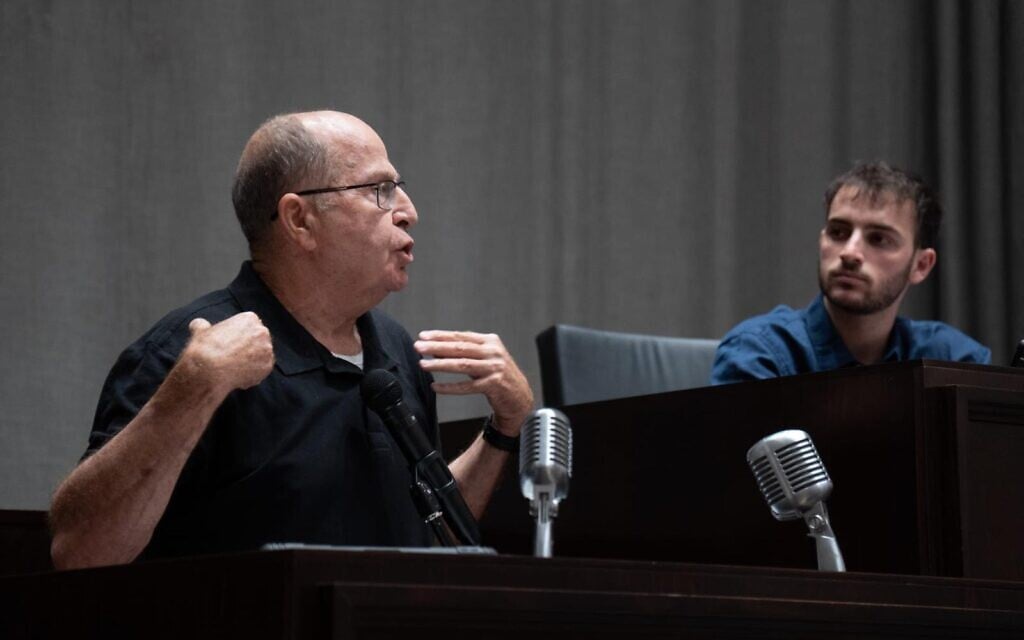
The motion of Monday’s debate was “Military Independence, or Regional Agreements.” The speakers were Moshe (“Bogie”) Ya’alon, a former IDF chief of staff and former Likud defense minister, who subsequently moved to the political center before quitting politics and becoming a staunch critic of Prime Minister Benjamin Netanyahu; Uzi Dayan, a former deputy chief of staff, National Security Council head and Likud party lawmaker; Ksenia Svetlova, a former Knesset member (Hatnua) and executive director of the Regional Organization For Peace, Economics & Security; and Hebrew University military historian Prof. Danny Orbach.
Two-thirds of the roughly 100 students in the audience voted to prioritize regional agreements, supporting Ya’alon and Svetlova, although all the speakers noted that military strength and diplomacy went hand in hand.
After the formal debate, the speakers moved upstairs to continue lengthy discussions with different circles of students.
Get The Times of Israel's Daily Edition
by email and never miss our top stories
By signing up, you agree to the terms
The idea was the brainchild of a first-year Politics, Economics and Philosophy student, Adam Freeman, as part of a program run this year by the Van Leer Jerusalem Institute. (Full disclosure: Adam Freeman is the son of a Times of Israel reporter).
Further debates are planned for the next academic year.
Introducing the session, Freeman said: “Israel needs debate. At a time when public discourse has become loud and shallow, when TV studios and social media networks are driven by ratings, rows and small politics, we, as students, seek to create an alternative. We want a space where the stage does not belong to whoever shouts the loudest, but to whoever brings knowledge, depth and expertise to the table.”
He added: “Here, in this historical Knesset building, Israeli democracy was vibrant in its early days… Our goal is to bring that spirit back to these walls. To bring the greatest experts to this historic building, in order to hold proper and respectful discourse on the burning issues.”
The debate was held at the building in downtown Jerusalem that housed Israel’s parliament from March 1950 until the August 1966 dedication of the Knesset’s permanent residence in Givat Ram. Last year, the Old Knesset, also known as Froumine House, was established as the new Knesset Museum after it was restored and reconstructed. The last debate in the building was held on August 11, 1966.
Monday’s debate was held in the reconstructed Plenum Hall.
Knesset Museum director Moshe Fuksman-Sha’al said: “I’m delighted that after 60 years, we will once again hear interesting ideological arguments within these walls. I hope this is just the start.”
The three-story Froumine House, which then-prime minister Levi Eshkol described as “a symbol of Israel’s rebirth in its land,” saw decisions on issues that included German reparations for the Holocaust, the Laws of Return and Citizenship, and the abolition of the death penalty for regular homicides.
View original source — Times of Israel ↗
Related stories

The Hindu
PoliticsJul 2, 2026 · 1 min
‘Excited’ Donald Trump takes first flight on Qatar-gifted Air Force One
The Hindu

Straits Times
PoliticsJul 2, 2026 · 1 min
Hungary to launch $128 million school-start benefit scheme
Straits Times
Times of Israel
PoliticsJul 2, 2026 · 1 min
Tajik man accused of spying on Israel for Iran, as espionage arrests continue
Times of Israel

OnlineKhabar
PoliticsJul 2, 2026 · 1 min
5 ways to safely store a large quantity of mangoes
OnlineKhabar