VnExpress
VnExpress··3 min read
Australia hikes student visa fees for 3rd straight year
Australia has once again raised visa fees for international students, with the application fee for higher education reaching A$2,500 (US$1,723), the highest among all "Big Four" study destinations.
The Australian government raised the cost of both student and post-study work visas on Wednesday. The increase was neither announced in advance nor accompanied by a public explanation.
According to the latest update from the Department of Home Affairs, the subclass 500 student visa fee for higher education and vocational education and training (VET) has jumped from $2,000 to $2,500. Students from ASEAN countries are subject to a slightly lower fee of $2,050.
The visa application fee for English-language studies (ELICOS) has increased from $2,000 to $2,050, while the Temporary Graduate Visa (subclass 485) for post-study work has surged from $4,600 to $5,750.
The cost of studying in Australia has risen relentlessly over the past years. The student visa fee climbed from $710 to $1,600 in 2024, before hitting $2,000 in July 2025.
The Temporary Graduate Visa, which allows foreign graduates to stay and work for up to three years, had already doubled in cost just four months prior to this latest hike. Applicants will not receive a refund if their visas are rejected.
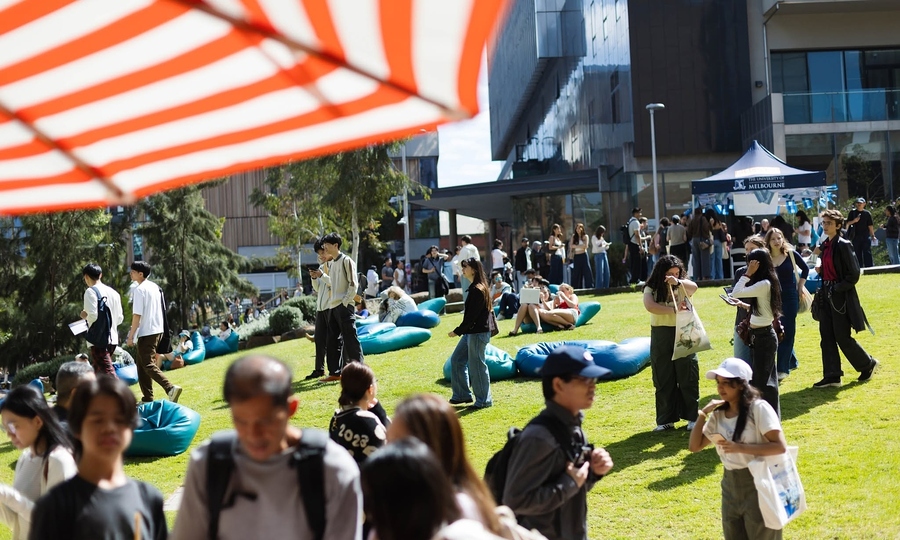
Students gather on the campus of The University of Melbourne in Melbourne, Australia, Feb. 26, 2026. Photo from the university's Facebook page
Big Four study visa fees
At $2,500, Australia's student visa fee for higher education and VET easily outpaces its top competitors. In comparison to other "Big Four" destinations, equivalent visas cost approximately $775 in the U.S., $935 in the U.K., and just $240 in Canada, according to ICEF Monitor. New Zealand currently charges $790.
Between 2022 and 2026, the Labor government repeatedly increased Australia's visa fees with little to no industry consultation.
Even ignoring the string of incremental hikes during that window, the net jump over the past four years is severe.
Since 2022, student visa application fees have surged by 285%. Temporary graduate fees have skyrocketed by 148%, and partner visa fees have grown by 45%.
Canada has not raised its study permit fee since 2022, and the U.S. has similarly frozen application costs for F-1, M-1, and J-1 visas over the same timeframe.
While the U.K. has implemented two fee hikes since 2022, its total increase across those four years amounts to just 15%.
Ian Aird, CEO of English Australia, told ICEF that the fee hikes are not just turning prospective students away. He warned they are also destroying the livelihoods of Australians working in ELICOS and other sectors that rely on international student spending.
"[The increases] come without care for the Australians who will lose their jobs or the Australian businesses it will destroy—and not just in the education sector," Aird said. "ELICOS students contribute significantly to international tourism, retail, and hospitality."
He added that past visa fee hikes have already caused ELICOS enrollment to plummet 60% to 20-year lows, costing thousands of Australians their livelihoods. "This new fee increase will drive that further," he said.
The Council of Australian Postgraduate Associations (Capa) called the increased post-study work visa costs "wrongheaded," according to Times Higher Education (THE).
"The only thing a higher 485 fee reliably manages is revenue," said Capa president Jesse Gardner-Russell. "International students are not just another resource to be mined, their value extracted and then shipped offshore, like iron ore."
"They are a critical component of Australia's global soft power and part of our multicultural community," he told THE.
International students currently make up the largest group of temporary visa holders in Australia. This has made them a primary target in the government's plan to slash net overseas migration.
The government is implementing a phased reduction of net overseas migration, aiming for a target of 225,000 by 2027-2028 to alleviate housing and cost-of-living pressures. Measures include enrollment caps on international students, increased skilled migration quotas, and a revised points system to address economic needs.
Beyond raising visa fees, officials have introduced several restrictive measures over the past two years. These include shortening post-study work rights for graduates from 4-6 years down to 2-3 years, raising English language requirements, and increasing the minimum financial proof required for applicants.
The number of international students in Australia totaled 845,933 for the 2025 calendar year, according to Department of Education data, down 1% from 2024. China remained the top sending market, followed by India, Nepal, Vietnam, and the Philippines.
For the January-February 2026 period, government data shows 622,043 international students enrolled in the country. The top nationalities for this period were China, India, Nepal, Vietnam, and Bangladesh.
View original source — VnExpress ↗
Related stories

The Punch
SportsJul 2, 2026 · 1 min
World Cup: LeBron James praises Balogun after ‘Silencer’ celebration
The Punch
The Punch
NewsJul 2, 2026 · 1 min
Iran urges huge turnout at Khamenei’s funeral to ‘avenge’ his death
The Punch
The Punch
NewsJul 2, 2026 · 1 min
Pilot who hit Beijing tower wrote about ending life – Govt
The Punch
The Punch
NewsJul 2, 2026 · 1 min
LASEMA debunks report of another Lagos building collapse
The Punch