The Guardian
‘I pray for a miracle’: the African women held for years in India’s detention centres
Nine months without the antiretroviral drugs that keep her alive has caused Mary’s* health to decline. For 29 years, the Kenyan mother of four had managed her HIV. Now she is being held indefinitely in an immigrant detention centre in India, it is becoming a death sentence.
Her legs are swollen and distended, her blood pressure has soared, and she has collapsed from weakness. “If I don’t get my tablets, I may become bedridden. And then no airline will take me home,” Mary says, speaking by phone from inside the facility.
She was running a pavement clothing stall in the Kenyan city of Kisumu, earning a few shillings a day to feed her four children.
One day three years ago, a woman began chatting to her. She offered the widowed mother the opportunity of well-paid work in India. All Mary had to do was carry a bag on a flight to Delhi, so the 55-year-old boarded her first international flight in September 2023. On landing in Bengaluru, she was intercepted by an anti-narcotics team. The bag contained cocaine.
“If I had known what was inside that bag, I never would have left Kenya,” Mary says.
After serving a two-year sentence, she was not released or deported but transferred to the foreigners’ detention centre last September.
She describes a life of neglect and fear inside. Three months ago, she says, a 36-year-old Ugandan woman with HIV, a trafficking victim, died in the same centre. Mary is terrified of a similar fate.
“Sometimes I cry alone. I just pray for a miracle,” she says.
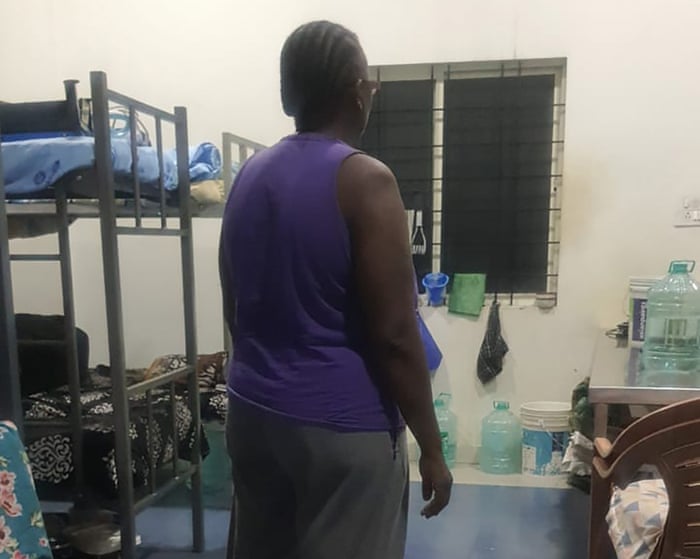
Across India, the foreign national detention system is absorbing entire families, including children. The Guardian has interviewed 22 women in three such detention centres who allege they are being detained indefinitely in poor and abusive conditions.
Many are victims of trafficking, who have ended up in foreigners’ detention centres after being picked up by police for visa infractions. They, and sometimes their children, are held for months or years with no timeline for release.
Mary has no access to her legal documents and no idea about the status of her case.
Peace*, her daughter, says attempts to seek help from the Kenyan high commission in Delhi and the Indian foreigners registration office (FRRO) have gone unanswered.
Peace and her siblings are struggling to survive. “I feel so depressed. Sometimes I just cry because she’s the only one we have after we lost our father,” Peace says over the phone.
Lily*, 27, a Ugandan survivor of sex-trafficking, has been held since she was arrested in a police raid in April 2025. At 3am, Lily and her sons, aged two and four, were woken by banging on the door. “My children woke up terrified. Before I could respond, nine policemen broke the lock and stormed in,” says Lily.
The officers said her visa was invalid and put the family into a van. “Three hours later, they dropped us at a detention centre near Bengaluru,” says Lily, speaking from the centre, where she is still being held more than a year later.
Her sons live with filth and constant mosquito bites, she says. Their playmates are the children of other African mothers awaiting deportation, from Uganda, Nigeria and Tanzania.
“Instead of being in schools, they are growing up in a cage. They need to read books, play games in the open and be children,” says Lily.
Lily was lured from the Ugandan capital of Kampala by the promise of a job, and trafficked into the sex trade in Karnataka in 2019, she says. After she escaped, she says she tried to live quietly with her children.
Lily has no way to contact officials to challenge her arrest or seek bail. Her passport remains confiscated and she has no access to her legal paperwork.
“Lawyers demand huge fees for empty promises of freedom, only to disappear. I have no income, no financial support and no family to turn to. I am all alone, and the thought of my children’s health and future terrifies me,” says Lily.
In 2025, a coordinated series of police crackdowns, called Operation Clean Sweep, began targeting African nationals including children in Delhi, Tamil Nadu, Hyderabad and other states.
According to human rights activists, many of those held are long-term victims of human trafficking, refugees or people with pending legal cases who are now locked in a system where missing documentationleads to lengthy imprisonment.
Liyi Marli Noshi, a lawyer who works on cases involving foreign nationals in India, says the legal system often fails to recognise “victims as victims”.
“When African nationals are detained, the first assumption is that they are illegal migrants who have overstayed their visas or are living without valid documents. The trafficking element is not properly investigated. Once this framing is established, it is incredibly difficult to shift the legal narrative back to victimhood or exploitation,” Noshi says.
According to Nirmala Walter, founder of the Delhi-based anti-trafficking organisation Manobal, women who survive trafficking – and their children born in India – face deep prejudice, a lack of documentation, limited healthcare and social exclusion.
“These children are losing their basic right to education and instead inheriting the consequences of human trafficking,” says Walter.
The Guardian has sought comment on the detained and deported, particularly African nationals, from the FRRO, the home affairs and external affairs ministries, the Ugandan high commission and the Delhi police. To date, there has been no response from any of the agencies.
In a Delhi detention centre, Yuvi*, a 24-year-old Nigerian, waits for news that never comes. What began as a promise of work and a better future unravelled into trafficking, sexual exploitation and indefinite detention.
A Nigerian woman lured her to India in September 2024 with the promise of a hairdressing job. Instead, she was forced into sex work and told she owed a “ransom” for her life.
“I had to pay 3.5m naira [£1,900] to her for my freedom,” Yuvi says. “After leaving that place, I finally started working as a hairdresser, hoping to build a new life.”
However, in May last year. Police stopped her while she was walking to buy water, asked for her documents and found her visa had expired.
“They put me inside a car, took me to the hospital for medical tests and then dropped me at this camp,” Yuvi says.
According to Yuvi, officials say only those with return tickets to their countries will be permitted to leave detention, otherwise they face indefinite incarceration.
She says she was cheated into paying 20,000 rupees (£160) to a centre officer after being promised assistance with a ticket home, but is still stranded months later. The same officer beat her with a stick, she says, showing photographs of her injuries.
“I’m tired and frustrated. All we hear now is that we will be sent home,” Yuvi says, “but no one can tell us when. I have no money now. I keep thinking of killing myself.”
* Names have been changed to protect their identities
View original source — The Guardian ↗
Related stories

TechRadar
TechnologyJul 2, 2026 · 1 min
‘Something has gone completely wrong’: Palantir CEO Alex Karp slams OpenAI, says AI industry is "effing insane"
TechRadar

TechRadar
TechnologyJul 2, 2026 · 1 min
Don't pay silly prices for DDR5 memory — Newegg's 4th of July sale is packed with unmissable RAM deals right now
TechRadar

TechRadar
TechnologyJul 2, 2026 · 1 min
Exclusive: Blood Message developer says latest trailer's glowing reception gives them 'confidence'
TechRadar

Wired
TechnologyJul 2, 2026 · 1 min
I Tried Rips, the Card-Pack App Where Users Spend Thousands Chasing Pricey Pokémon
Wired