Indian Express
Indian Express··3 min read
The Odyssey in Michael Caine’s AI voice? Why I’d choose a voice artist any day
It has been 76 years since the British actor Sir Michael Caine debuted in an uncredited walk-on role in the 1950 film Morning Departure; it would take him six more years to get his first role with dialogue. “They gave me a little part, about ten lines. Eight of which I screwed up,” he told BBC Radio 2, reminiscing about A Hill in Korea.
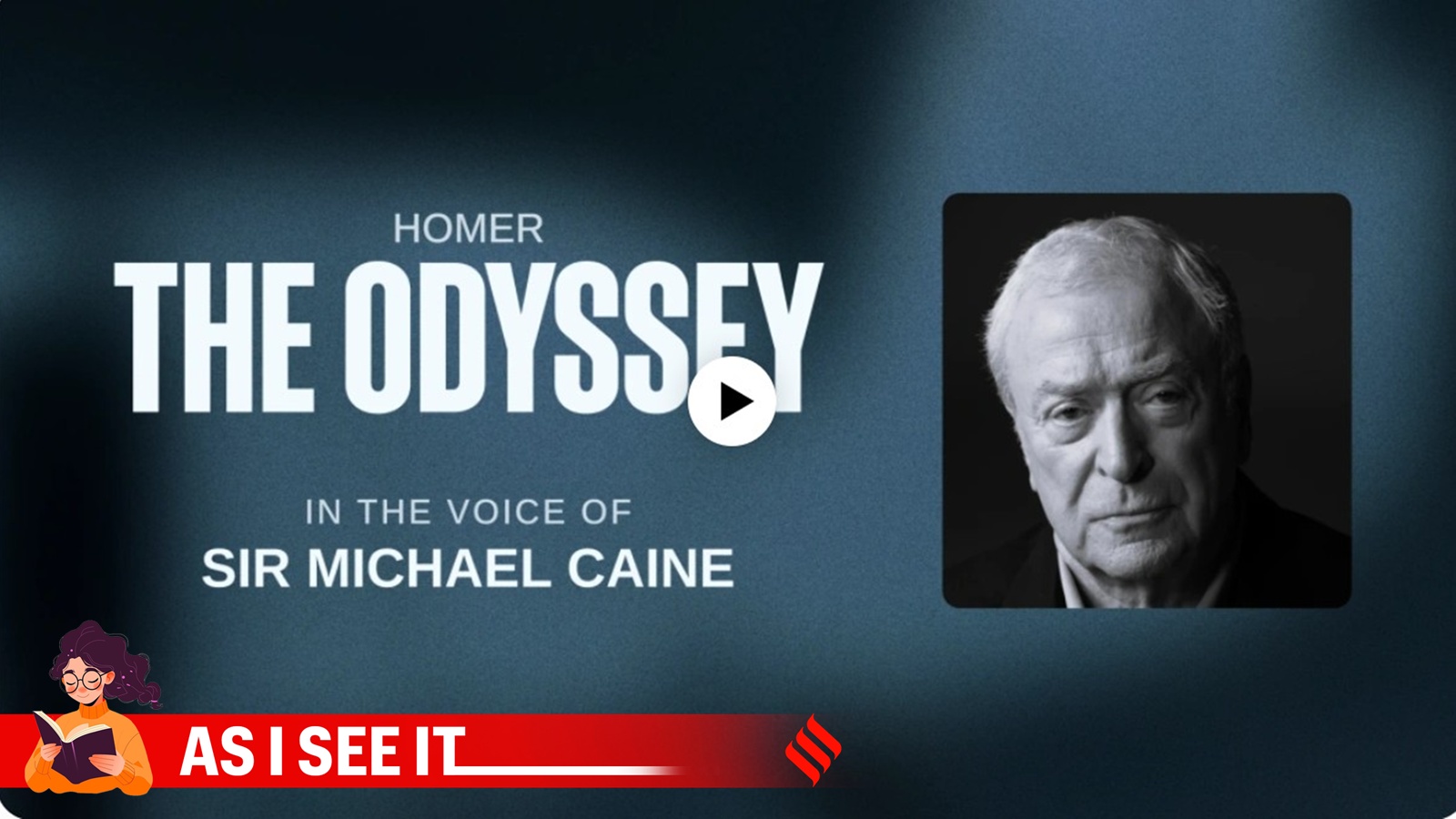
His gravelly baritone—a South London Cockney accent long associated with the working class—would become as recognisable as his person, with his catchphrase “Not a lot of people know that,” from his 1983 film Educating Rita, becoming popular among mimics. Now, the same voice—but, not quite—will enthrall through an audiobook those trying to reacquaint themselves with The Odyssey before Christopher Nolan’s adaptation releases on July 17. The catch is that the narration will only be an AI-generated simulacrum.
Reader, before you let loose a tirade against parasitic artificial intelligence companies, let me clarify that Sir Caine is absolutely on board with this and has given the company the right to use his voice. One might ask: as long as he has given permission, and is being compensated, what is the issue? The problem is that his acquiescence makes him an accomplice in the demise—or, if that’s too extreme a word, the decline—of human creativity.
It is not fair to pin this on him alone, for he is not the only one normalising AI narrations. Other iconic voices available on the platform include Maya Angelou, Alan Turing, Liza Minnelli, and Art Garfunkel. Their acquiescence helps normalise the plague of AI-generated audiobooks, and there’s the rub. While their personal legacies will be preserve, possibly allowing fans to reimagine other characters in their distinctive voices, on celluloid or in audio, even after they pass away, they have effectively helped shut the door on a new generation of voice artists who have not yet had the opportunity to build a personal brand or Sir Caine’s fan base—and who might never get that chance.
Imperfectly perfect
Besides, as Sir Caine rather self-effacingly put it in that BBC Radio 2 interview, the beauty of human creativity—and human narration is certainly an art—lies in its little flaws, perceived or otherwise. A slightly imperfect rhythm here, a mispronunciation there, and more than that, the ability to read a scene differently depending on how the artist feels in the moment—to render as a whisper what another artist might thunder, or to read grief slowly and softly where another might rush it—is the beauty of an audiobook, a play, or a popular character rendered by different artists over time. One imagines AI will certainly manage to capture the rhythm and cadence of his voice. It will never match his ingenuity as an artist, his ability to feel and react differently from what is expected.
An Indian example would be the superstar Amitabh Bachchan, who frequently lends his voice to public advisory calls, among other things. It is always exciting to hear his voice, but one would rather have him than an impersonator, and AI, however excellent a mimic, is no better than an artist’s duplicate, it does not have the same charm as the original.
Signing away one’s likeliness
The final season of the Lisa Kudrow-starrer The Comeback wrestled with the dilemma of an artist who signs her own death warrant when she inadvertently signs away her own likeliness, and ends up getting replaced on her own show. We are living in this dystopia, only artists are wilfully signing their likeness away.
Story continues below this ad
It is also ironic that an AI simulacrum is being used to narrate The Odyssey, of all books—that ancient classic whose precise origins scholars still cannot agree on, though they do agree it was first passed down as part of the Greek oral tradition, performed by bards scene by scene, before the epic was compiled in writing and preserved for posterity as a celebration of human imagination.
The Odyssey, which has stayed popular over centuries, gives me hope for the future of art and the artist. AI, too, is in its own way a leap of human imagination and enterprise, which is not so easily subdued. It will likely prevail. One assumes, though, that it will do so on the grave of a great many foiled ambitions—the narrators, mimics, and voice artists who never got the chance to add their ingenuity to a classic told down the ages.
(As I See It is a space for bookish reflection, part personal essay and part love letter to the written word. Views expressed are personal.)
View original source — Indian Express ↗
Related stories

The Punch
SportsJul 2, 2026 · 1 min
World Cup: LeBron James praises Balogun after ‘Silencer’ celebration
The Punch
The Punch
NewsJul 2, 2026 · 1 min
Iran urges huge turnout at Khamenei’s funeral to ‘avenge’ his death
The Punch
The Punch
NewsJul 2, 2026 · 1 min
Pilot who hit Beijing tower wrote about ending life – Govt
The Punch
The Punch
NewsJul 2, 2026 · 1 min
LASEMA debunks report of another Lagos building collapse
The Punch