Indian Express
Indian Express··4 min read
Liver transplant hinged on his 17-year-old son: How Delhi High Court gave rare nod
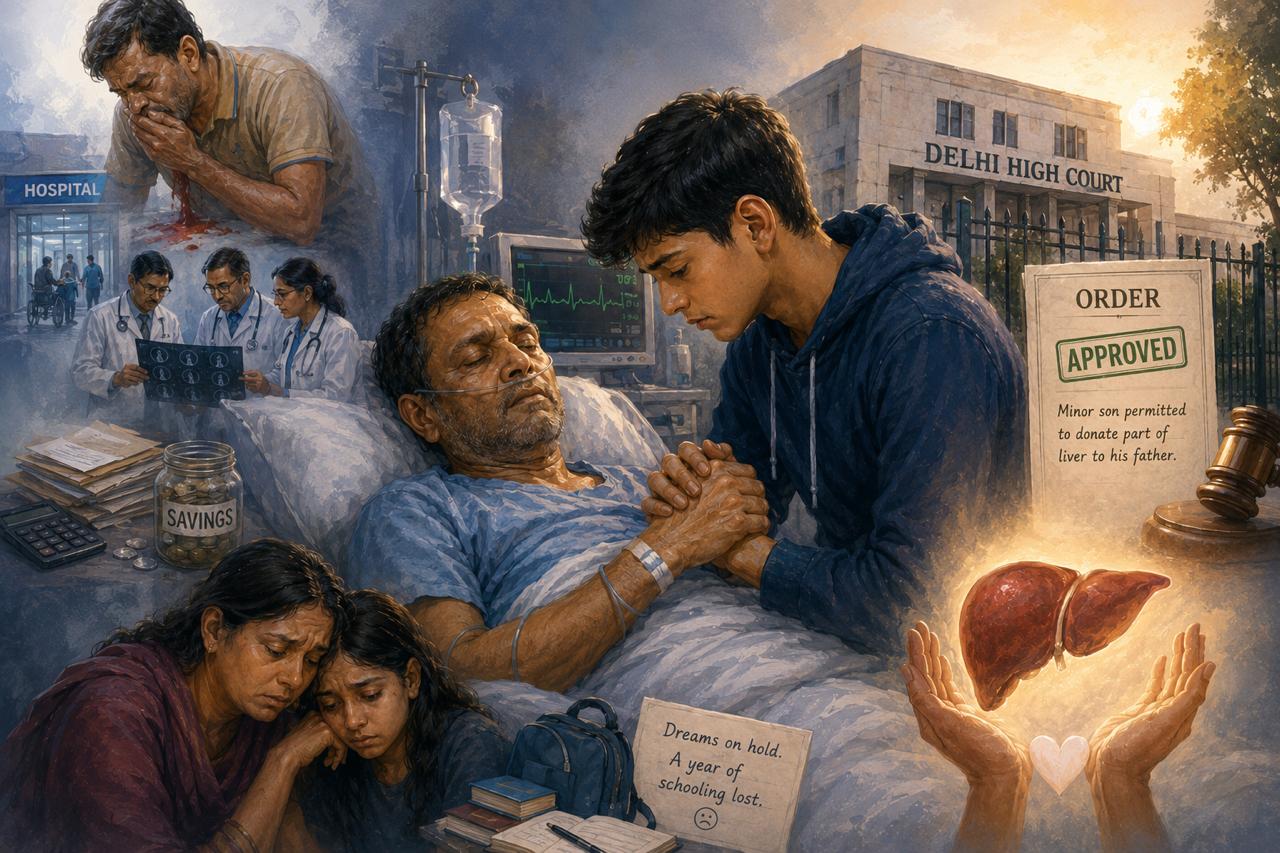
Uttam Kumar Shaw, 52, has been in and out of hospitals for six months.
His liver is failing. For the past 20 days, he has been admitted to the Institute of Liver and Biliary Sciences (ILBS) in Delhi.
A former state-level cricket player — he played for the Kolkata Police’s cricket team — he runs an electricals shop in Kolkata. In January, the family grew alarmed after he suddenly started vomiting blood.
A series of tests followed: CT scans and a biopsy, and the diagnosis came as a blow: Uttam had hepatocellular carcinoma, liver cancer caused by cirrhosis.
By the second week of February, his condition deteriorated rapidly, and he had to be admitted to the critical care unit of a private hospital in Kolkata. The hospital advised a liver transplant.
Uttam and his family then consulted another private hospital in Hyderabad, which gave them the same opinion.
In March, when Uttam had to be admitted again following incessant bleeds, the Kolkata hospital reiterated that he needed a transplant.
Story continues below this ad
This time, the family sought a second opinion from ILBS. The advice was no different: loco-regional therapy for the cancer and evaluation for a liver transplant.
But the hardest part lay ahead. Finding a donor, and finding one quickly, seemed nearly impossible.
There was only one person who could step forward: Shaw’s 17-year-old son.
While the Transplantation of Human Organs (THO) Act allows close relatives, including children, to be living donors, minors can be allowed to be donors only under exceptional circumstances and as prescribed by the government under the Act and its Rules.
So they moved the court in March.
Story continues below this ad
Finally, on June 29, the Delhi High Court came to their aid, permitting Shaw’s teenage son to donate a part of his liver for the transplant his father urgently needs.
A three-month ordeal
Speaking to The Indian Express, Sanjeev Kumar, Uttam’s brother-in-law, a practising advocate at Sasaram in Bihar, who has been assisting the family, described their ordeal.
“We realised that only his 17-year-old son can donate part of his liver,” he said. “No one else in the family was a match.”
On March 25, the son, through his mother, moved the High Court to allow him to donate a part of his liver to his father “in view of the life-threatening liver disease and hepatocellular carcinoma from which he is suffering and for which liver transplantation is the only viable and life-saving treatment”.
Story continues below this ad
“It was a hard decision to make for the family, but he was very clear that his father needed to be saved. There was no other option,” said Sanjeev.
In April, responding to the petition, the Centre, through the National Organ and Tissue Transplant Organisation (NOTTO), under the Ministry of Health and Family Welfare, said that while living organ donation by a minor “is not ordinarily permissible”, it is the Delhi government which is authorised to take a decision in such a matter.
The Delhi government would take nearly two months to give its assent.
A costly wait
For the family, the hospital admissions and visits have drained them of their savings — over Rs 20 lakh — even as the transplant surgery remains.
Story continues below this ad
Uttam is their sole earner. His son, who was studying at a school in Bhubaneswar in Odisha, had to drop out this year after appearing for his Class 10 Board examinations, said Sanjeev.
“One can recover from a year of missing school, but how will one recover from the loss of a father?” said Sanjeev.
Uttam also had to undergo TIPS (Transhepatic Intrajugular Portosystemic Shunt) surgery earlier in June, barely speaks now, and continues to battle with complications, said Sanjeev.
The surgery involves placing a stent that moves the blood away from the liver.
Story continues below this ad
Advocate Arvind Gupta, who was representing the minor before the Delhi HC and worked pro bono for the case, said the family has been running around for three months, waiting for approval, even as Uttam’s condition has deteriorated. “… This is not a first; such exceptions have been drawn by various courts earlier to allow minors to donate organs; the government should take a sympathetic view of such cases. A day’s delay only takes a toll on the patient and the family,” he added.
On June 29, the Union Health Ministry, taking into note the Lieutenant Governor of Delhi’s approval for the minor to donate a part of his liver, granted its assent for the procedure and communicated its decision to the ILBS.
The same day, Justice Mini Pushkarna, taking note of the Centre’s stance, reasoned that the balance of equities “overwhelmingly lies in favour of permitting the proposed liver donation and transplantation”.
Giving its green light for the procedure, the High Court further recorded, “In case, this Court denies such permission, it may lead to the loss of life of the petitioner’s father.”
Story continues below this ad
The court had also recorded in its order that ILBS shall now expeditiously fix a date for the operation.
Sanjeev said, “The hospital has not yet told us a date for the transplant. The donor tests that were done earlier are outdated now, and fresh tests will have to be conducted. Each day counts for us, and the court order is a ray of hope.”
View original source — Indian Express ↗
Related stories

The Punch
TechnologyJul 2, 2026 · 1 min
Court adjourns Emeka Ike’s N10bn suit against INEC, Wike’s aide
The Punch
The Punch
PoliticsJul 2, 2026 · 1 min
Labour Party unveils ₦2.8m essay competition in Abia
The Punch
The Punch
NewsJul 2, 2026 · 1 min
Jigawa opens 2027 Hajj registration, fixes N7.5m initial deposit
The Punch
The Punch
BusinessJul 2, 2026 · 1 min
FG to replace NYSC khaki with Adire
The Punch