Indian Express
‘My diamond button’: YouTuber’s power bank explodes, destroys room; expert shares safety tips
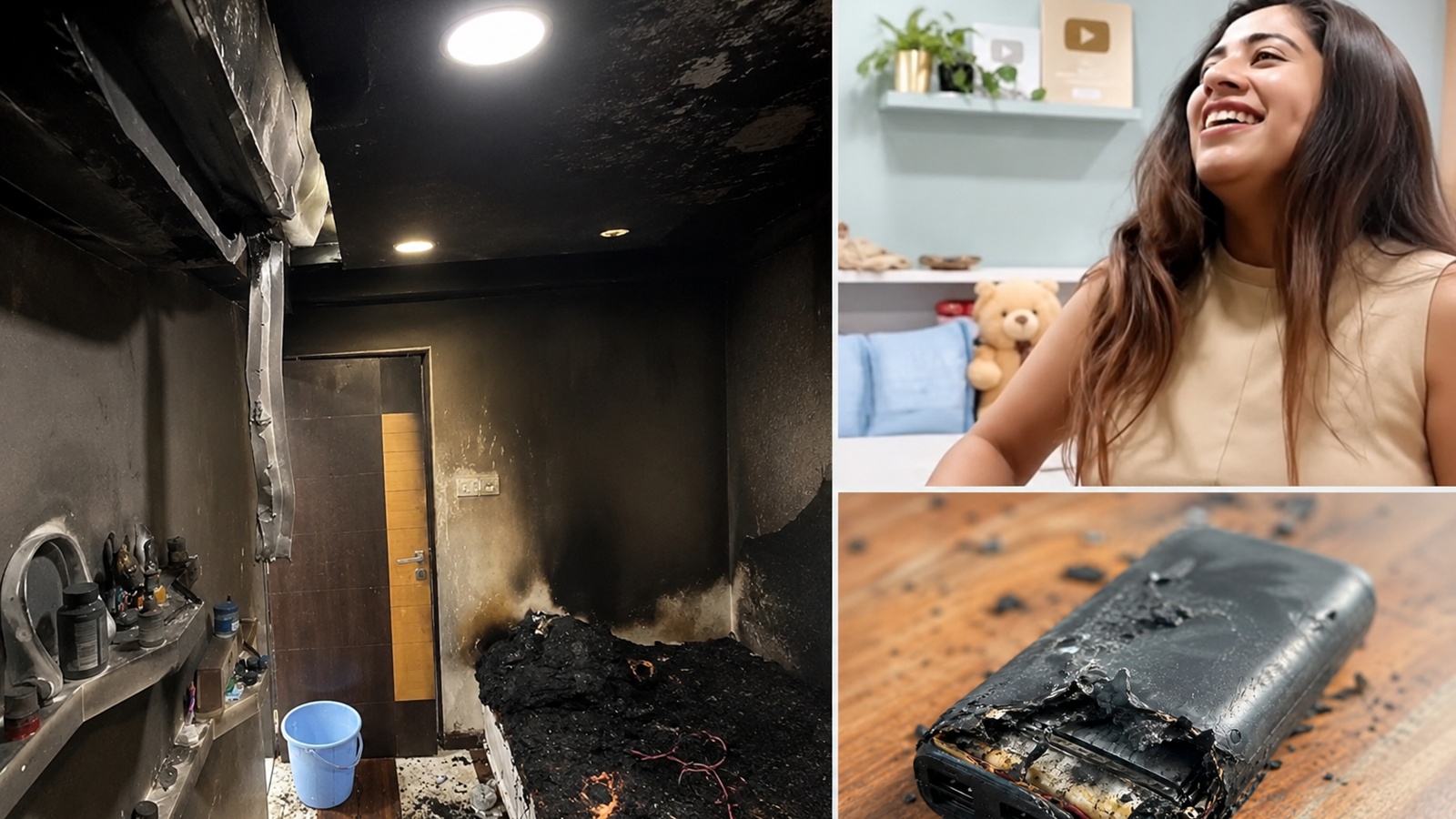
A Surat-based YouTuber, Shivani Kapila (known online as Little Gloves), documented how a wireless portable charger exploded in her bedroom, causing a devastating fire in late June 2026. “I had put a power bank on charge. It was a good company’s power bank that cost Rs 4,000-Rs 4,500. And it exploded. I had worked hard to make this room. I feel so demotivated. I don’t understand what my fault is. My dog was inside. He is very traumatised. The room is charred. The AC is gutted. I lost my hard-earned YouTube Silver, Gold, and Diamond Play Buttons. The blaze destroyed my clothes and bags. Everything is burned to ashes,” a crying Shivani expressed in an Instagram post.
DISCLAIMER: This article is based on information from the public domain and/or the experts we spoke to. Always consult your health practitioner before starting any routine.
Fortunately, no injuries were reported as her family and pet dog escaped safely. “This is a hard time… I lost so much to fire — my room … my diamond button .. my memories, but I don’t feel sad because my family.. my people are safe and are standing with me. It’s time to take this as a new beginning and restart again. I promise I will bounce back and fly higher,” Shivani captioned the post.
Taking a cue from this incident, we asked experts to understand electronic safety hazards.
Why do such explosions happen?
Mashmoom Zaheem, safety engineer, Abu Dhabi Ports Group, said portable chargers or power banks primarily rely on lithium-ion (Li-ion) batteries. “While highly efficient, these batteries are sensitive to physical damage, manufacturing defects, and extreme temperatures. If a battery is compromised, it can undergo thermal runaway—a rapid, uncontrollable increase in temperature that leads to fires, toxic gas release, or even explosions,” said Mashmoom.
Jeewan Mahadik, senior head, audit and consultancy, British Safety Council, India, said factors contributing to overheating include overcharging, exposure to high temperatures, using incompatible chargers, or physical damage to the device. “Overheating can start a chain reaction in the battery cells, leading to smoke, fire, or in rare cases, an explosion,” said Jeewan.
How to prevent such incidents?
*Buy certified: Only purchase chargers with safety certifications from recognised testing labs (e.g., UL, CE, or ETL). Avoid cheap, unbranded counterfeits, said Mashmoom.
Story continues below this ad
*Inspect for damage: Discard any portable charger that is swollen, dented, punctured, or excessively hot to the touch. “Find a dedicated E-waste or battery recycling center. Before that, you can store a swollen power bank in a stainless steel box. You can also drop off at retail stores (like major electronics outlets) that accept degraded lithium batteries,” said Mashmoom. When you drop it off, explicitly tell the attendants that the battery is swollen or damaged so they can safely store it in their designated hazardous bin, Mashmoom added.
*Don’t overcharge or leave unattended: Avoid leaving devices charging on flammable surfaces like beds or couches. Charge them on hard, flat surfaces that dissipate heat.
*Avoid extreme temperatures: Never leave power banks in direct sunlight, hot cars, or freezing environments, said Mashmoom.
Here’s what you should consider (Image: AI Generated)
Is this the case with other chargers?
Wall chargers and charging cables: Mashmoom said these do not store energy but handle electrical conversion and resistance. “Cheap, uncertified wall blocks or frayed cables can fail internally, causing electrical arcing (sparks) or overheating that can ignite surrounding materials like curtains, carpets, or bedding,” cautioned Mashmoom.
Story continues below this ad
Wireless chargers: These rely on electromagnetic induction, which naturally generates heat. “If the coils are poorly made or a stray metallic object gets between the phone and the pad, the heat can spike rapidly and melt the casing. So, always remove chargers once the job is done,” said Mashmoom.
Workplaces not just homes
Although such incidents are rare, they highlight the need for strong electrical and fire safety practices not just at homes but workplaces, too. Jeewan said, “Employers should make sure that battery-powered portable chargers are not kept in hidden spots like lockers, drawers, or bags, where early signs of overheating or smoke might go unnoticed. Keeping these devices in visible areas allows for quicker detection and a faster response if something happens.”
Organisations should also ensure that only original batteries and manufacturer-approved replacements are used in workplace devices, including laptops. “They need to replace and safely dispose of damaged or expired batteries. Workplaces should be equipped with the right fire safety equipment, including suitable fire extinguishers, so any battery-related fire can be contained quickly and prevented from getting worse. Together, these steps are essential for a safe workplace environment,” said Jeewan.
What to do if such an incident happens?
Dr Sundar Krishnan, senior consultant, internal medicine, KIMS Hospitals, Thane, said the main concerns after such incidents are burns, smoke inhalation, and injuries that can happen during panic. “A battery fire can cause anything from minor skin burns to deeper tissue damage if someone is holding the device or is close to it. The fumes released may also irritate the eyes, nose, and throat, especially in children, older adults, and people with respiratory issues like asthma,” said Dr Sundar.
If a power bank suddenly catches fire, what should people do first?
Story continues below this ad
The priority is safety. “Move away from the device and keep others at a safe distance. If it is safe to do so, disconnect the charger or turn off the power source. Avoid touching, picking up, or trying to cool a burning battery with bare hands. If the fire is spreading or producing heavy smoke, evacuate the area and call emergency services,” said Dr Sundar.
What should someone do if they sustain a burn from a battery fire?
Dr Sundar said that one should cool the affected area under cool running water for at least 20 minutes. “If possible, remove rings, watches, or tight clothing near the burn. Do not apply ice, toothpaste, butter, or any home remedies, as these can worsen the injury and delay healing. Cover the burn with a clean, non-stick cloth and seek medical help if there are blisters, severe pain, or a large area of skin involved,” said Dr Sundar.
When should a person seek medical help after such an incident?
Dr Sundar advised that one should seek medical attention if the burn is extensive, involves the face, hands, or eyes, or if there is trouble breathing, persistent coughing, dizziness, confusion, or if the person has received an electrical shock. Quick first aid and timely medical assessment can significantly lower the risk of complications and help with recovery.
Story continues below this ad
DISCLAIMER: This article is based on information from the public domain and/or the experts we spoke to. Always consult your health practitioner before starting any routine.
View original source — Indian Express ↗
Related stories

Variety
EntertainmentJul 2, 2026 · 1 min
How Jolin Tsai’s ‘Pleasure’ Finally Came Together, According to the British Producer Who Made It
Variety

The Hollywood Reporter
EntertainmentJul 2, 2026 · 1 min
Merger of Korean Cinema Chains Lotte and Megabox Collapses
The Hollywood Reporter

Indian Express
EntertainmentJul 2, 2026 · 1 min
Super Subbu review: Rural sex-ed comedy starts strong, but fails to give a satisfying finish
Indian Express

Indian Express
EntertainmentJul 2, 2026 · 1 min
Akshay Kumar sells four apartments in one month for Rs 20 cr; earns Rs 7 cr profit
Indian Express