Indian Express
Indian Express··4 min read
‘A new chapter’: India, Japan unveil roadmap on energy, tech, defence ties
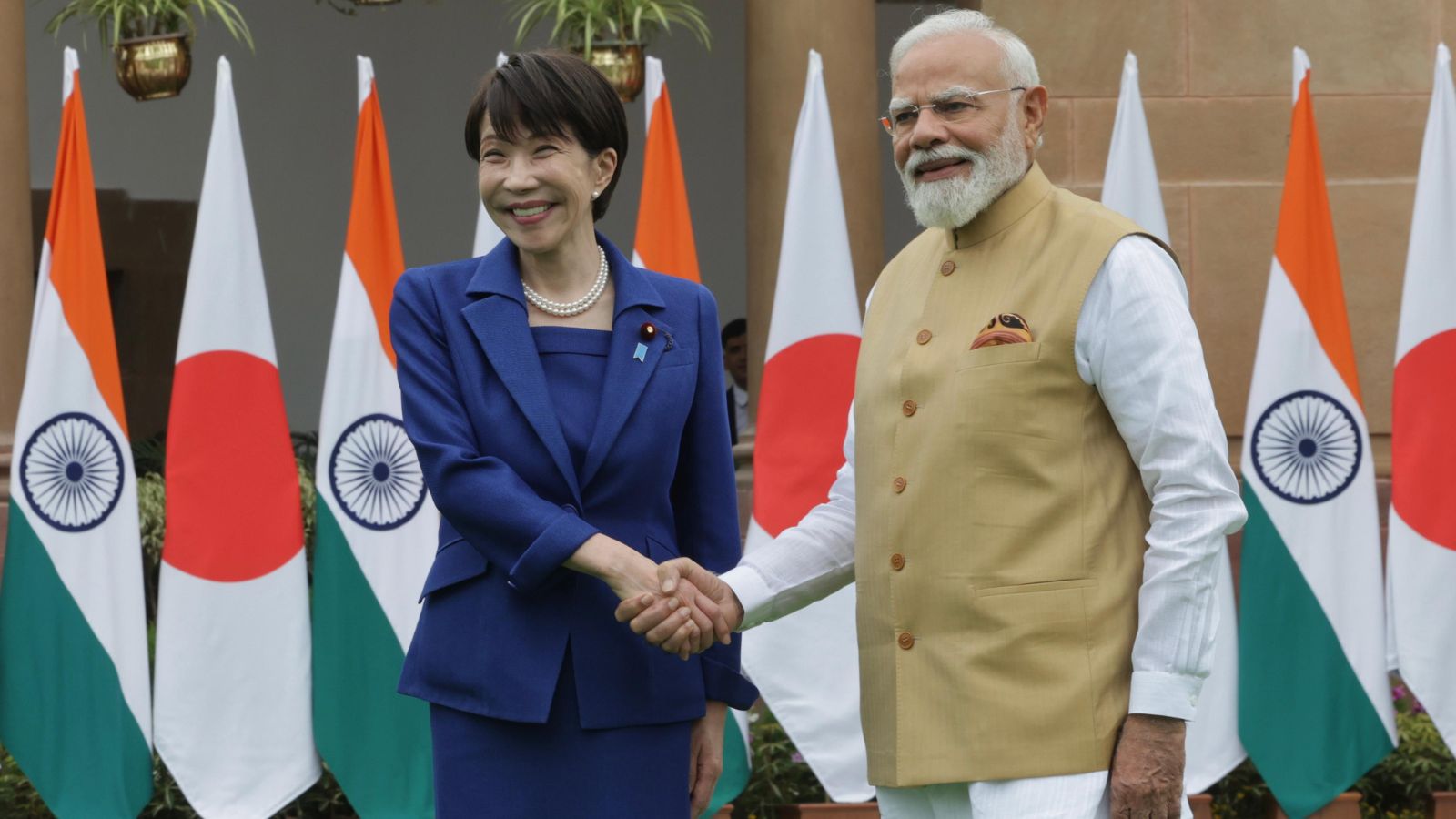
Prime Minister Narendra Modi and his Japanese counterpart Sanae Takaichi positioned economic and energy security as the defining pillars of the next phase of bilateral ties between the two countries. (Express Photo by Renuka Puri)
Amid global trade disruptions, concerns of economic coercion, and volatile energy markets, India and Japan on Thursday unveiled an expansive strategic partnership centred on energy security, resilient supply chains, and emerging technologies, while also stepping up defence cooperation to reinforce a rules-based order in the Indo-Pacific.
Prime Minister Narendra Modi and his Japanese counterpart Sanae Takaichi positioned economic and energy security as the defining pillars of the next phase of bilateral ties, announcing a joint roadmap on economic security, a new framework on mobility, an artificial intelligence (AI) partnership, and agreements spanning critical minerals, batteries, pharmaceuticals, and biogas.
The two sides also moved to deepen maritime and defence cooperation amid growing strategic competition in the Indo-Pacific, with plans for more naval exercises, defence technology collaboration, and an early convening of the India-Japan 2+2 ministerial dialogue.
“In the environment of global turbulence today, mutual trust is our biggest strategic asset,” Modi said, describing the visit as the beginning of “a new chapter” in the India-Japan strategic partnership.
Stressing that “economic security is shared security and energy transition is shared opportunity”, Modi said India and Japan had prepared a joint roadmap to strengthen supply chain resilience in semiconductors, quantum technologies, and advanced materials. He said the two countries had also launched an initiative to build 1,000 biogas and organic fertiliser plants in India, complementing the Centre’s GOBARdhan programme, besides expanding cooperation in batteries, green hydrogen and nuclear energy.
Takaichi linked the new initiatives to the changing geopolitical environment, saying both countries faced challenges arising from “economic weaponisation and non-market practices” and needed to urgently build resilient critical mineral supply chains.
She also referred to disruptions in global energy markets arising from the situation in West Asia and announced the launch of a bilateral dialogue to strengthen India’s petroleum stockpiling system. Japan, she added, would continue to support India’s bid for membership of the International Energy Agency.
Story continues below this ad
Modi referred to Takaichi as his “younger sister” and highlighted her roots in Japan’s Nara Prefecture, which he noted shared historic Buddhist linkages with India. The Japanese Prime Minister responded, saying, “You called me a beautiful younger sister, Prime Minister Modi, but at the small meeting before the big meeting, we confirmed that we are on the same page and develop this relationship as brother and sister. Japan and India must leverage our respective strengths to become stronger and more prosperous together.”
Rules-based Indo-Pacific a priority
The two leaders also underscored concerns over preserving a rules-based order in the Indo-Pacific. Modi said a “free, prosperous and rules-based Indo-Pacific” remained a shared priority for both democracies, while announcing an agreement on the India-Japan Core Development Project under the Naval Radio Antenna Unicorn programme, which he said would “open a new chapter” in bilateral defence cooperation and contribute to regional peace, maritime security, and the rules-based order.
Takaichi said Japan’s updated vision for a Free and Open Indo-Pacific and India’s MAHASAGAR initiative reflected common strategic objectives, adding that maritime security was “especially important” for regional peace and stability.
She announced that a destroyer of the Japan Maritime Self-Defence Force and Indian naval vessels would undertake a joint exercise, with the two sides also expanding cooperation on naval maintenance and repair, defence equipment under the Make in India framework, and other security initiatives.
Story continues below this ad
Technology, the ‘strongest pillar’
Calling technology cooperation the “strongest pillar” of future ties, Modi said the two countries had issued a joint statement on AI, while several institutions associated with the IndiaAI Mission signed agreements with Japanese partners. “The coming together of Japan’s precision technology and India’s software capability will give new speed and strength to global AI development,” he said.
Ahead of the leaders’ joint statement, the two governments exchanged agreements covering economic and energy security, including cooperation in geological and mineral exploration, pharmaceuticals and medical devices, batteries, biogas and organic fertilisers, as well as collaboration between the IndiaAI Mission and Japan in artificial intelligence.
10 trillion yen investment target
The leaders also reaffirmed their economic ambitions. Modi said nearly 120 new business agreements had been concluded over the past year, expected to bring investments of more than $10 billion into India. He reiterated the target of attracting 10 trillion yen in Japanese investment over the next decade while doubling the number of Japanese companies operating in India.
The two sides also unveiled an India-Japan Mobility Partnership Framework aimed at expanding cooperation beyond the automobile sector into shipbuilding, aviation and logistics, alongside greater collaboration in research, education, startups, skilling and talent mobility.
View original source — Indian Express ↗
Related stories

ESPN
SportsJul 2, 2026 · 1 min
Ranking the 50 best players in the WNBA
ESPN

The Punch
NewsJul 2, 2026 · 1 min
Court affirms David Mark-led ADC leadership, dismisses Abejide’s suit
The Punch
ESPN
SportsJul 2, 2026 · 1 min
Taylor Swift and Travis Kelce's wedding (FAQ versi...
ESPN

ESPN
SportsJul 2, 2026 · 1 min
All of the special MLB July 4 uniforms and caps
ESPN