Indian Express
At 38, Messi has stopped running. That is what makes him impossible to stop
Lionel Messi scored zero World Cup goals at 23. He has scored 19 in six tournaments since then. Something about the conventional story of athletic decline does not apply to him. The question worth asking is not how long he can keep going. It is why he keeps getting better.
Against Austria, he missed a ninth-minute penalty, then scored twice to break Miroslav Klose’s all-time World Cup record. He then came off the bench against Jordan to ping in a free kick.
Watch the record-breaking goal against Austria. Messi receives wide, near the touchline, with two Austrian defenders close. He does not dribble or run, playing it first time to the other side of the pitch, creating a four versus two, already moving to the near post before the ball leaves his foot. Every defender in that block had already shifted towards him. That fear created the space on the other side. Messi standing still in the right place is the most dangerous thing happening on a football pitch.
Most players run and then deal with the ball. Messi runs as though the ball is not there, as though controlling it costs nothing, takes nothing from the stride. At full pace he moves the way other players move when unburdened. The ball simply accompanies him.
Joao Pedro, who faced him at the Copa America, explained it on Rio Ferdinand’s YouTube channel. “It’s difficult to explain him, you know? He’s not tall, he don’t look strong, but he hold players, he don’t drop, he stay there. The team run for him. Every ball they getting back, they pass to Messi. You know, he move and they come. It’s like how you say, magic.” He paused. “If he get the ball near to the area” [laughter] “problems”.
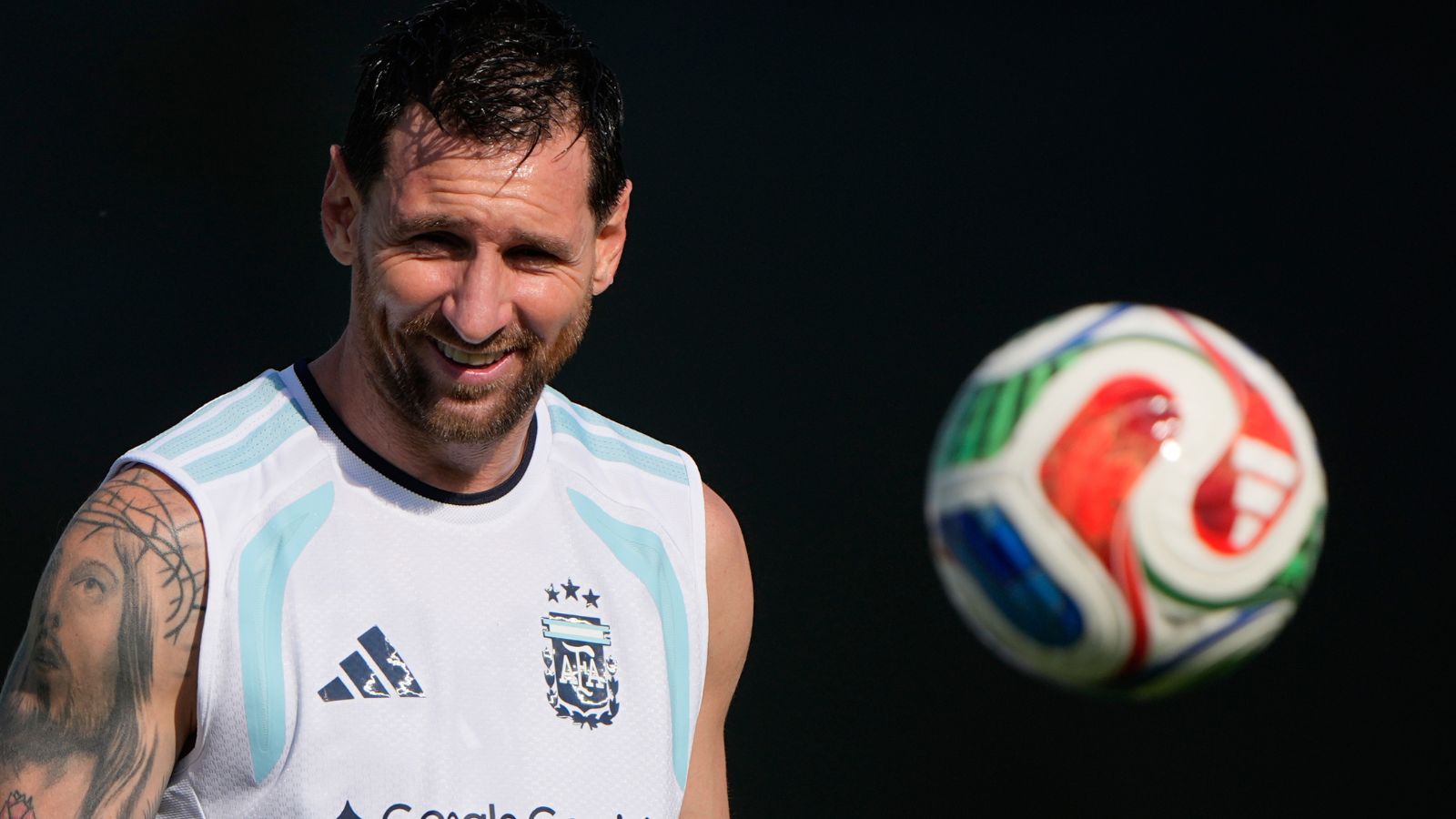
Lionel Messi is playing for Inter Miami. (FILE photo)
“At Inter Miami, and across the 2024 Copa America, Messi walks more than he runs,” Guillem Balague, the Spanish football writer and Messi biographer, wrote for the BBC. “Critics once used this against him. Now it reads as mastery.”
***
It did not start as walking.
The first version of Messi was the teenage winger at Barcelona, explosive and direct from the right flank, relying on acceleration and elasticity. Both were finite. Guardiola understood this before Messi did. On May 2, 2009, at the Santiago Bernabeu, he pulled him off the right wing and placed him at the tip of the attack: drop, receive, decide. By full time it was 6-2.
Story continues below this ad
“I didn’t used to pay much attention to tactics,” Messi told journalist Juan Pablo Varsky in 2024. “But with Guardiola I learned an enormous amount. I started to understand spaces, ball retention, how the game really works.”
Then Xavi left Barcelona in 2015, and Iniesta in 2018. The midfield that had been his safety net was gone. He dropped deeper. Assists began to rival goals. A goalscorer had become Iniesta.
“Football changed a lot,” he told Zinedine Zidane in a 2023 interview. “The game today is much more tactical and physical than before. Before, you found more spaces.” He said it like someone who had spent fifteen years finding spaces nobody else saw.
Three consecutive finals lost. The retirement that wasn’t. Then the Copa America 2021 release in the Maracana. By Qatar 2022 the burden had become fuel: seven goals in seven matches, twice in the final. He hoisted the World Cup.
The walking Messi is not decline. It’s distillation.
Story continues below this ad
The numbers agree. Messi has covered 17.23 kilometres at this World Cup, 6.95 per ninety minutes, one of the least among all 618 outfield players with 90-plus minutes in the group stage. Nearly two-thirds of that distance, 10.64 kilometres, was walked. Mbappe has covered more than double Messi’s total and still spent under half of it walking. Haaland’s figure is lower still. The two men chasing him for the Golden Boot have had to run for their goals, sprint for them, chase them down. Messi has only walked, as if none of it concerned him, and still averages one every 37 minutes.
***
Distillation presents different problems to different opponents. Here is what the craft is built to solve.
Against Brazil, a man who walks through matches will have no tell: no acceleration to read, no shift in the shoulders to spring the trap. The moment one midfielder commits, the ball will already be gone, first time, into the space behind him. Brazil know this. In 2021 he won the Copa America in the Maracana, on their ground, in their final. The hunt has caught him before. It will need to catch him again.
Lionel Messi in action. (FILE photo)
Against Spain the high line will be an invitation, but not for Messi to run. Alvarez does that now. Their centre-backs will face the dilemma Real Madrid faced that night at the Bernabeu: step up to him and leave space, or hold and give him time to think. Guardiola had just repositioned him then. Seventeen years later, the position has changed again. Neither answer has kept up.
Story continues below this ad
Against France the problem starts with speed: Mbappe in behind, wide players who punish any team that commits high, a counter press that suffocates slow build-up. But a man who has walked through ninety minutes has spent nothing, and Mbappe at the other end does not solve what Messi does at this one. France had no answer in 2022 when they needed one in the final. They will need a new question now.
***
That is the theory. What actually happened started twenty years earlier.
He scored his first World Cup goal on June 16, 2006, at eighteen. Twenty years later, to the day, on June 16, 2026, his hat trick against Algeria came against a goalkeeper named Luca Zidane, Zinedine’s son, now 28. Zinedine’s last World Cup was Messi’s first.
Zero goals at 23. Nineteen in six tournaments.
Pablo Aimar, his childhood idol, once said: “The last Messi is always the best Messi.” When Aimar said it he wasn’t guessing. He had been watching since Rosario.
( — With stat inputs from Shuvaditya Bose )
View original source — Indian Express ↗
Related stories

ESPN
SportsJul 2, 2026 · 1 min
Ranking the 50 best players in the WNBA
ESPN
ESPN
SportsJul 2, 2026 · 1 min
Taylor Swift and Travis Kelce's wedding (FAQ versi...
ESPN

ESPN
SportsJul 2, 2026 · 1 min
All of the special MLB July 4 uniforms and caps
ESPN

ESPN
SportsJul 2, 2026 · 1 min
Winners and losers from NBA free agency week: Maki...
ESPN