Indian Express
In Your Neighbourhood: At 122, this Chor Bazaar family business keeps Mumbai’s antiques alive
At Dadabhai & Sons in Chor Bazaar, almost nothing is sold the way it arrives.
Inside the Jamnadas Building on Mutton Street in Chor Bazaar, the 122-year-old family-run shop is packed with industrial lamps, antique fans, barber chairs, brassware, mirrors, and furniture dating from the 1920s to the 1970s.
But what customers see on display is only the finished stage of a painstaking restoration process.
“We buy things, and we restore them. It’s a business, but along with the business, it’s a passion,” said Husain Furniturewala, who runs the shop with his two brothers.
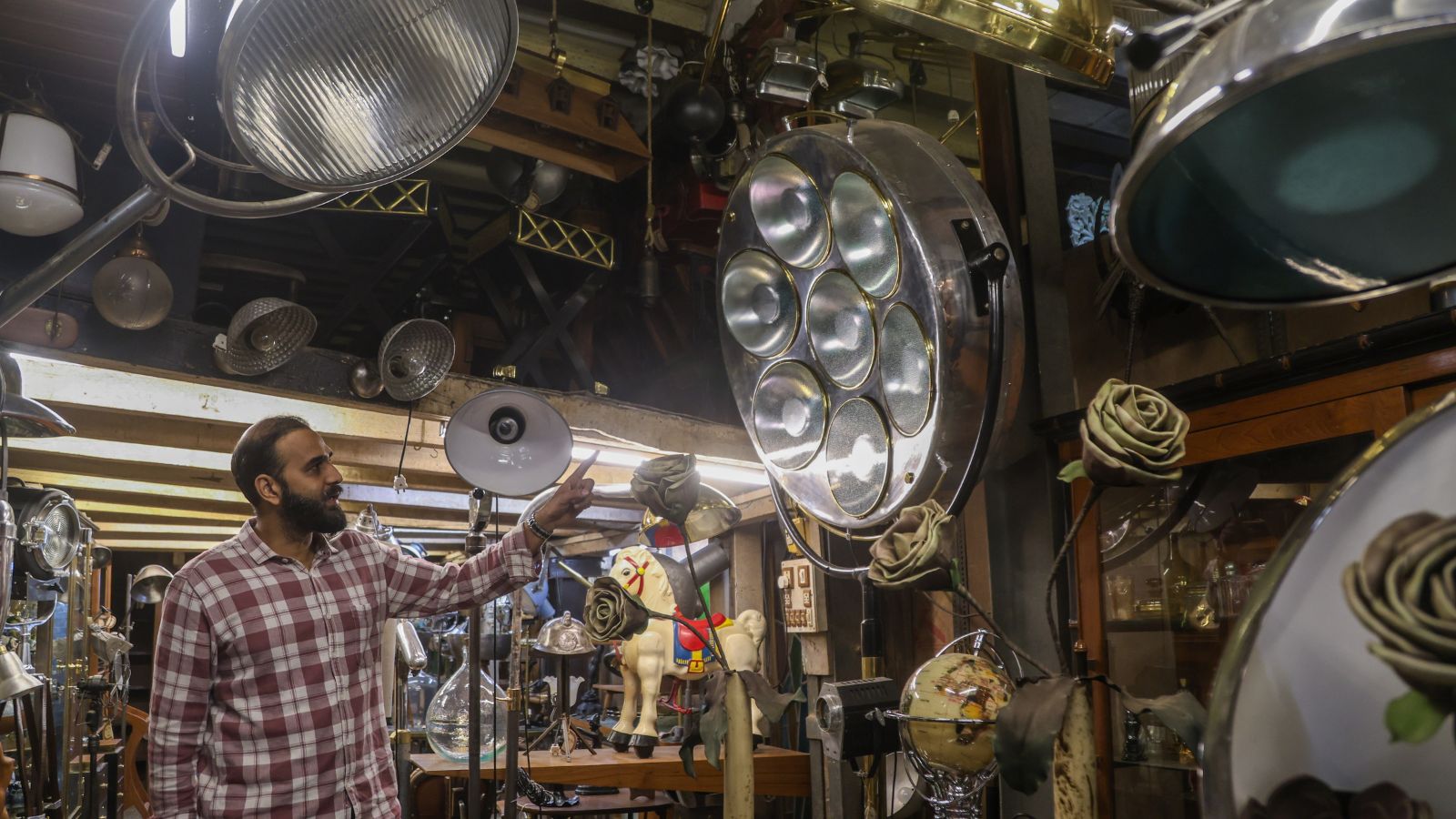
A restored vintage surgical operating light stands among curated antiques at Dadabhai & Sons, reflecting the family’s focus on preserving rare industrial and medical artefacts.
(Express Photos by Akash Patil)
Every object that enters the workshop is stripped down completely before being rebuilt.
Some restorations stretch close to a month, depending on the condition of the piece.
The emphasis, Husain said, is on preserving the original character rather than making it look new.
Explaining the process, he said every lamp is taken apart screw by screw before being polished and rewired. Wooden furniture demands even greater care.
Story continues below this ad
“We scrub out every last screw and wire, polish it completely, and only then does the beauty come through,” he said.
“If I just polish it from top to bottom, it won’t look good. You have to be able to see the grain.”
From a 1904 trading shop to Bollywood’s favourite prop house
The business traces its roots to 1904, when Husain’s great-grandfather, Mohammadali Dadabhai, opened a furniture trading shop. By the 1960s, under the next generation, the business had become a familiar name in Hindi cinema, supplying furniture and props for elaborate film sets.
A wide range of restored antique furniture, industrial lighting, and vintage décor pieces lines the interiors of Dadabhai & Sons, a 122-year-old family-run shop in Mumbai’s Chor Bazaar. (Express Photos by Akash Patil)
“We specialised in hospitals, casinos, bars. We used to set up all of these,” Husain recalled. “We used to set it all up ourselves.”
Story continues below this ad
The work brought some of Bollywood’s biggest names to the family’s warehouse. Husain remembers actors such as Raj Kapoor, Feroz Khan, and Amitabh Bachchan visiting to select antique pieces while spending hours chatting with his grandfather.
As film productions gradually began building their own sets, demand for rented furniture declined. Around 2004, the family reinvented itself again, making industrial antiques and Art Deco restoration the centre of the business.
“He got a project from a client who wanted a certain finish on a piece. He dismantled it, refinished it, reassembled it, and showed it to me. I started liking the process,” Husain said. “I said we could do this too, and that’s how we began.”
Among the workshop’s prized possessions is a delivery table from around 1910, complete with an adjustable backrest and leg supports, restored over three months.
Story continues below this ad
“Even if you found one somewhere else, I doubt it would be in this condition. Nobody restores things to this level,” Husain said. “I don’t even know how many of these pieces still exist, maybe ten or fifteen, and even those wouldn’t be in this condition.”
Nearby are a dentist’s chair from around 1890, an early studio lamp manufactured by RRB, and a Murphy radio that still functions after servicing.
Sourcing antiques across India
Finding antiques often takes the family across India.
“It isn’t fixed to one place. Many times we get a call, and then we travel, but only within India,” Husain said, adding that they source pieces through a network of dealers spread across different states.
The family also ships antiques to buyers overseas, although freight costs often determine what foreign customers eventually purchase.
Story continues below this ad
“They love to buy, but the shipping is the problem,” Husain said.
For trusted clients renting antiques, the family often waives the security deposit. For Husain, it reflects a relationship built over generations rather than a business decision.
“It’s not really about the money. It’s that some people don’t take care of the pieces,” he said. “These are like our own, we’ve raised them, in a way.”
View original source — Indian Express ↗
Related stories

BBC
TechnologyJul 2, 2026 · 1 min
Could a heatwave hit Taylor Swift's wedding?
BBC

The Guardian
TechnologyJul 2, 2026 · 1 min
Defra breached law when it let farmers use bee-killing pesticide, watchdog says
The Guardian

Ars Technica
TechnologyJul 2, 2026 · 1 min
Ars Live recap: When are the big rockets NASA desperately needs going to be ready?
Ars Technica

Indian Express
TechnologyJul 2, 2026 · 1 min
Wanted in Salman Khan house firing case, Anmol Bishnoi moves court to surrender
Indian Express