Times of Israel
Survivors rail at government on 1,000th day since Oct. 7: ‘They’ve never taken responsibility’
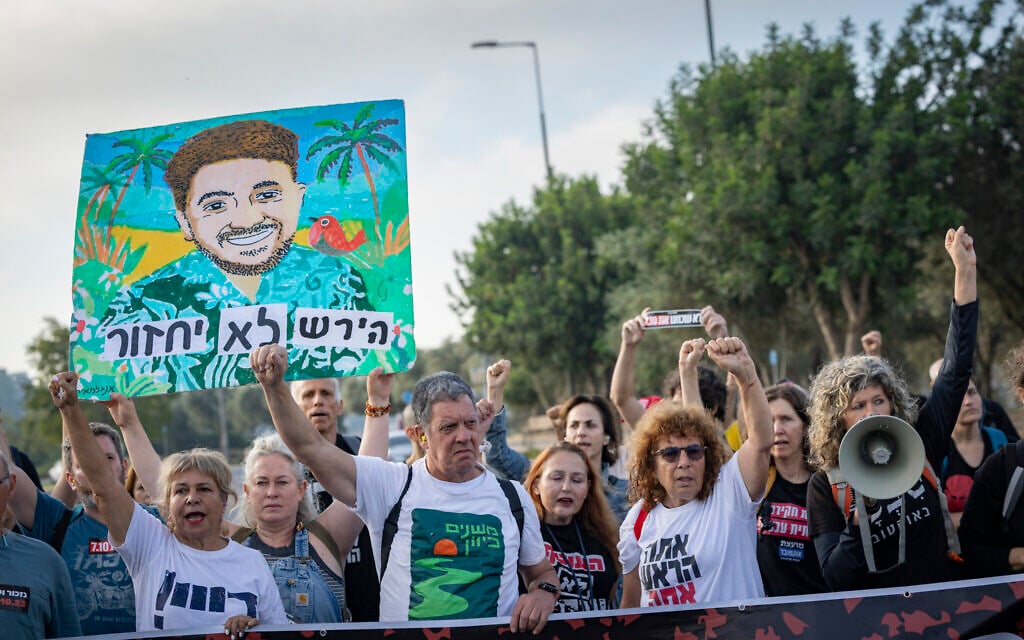
Protests and unofficial memorial events were held throughout Israel on Thursday to mark 1,000 days since the October 7, 2023, Hamas-led assault on Israel, which killed 1,200 people and triggered wars that have killed hundreds more, with survivors and family members accusing the government of completely failing to take responsibility for the massacre.
Many events were themed around anger at the government for not acknowledging culpability for the failures that enabled thousands of terrorists to invade the south of the country, massacring roughly 1,200 people and abducting 251 people as hostages to the Gaza Strip. It was the worst terror attack the country has ever suffered and by far the biggest single-day slaughter of Jewish people since the Holocaust.
The October Council, a group of bereaved families, October 7 survivors, and some former hostages, organized some of the key events to mark the occasion.
The organization — which is sharply critical of the government’s failure to prevent the Hamas invasion and its refusal to form a state commission of inquiry — opened the day’s events at 6:29 a.m., the exact time that the attack began 1,000 days earlier, with a series of protests, including at numerous junctions.
The focus of many of the protests was the government’s refusal to set up a state committee of investigation, the country’s most powerful investigative body, to investigate the failures of Oct. 7. The government claims that due to its efforts to curb the powers of the judiciary, a state committee, appointed by the Supreme Court, will be biased against it. It has sought to form a government-appointed commission. Critics say the government fears it will be blamed for the disaster and is outraged that it seeks to appoint its own investigators.
Get The Times of Israel's Daily Edition
by email and never miss our top stories
By signing up, you agree to the terms
At Re’im, in the south, families of victims held a memorial event at the scene of the Nova music festival massacre, where invading Hamas gunmen murdered 361 people amid acts of brutal sexual violence.
1000 ימים לטבח | יורם וסיגל יהודאי בטקס זכרון במקום בו נרצח בנם רון בפסטיבל הנובה
????חדר מלחמה • עדכונים שוטפים בווטסאפ ???? > https://t.co/1xUr5HrvV2 | ????️ לתמיכה בעיתונות עצמאית-ליברלית: https://t.co/e362Hp58gz pic.twitter.com/oPzU7h6F9F
— Dave Acting Now???????????????? (@DaveActNow) July 2, 2026
Yoram Yehudai, father of Nova festival victim Ron Yehudai, said at a memorial held there: “Above all, it’s a thousand days without Ron, a thousand days of a rent heart. A thousand days for the bereaved families, a thousand days of torment inflicted on the people. A thousand days of not knowing what happened and how it happened.”
Nissan Calderon, a survivor of the massacre and brother of former hostage Ofer Calderon, accused the government of doing everything to make the country forget the day during a speech at a memorial site for observation soldiers near the Gaza border.
“But we are here, at this point, in front of the Gaza Strip, and we won’t let anyone forget October 7, the worst massacre to occur in this country,” he said, vowing that residents would rebuild the communities destroyed during the brutal assault.
“After three years, we returned to Kibbutz Sufa, as if nothing had happened. The enemy is still beyond the fence. Those responsible for the massacre have not taken responsibility. As if nothing happened here. And the cover-up continues day by day,” he added.
Esther Buchshtab, the mother of Yagev Buchshtab, who was abducted and murdered in Hamas captivity, said at a protest outside the IDF headquarters in Tel Aviv: “One thousand days have passed since the abandonment began. Military pressure did not save hostages — it harmed them. But the government continued on its path and failed to see the people who were there.
“We, who lived through the massacre and experience its devastation and loss every single day, will neither forget nor give up on the demand for a state commission of inquiry to investigate and explain what happened on the day of the disaster and what has happened since. We have returned to the kibbutz and still don’t know what caused the disaster of October 7 or how to prevent the next one. In the grief and pain I live with, I am not seeking revenge. I am seeking hope — hope for my family, for the people around me, and for Israeli society.”
Also at that rally, Danny Elgarat, the brother of murdered hostage Itzik Elgarat, said: “For a thousand days I’ve heard over and over again people saying, ‘The hostages have returned.’ Not all of them have returned.”
Elgarat said, “Those who came back alive returned. Those who were kidnapped alive, abandoned in captivity, murdered, and brought back in a coffin — did not return. My brother Itzik did not return. Itzik was kidnapped alive and could have come back alive, but he was abandoned to die. And what came back to us was not my brother. What came back was a body, and no one will ever be able to blur that truth.”
In Jerusalem, footage showed protesters scuffling with police near the Knesset, where a demonstration was held.
עימותים בין מפגינים לשוטרים במחאה מול הכנסת לציון 1,000 ימים לטבח 7 באוקטובר
(קרדיט: אורנה קופרמן) @VeredPelman pic.twitter.com/QVXE4SHcF9
— כאן חדשות (@kann_news) July 2, 2026
The October Council had also called for a nationwide moment of silence at 10 a.m. to remember the October 7 massacre. That time of day is also the time in which a siren rings out nationwide on Israel’s Holocaust Memorial Day each year. At 11 a.m., the organization opened an exhibit in Tel Aviv presenting 1,000 personal items that belonged to those killed or kidnapped that day.
At Tel Aviv’s Hostages Square, footage showed the moment of silence being marked by survivors and the families of those murdered and kidnapped during the massacre.
1000 ימים של שבעה – עוצרים אל המדינה.
דקת דומיה בכיכר החטופים, בהשתתפות משפחות נרצחים, חטופים ושורדי שבי
בית אריאלה ת"א pic.twitter.com/fEcjKdHWdv
— מועצת אוקטובר (@OctoberCouncil) July 2, 2026
Also on Thursday, President Isaac Herzog and First Lady Michal Herzog hosted survivors and bereaved families from Kibbutz Kerem Shalom at the President’s Residence, according to a readout from Herzog’s office.
Herzog called the day “a milestone that reminds us of Israel’s ability to emerge from crisis and unimaginable pain — to remember and never forget.”
“This is the story of Israeli resilience. The enemy made no distinction between us — not between one opinion and another, nor between those who wear a kippah and those who do not. It came to destroy all of us. Our answer, and our true victory, lies in rebuilding, in restoring our communities, and in returning to the kibbutzim,” he said.
Yigal Moskovitz, chairman of the Kerem Shalom community committee, added: “Today, the kibbutz has the same number of members it had on October 7, and more families are expected to join us. That is Israel’s victory.”
Nearly 90 percent of pre-October 7 residents have returned, and six new families have arrived at Kerem Shalom — one of the communities that were worst affected by the massacre — as of last September.
David Habaz, a survivor of the attack and the kibbutz’s longest-serving farmer, told Herzog at the event that “returning to the kibbutz is the most important thing we’ve done. But emotionally, even after one thousand days, I still haven’t truly returned. The fears are still there, including the fear of what is still happening beyond the fence,” referring to the border with Gaza, where Hamas remains armed and in control of most of the Strip’s population (though the IDF holds a broad security zone inside Gaza and along the border).
Deputy minister blames left for Oct. 7 massacre
Meanwhile, Deputy Minister Almog Cohen blamed the left for October 7, arguing that some reservists’ threats that year to refuse to show up for reserve duty — due to the government’s judicial overhaul efforts — led to the worst massacre of Jews since the Holocaust.
Cohen dismisses Thursday’s protesters as “the far left.”
“We don’t need you to remember” what happened on October 7, the far-right politician declared in a video posted to his X account. “We remember every day the refusal that you brought upon us in this disaster. How on that same morning, you stayed in your homes. You didn’t even go out to help anyone.”
Cohen’s claim was a falsehood. Israelis from all political backgrounds and all walks of life rushed to help the south that day.
“How days before that, you said ‘You have no army and you have no air force.’ How, in your ultimate audacity, you took the future of our children, their security, and compromised it for some political payoff,” he charged.
“We will not forget and we will not forgive Shikma Bressler, Brothers in Arms, Yair Golan and Gadi Eisenkot,” he said — referring to a prominent anti-government activist, a leading protest group, the head of the left-wing Democrats party, and the chief of the Yashar party. “They literally sacrificed our children to Hamas. The People of Israel live, do not forget, and do not forgive.”
Golan, a retired IDF general, was celebrated for rushing south to rescue people with his car on October 7. Eisenkot lost a son who fought in the ensuing war. Brothers in Arms was among several civil society groups that redirected their resources on October 7 to aid those in need during and after the massacre.
Netanyahu, Smotrich, assailed by Oct. 7 survivors
Former hostage Eli Sharabi lamented recent “embarrassing” and “impertinent” comments from Prime Minister Benjamin Netanyahu and Finance Minister Bezalel Smotrich about the onslaught, during which he was taken captive and his wife and daughters were killed.
Netanyahu, in an interview with the right-wing pro-government Channel 14 this week, joked that what October 7 changed about him was that he has “lost a little weight,” sparking outcry from political opponents and others for ostensibly making light of the attack.
Smotrich, two days prior, claimed credit for the return of all the hostages held by terror groups in Gaza, despite having repeatedly voted against deals that would have seen them released earlier.
“This was another embarrassing statement from people who claim to be the leaders of Israel and for the people of Israel,” Sharabi told Kan about Netanyahu’s Channel 14 interview.
Smotrich’s comments, Sharabi said, were “impertinent.”
“October 7, and many days after it, became days of disaster and national mourning for thousands of families. Statements of this kind are simply impertinent.”
Additionally, former hostage Omri Miran told Kan radio that Smotrich “should stop talking nonsense. He bragged about having torpedoed so many hostage deals. It’s possible that more hostages who could have been with us today were murdered there.”
Miran said Netanyahu should “take responsibility and start dealing with what taking responsibility actually means — instead of focusing on the draft exemption law for Torah scholars just to buy yourself another two weeks in power.”
Elad Or, whose brother Dror Or was murdered on October 7 with his body seized and taken to Gaza, also said of Smotrich’s claim on Kan: “It’s such a huge lie. It’s part of the campaign the government decided to wage against us after it realized the public does care about the hostages and its citizens, and that the public is with us. For political reasons, the government launched a campaign against us, at our expense, trying to smear us — as if the disaster we’ve endured wasn’t enough.”
“The statements by these despicable people like Smotrich are just a continuation of that campaign. It’s infuriating but it’s not surprising. We’ve been hearing them spread these lies for more than two years. The only thing we can do on this day is tell the public the truth: what happened, and the scale of the disaster, the failure, and the abandonment for which they have never taken responsibility.”
At 5 p.m., a protest was to be held outside the Defense Ministry headquarters in Tel Aviv, and at 8 p.m. the day’s main rally will be held at the former Hostages Square in Tel Aviv. A number of other events will be held throughout the day at locations nationwide.
The Hamas attack triggered a war in Gaza that spilled over to several other fronts, after Israel came under attack from the Hezbollah terror group in Lebanon and Houthi rebels in Yemen, both of which are sponsored by Iran. Israel also went to war with Iran, alongside the US.
Though fighting has largely been halted on all fronts, none of the conflicts have ended with a permanent ceasefire, and sporadic clashes continue to threaten an outbreak of further fighting.
View original source — Times of Israel ↗
Related stories
Times of Israel
PoliticsJul 2, 2026 · 1 min
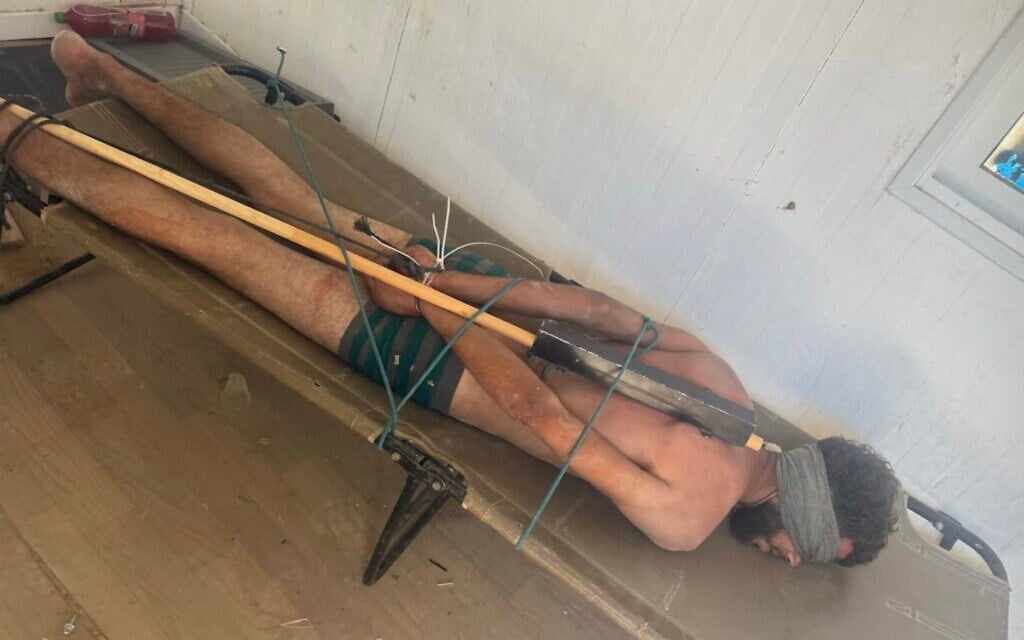
IDF says it tracked down troops who blindfolded suspect and bound him to cot
Times of Israel

Lovin Malta
PoliticsJul 2, 2026 · 1 min
Daphne Caruana Galizia’s Sister Says It Is ‘A Relief’ To See Yorgen Fenech Trial Finally Begin
Lovin Malta

The Guardian
PoliticsJul 2, 2026 · 1 min
229,000 excess deaths: the cost of US-UK trade deal? - The Latest
The Guardian

The Hill
PoliticsJul 2, 2026 · 1 min
Wall Street Journal: Trump family ‘cashing in on the presidency in big and sketchy ways’
The Hill