Times of Israel
IDF chief says soldiers must be priority after Basic Law on Torah study advances
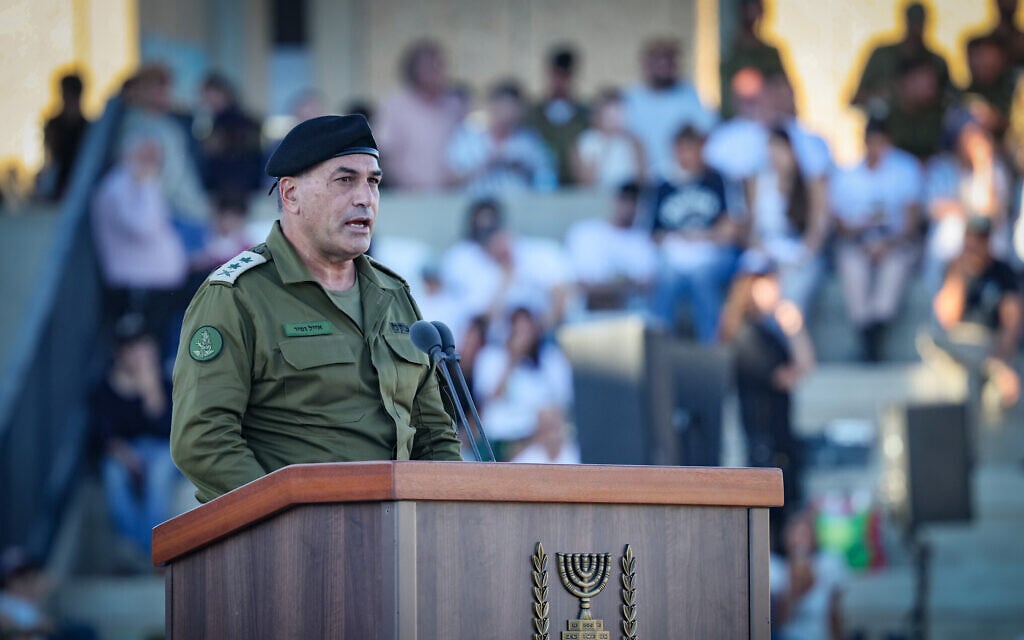
IDF Chief of Staff Lt. Gen. Eyal Zamir on Thursday said that soldiers should be the ones to be prioritized after the Knesset advanced a highly controversial Basic Law declaring Torah study a foundational value of the State of Israel, a day earlier.
“The soldiers and commanders in mandatory service, career service, and the reserves are the State of Israel’s most important resource,” Zamir said during an assessment this morning.
“It is fitting and right that they be first in the order of priorities to receive the state’s appreciation through its decisions and resources, while ensuring care for them, their families, and their future,” he said.
The proposal has drawn fierce opposition, including from within the coalition, with critics arguing that the measure is a transparent attempt to circumvent High Court rulings requiring the enlistment of ultra-Orthodox yeshiva students by legislatively entrenching Torah study as a national value to shield draft evaders from sanctions and prosecution.
Absent a constitution, Basic Laws in Israel have the highest legal status in the country.
Get The Times of Israel's Daily Edition
by email and never miss our top stories
By signing up, you agree to the terms
The advancement of the bill came after a series of mass Haredi demonstrations over the arrests of draft dodgers, who have blocked traffic and targeted police and judges in recent weeks.
On Thursday, a senior military officer again stressed to lawmakers that the IDF urgently needs the government to pass legislation to address the army’s personnel shortages.
Speaking at the Knesset’s Foreign Affairs and Defense Committee, Brig. Gen. Shay Tayeb, head of the IDF Personnel Directorate’s Planning and Personnel Management Division, said the IDF needs three laws that will help solve the manpower crisis: “an effective conscription law,” lengthening mandatory service, and a new reserve duty law — given that currently the IDF relies on emergency call-up orders with various limitations.
“The standing army is reaching its limit, for the overwhelming majority of the year it is at war, and there are many casualties. The intensity of the fighting is only increasing, and this is what the coming years are going to look like,” Tayeb said.
The IDF has repeatedly urged the government to extend mandatory military service for men to 36 months again, after it was shortened to 30 months in August 2024. The government has so far refused to approve this move. The first cohort enlisted under this shorter service period will be discharged in January 2027, further exacerbating manpower issues unless the existing law is changed.
“Extending service will provide an answer for force buildup and burnout, as well as flexibility,” he said, while noting that, meanwhile, the IDF has “done a great deal to expand its ranks,” including establishing dozens of reserve battalions, forming two new infantry battalions, and returning “tens of thousands of personnel to [reserve] service.”
“We are also taking unprecedented steps to integrate members of the ultra-Orthodox community, [but] the reality shows that what we are doing is not enough,” Tayeb said.
He warned that in January 2027, “we will have a cohort gap. Because we operate on a four-month cycle, a service length of 30 months does not allow continuous rotation between cohorts, and thus a gap of an entire cohort is created.”
“This means the loss of thousands of combat soldiers,” he added.
Calls for Haredi conscription have mounted as Israel has fought a multifront war since the Hamas-led October 7, 2023, invasion and massacre, while facing a growing manpower shortage. The IDF has repeatedly said it urgently needs 12,000 more recruits, and Zamir has reportedly warned ministers that the army will “collapse in on itself” if it does not get more manpower.
Some 80,000 ultra-Orthodox men aged between 18 and 24 are currently believed to be eligible for military service, but have not enlisted.
Ultra-Orthodox parties have sought to preserve the military service exemptions following a 2024 High Court ruling that found them unconstitutional, leading to some state benefits being curtailed.
Ariela Karmel contributed to this report.
View original source — Times of Israel ↗
Related stories

The Punch
PoliticsJul 2, 2026 · 1 min
Ghana, South Africa in diplomatic row over migrant’s death
The Punch

The Hill
PoliticsJul 2, 2026 · 1 min
Democrats demand HHS reinstate cancelled teen pregnancy prevention grants
The Hill
Times of Israel
PoliticsJul 2, 2026 · 1 min
Media watchdog reaffirms journalist criteria amid backlash over Gaza database review
Times of Israel
Times of Israel
PoliticsJul 2, 2026 · 1 min
Finance and Defense ministries reach deal to give IDF an extra NIS 15 billion
Times of Israel