SBS News
The Socceroos diehards putting on a festival in an unlikely location
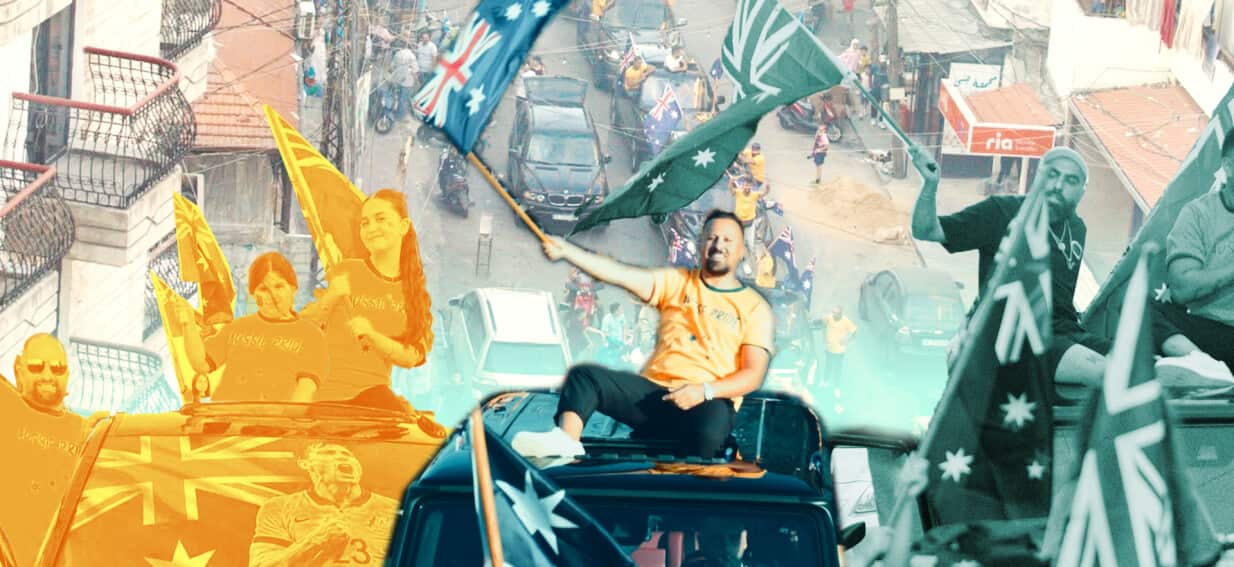
A lengthy motorcade of Socceroos fans — replete with Aussie flags, green and gold T-shirts and flares — stretches through the streets, but this isn't Australia or anywhere near a World Cup stadium in Mexico, Canada or the United States.
It's Jabal Mohsen — a neighbourhood in the city of Tripoli, Northern Lebanon — and for the first time ever, locals here have thrown a festival to support Australia in the 2026 FIFA World Cup.
Videos of the festival circulating online show an entire street taken over by die-hard Socceroos supporters, some bearing AI-generated banners of the team's players and others leading chants of "Aussie, Aussie, Aussie! Oi, oi, oi!"
"This is the least we can do for this great country!" one of the march organisers, Omran, shouts from a car window.
"This is just our way to say 'Thank you, Australia, from Jabal Mohsen!'"
News that makes sense
Your trusted source for staying up-to-date with the world around you. Get free daily news updates and analysis, straight to your inbox.
Lebanon has never qualified for a FIFA World Cup, and this time around the Socceroos are partly to blame for that.
So why is there so much love for Australian football in this part of North Lebanon?
A connection that runs deeper than football
Ali, who was also one of the organisers of the 19 June festival, said he's a fan of Socceroos legend Tim Cahill, and that his kids are fluent in "Oi, oi, oi!".
The 38-year-old lives with his wife and two young children in Jabal Mohsen, which is home to Tripoli's Alawite minority.
He told SBS News the connection between Jabal Mohsen and Australia runs deeper than football.
"In almost every household in Jabal Mohsen you will find that one of the family members lives in Australia," he said.
Australia's ambassador to Lebanon, Tom Wilson, told SBS News it's common to see Australian flags in Tripoli.
"A lot of the Lebanese Australians who came to Australia in the 70s and 80s are mainly from Tripoli ... so there's really strong connections there," he said.
Ali, who has a brother living in Sydney, said the festival was about showing love and support to their friends and family.
"[The parade] was a way to give back to the Aussie community both here and in Australia."
Other communities in Jabal Mohsen held similar festivals this year for Brazil and Germany, nations that are also home to large Lebanese diaspora communities.
Some of the festival organisers are Australian citizens — including Omran, who has lived in Sydney for 22 years.
The festival took place while he was in Lebanon with his children to visit relatives over the holidays.
"Many families in Jabal Mohsen have relatives living in Australia who provide financial and emotional support, which makes a real difference and helps many people through difficult times," he told SBS News.
Football fans without a field
Suleiman, 30, is a sports photographer with the North Lebanon Football Association and a supporter of both Australia and Brazil at the World Cup.
"My favourite players are Messi, Neymar and Ronaldo. I just love beautiful football," he said.
Speaking to SBS News through a translation app, he explained there are few outlets for sport in his home town.
"Jabal Mohsen is alive, it breathes sports and loves football, but unfortunately it does not have a football pitch."
"You see a 25- or 26-year-old with incredible talent who could have gone very far, but the situation in Lebanon in general has not been good.
"Whether because of war or the economic crisis, many people end up leaving their passion behind and turning to other things."
Once a prosperous city, Tripoli was devastated by the Lebanese Civil War, which raged from 1975 to 1990.
In more recent times, the city continues to experience ongoing effects of the 2019 economic crisis, with high concentrations of poverty and much of the infrastructure in disrepair.
In February, 15 people were killed when two neglected residential buildings collapsed in Tripoli, according to Al Jazeera.
The city is also not insulated from recent conflict between Israel and Lebanon's Iran-backed Hezbollah group.
Since March — when Hezbollah began firing on Israel in retaliation for the joint Israel-US attack on Iran — Israeli attacks have killed 3,600 people and displaced over a million across Lebanon, according to the Lebanese health ministry and aid groups.
"It's been quite difficult over the past few months," Wilson said.
"Obviously, there's been a lot of conflict, there's been a lot of displacement. People have been forced to leave their homes. It's a very difficult time for the whole country."
'All our hearts are with them'
On a recent visit to Tripoli, Wilson arranged to meet the organisers of the Socceroo fan festival.
"Actually, one of the reasons I was up there in Tripoli was to put down the foundation stone on a project we're assisting through our direct aid program at the embassy," Wilson said.
The project is a football field.
After seeing videos of the Socceroos parade online, Wilson met with the organisers at a local Tripoli cafe.
"We had a good chat about the Socceroos. We all hoped they'd win a few more games," Wilson said.
Ali told SBS News he was proud the parade had an impact on the community in Jabal Mohsen and in Australia.
As for the Socceroos' chances in the upcoming match against Egypt, Ali said a win would be tough but possible.
"All our hearts are with them."
You can watch all 104 games of the FIFA World Cup 2026™ live, free and exclusive on SBS, SBS VICELAND and SBS On Demand.
For the latest from SBS News, download our app and subscribe to our newsletter.
View original source — SBS News ↗
Related stories

The Punch
SportsJul 2, 2026 · 1 min
Spain defeat Austria 3-0 to reach World Cup last 16
The Punch
The Punch
SportsJul 2, 2026 · 1 min
Rubio says USA ‘screwed’ by Balogun’s World Cup red card
The Punch
The Punch
SportsJul 2, 2026 · 1 min
Ghana owe Africa World Cup progress, says Queiroz
The Punch

ESPN
SportsJul 2, 2026 · 1 min
'Cool off' on criticism of Serena, says Djokovic
ESPN