The Guardian
Sciver-Brunt and Knight sink South Africa and fire England in to final
England launched themselves into the T20 World Cup final after defeating South Africa by 40 runs at the Oval on Thursday evening.
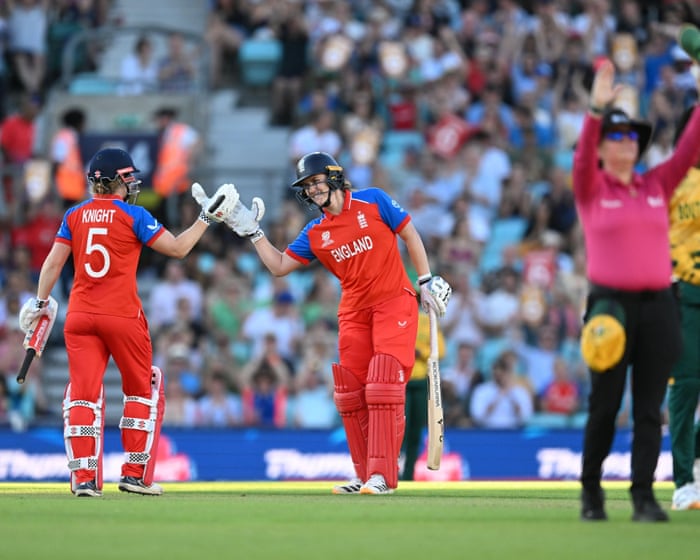
Emotions ran high, especially after England were left reeling at 23 for three having been put in to bat. But with a crowd of 21,000 roaring them on, the World Cup hosts were jubilant at the end as a record partnership of 133 from 90 balls between Nat Sciver-Brunt and Heather Knight put them in the driving seat. Sunday’s battle against Australia at Lord’s will be their first T20 World Cup final since 2018.
“I’m so proud of what we’ve been able to do today. We’ve set ourselves up with an amazing opportunity to be in a home World Cup final – you don’t get that many times in your career,” Sciver-Brunt said. “I think we’ve got what it takes.”
To successfully chase the necessary 170 runs, South Africa needed their captain Laura Wolvaardt to go big; she looked in sweet touch for the first five overs.
The key moment came in the sixth, courtesy of Sophie Ecclestone, who snatched the ball out of the air above her head at mid-on to send Wolvaardt packing.
Eight overs later she repeated the feat, pedalling backwards at short fine leg to get rid of Suné Luus. England, and especially Ecclestone, have worked hard to shed perceptions that they are a poor and unathletic fielding team; here was a moment of vindication.
Marizanne Kapp had masterminded an unlikely chase for South Africa against India earlier in the tournament, while Tazmin Brits scored a valiant 44-ball half-century at the Oval.
But both fell to near-identical dismissals, mistiming catches to Sciver-Brunt at extra cover from the bowling of Charlie Dean. From 95 for five, the match gradually petered out, as England – and the crowd – struggled to contain their excitement.
This was a rematch of England’s most recent T20 World Cup semi-final, in February 2023 at Newlands against the same opposition. Since letting that match slip through their fingers, England have worked hard to address their weakness in pressure moments. They even turned to the British Army for support with a two-day “leadership bootcamp” at Sandhurst in May. After strolling through the group stages of this tournament, the ECB might have considered asking the Army for a refund: there’s been very little pressure to speak of.
At last, in the semi-final, the test came: pressure doesn’t come much higher than finding yourselves 23 for three, with a home final at Lord’s on the line. Suddenly, the decision to throw Sciver-Brunt into the fray despite the risk posed by her weak calf made all the sense in the world, as she showed her class by piercing the gaps with ease. She said afterwards that she had been so comfortable in the middle that she forgot about her calf entirely.
Such was the importance of Sciver-Brunt’s wicket that South Africa wasted both their DRS reviews within the first 10 overs trying to get rid of her: the first, against Shabnim Ismail, had hit her way outside leg; while the second, against Nonkululeko Mlaba, showed obvious contact with the bat.
The new-ball partnership of Kapp and Ismail, reunited after Ismail was persuaded out of retirement for this World Cup, has been one of South Africa’s key strengths this tournament. Hence their decision to bowl first when Wolvaardt called correctly at the toss – a move which soon paid off.
Ismail thundered in from the Vauxhall End and struck immediately – Amy Jones predictably sending a catch straight into the hands of a ring-fielder, this time picking out Annerie Dercksen at point. Kapp then joined the party with an even bigger scalp, taking out Danni Wyatt-Hodge’s off-stump to ensure that the leading tournament run-scorer added just 12 more to her tally.
Then it was the turn of Alice Capsey to trudge off, after Ismail’s nip-backer struck her on the back pad. Sciver-Brunt advised her not to review the decision – incorrectly, as it turned out, with UltraEdge revealing she had actually got a tiny inside edge.
But there is a good reason why Ismail was brought out of retirement: South Africa have never managed to find anyone good enough to replace their pocket-rocket. Kapp was bowled out by the seventh over, while Ismail had just one over remaining; Sciver-Brunt and Knight were able to pick off boundaries at will against the second-string attack of Ayabonga Khaka, Nonkululeko Mlaba and Nadine de Klerk.
South African coach Mandla Mashimbyi said: “Bringing [Ismail] back was to bring that X factor into the bowling attack. Shabnim and Kappy can put anyone under pressure with the new ball, and that’s what we’ve been doing.
“Now the thing is to go back and make sure that we’ve got processes in place to make sure that we’ve got players that are coming through that are going to do similar, or better.”
View original source — The Guardian ↗
Related stories

ESPN
SportsJul 2, 2026 · 1 min
Spain finally have World Cup mojo back with first ...
ESPN

ESPN
SportsJul 2, 2026 · 1 min
MLB hands Cavalli, Contreras 7-game suspensions
ESPN
Sky Sports
SportsJul 2, 2026 · 1 min
Ronaldo and Modric meet in potential World Cup farewell as Portugal face Croatia LIVE!
Sky Sports

ESPN
SportsJul 2, 2026 · 1 min
Sources: 76ers, with Brown on board, eye LeBron
ESPN