Philippine Daily Inquirer
Filipino students win 4 medals in Asia-Pacific AI Olympiad
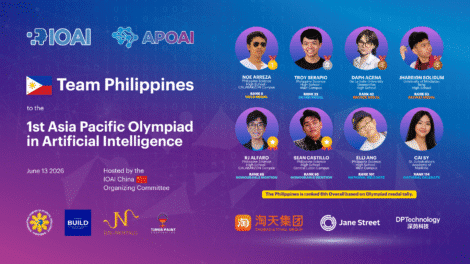
MANILA, Philippines — The Philippines won one gold, one silver and two bronze medals at the inaugural Asia-Pacific Olympiad in Artificial Intelligence, or APOAI 2026, with its eight-member delegation finishing in a historic tie for sixth place overall among 18 participating countries and territories.
The result marked the country’s first appearance in the regional competition, where 129 secondary school students from across the Asia-Pacific took a six-hour examination covering machine learning, mathematical modeling and algorithmic problem-solving, according to the Ateneo de Manila University Research Communications Section and the International Olympiad in Artificial Intelligence Philippines, or IOAI PH.
Hosted simultaneously across participating countries on June 27, the competition’s Philippine leg was held at the Ateneo Business Insights Laboratory for Development, or BUILD, of the John Gokongwei School of Management at Ateneo de Manila University.
Article continues after this advertisement
Participants took the six-hour examination from 2 p.m. to 8 p.m. under strict international testing protocols, with no breaks allowed and independent on-site invigilators supervising the contest. The final results were released after a full score audit conducted by the APOAI International Scientific Committee.
FEATURED STORIES
TECHNOLOGY
TECHNOLOGY
TECHNOLOGY
To ensure fairness across all participating countries and territories, all official competition sites were monitored simultaneously through live Zoom streams coordinated by the IOAI China Organizing Committee. Contestants also used the same high-performance AI GPU cloud environment, providing equal computing resources regardless of location.
Leading Team Philippines was Noe Nathan Y. Arreza of Philippine Science High School-Calabarzon Campus, who placed eighth overall to secure the country’s lone gold medal.
Troy Dylan T. Serapio of Philippine Science High School-Main Campus finished 23rd overall to win the silver medal.
Article continues after this advertisement
Bronze medals went to Daphne Eunice U. Acena of De La Salle University Dasmariñas High School, who ranked 42nd, and Jhareign S. Solidum of the University of Mindanao Ilang High School, who placed 52nd.
Also representing the Philippines were Ryan James L. Alfaro of Philippine Science High School-Calabarzon Campus, who ranked 88th and received an honorable mention; Sean Marcus N. Castillo of Philippine Science High School-Central Luzon Campus, who placed 95th and also received an honorable mention; Ellison Matthew S. Ang of Philippine Science High School-Main Campus, who ranked 101st; and Aretha Cai Faustine M. Sy of St. Scholastica’s Academy of Marikina, who finished 114th.
The four-medal performance placed the Philippines in a tie for sixth in the final country standings of the first APOAI, according to IOAI PH’s official Facebook page.
Article continues after this advertisement
The Philippine delegation was selected through a merit-based national screening process organized by IOAI PH. Organizers said participation in the program was free for students, with national representation based on talent, preparation and performance rather than financial capacity.
IOAI PH Executive Director Martin Gomez said the country’s performance provides an encouraging benchmark for future Philippine participation in the regional competition.
“This historic performance establishes a powerful baseline for the country,” Gomez said. “This result belongs to far more than the students who sat the exam. It is a testament to the coaches who trained this team, the local staff who maintained competition integrity, and the families, schools, and communities who championed these students every step of the way.”
In a separate Facebook post, IOAI PH credited the achievement to the collective efforts behind the national delegation, thanking the coaches and mentors who trained the students, the invigilators and local staff who ensured the integrity of the competition, the schools and communities that supported the delegates, and the parents who backed them throughout their preparations.
The Ateneo de Manila University’s Office of the Assistant Vice President for Research, Creative Work, and Innovation said that the Philippines’ performance in the inaugural APOAI reflects the country’s growing pool of young talent in artificial intelligence, an emerging field that continues to shape science, education, industry and other sectors.
“With the right support, these students show that Filipino talent can stand with the best in the region,” the statement said.
RELATED STORIES:
Filipino students notch 2nd podium finish in NASA-backed robotics tilt
Your subscription could not be saved. Please try again.
Your subscription has been successful.
NASA astronaut performs Filipino students’ space experiment
View original source — Philippine Daily Inquirer ↗
Related stories

CNA
TechnologyJul 3, 2026 · 1 min
Actress-host Eswari Gunasagar speaks out after AI-generated fake images of her surface online
CNA

Nepali Telecom
TechnologyJul 3, 2026 · 1 min
Nepal Telecom expands 4G coverage in Tikauli jungle, Bharatpur
Nepali Telecom
ABC News
TechnologyJul 3, 2026 · 1 min
Cause of wrongly-positioned aircraft control in Shellharbour crash unknown
ABC News

South China Morning Post
TechnologyJul 3, 2026 · 1 min
Kuaishou files US$3 billion Kling AI funding round to Hong Kong stock exchange
South China Morning Post