The Guardian
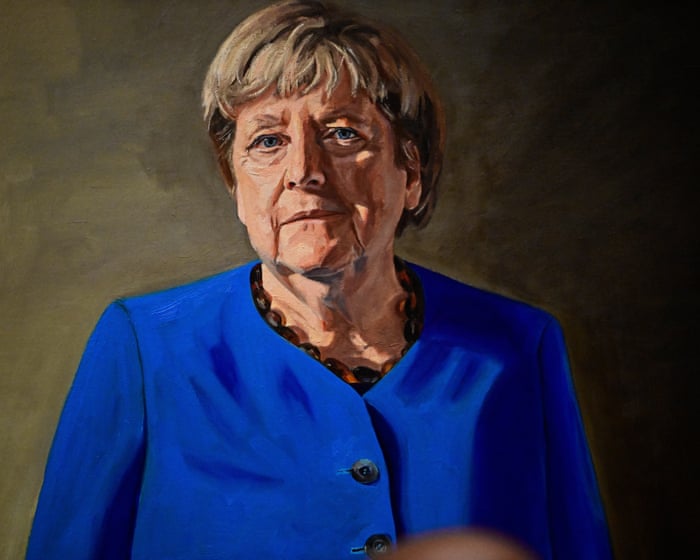
Portrait of Angela Merkel unveiled at museum in Berlin
Over months they met secretly in a studio in the government quarter of central Berlin – a young artist and his subject, the former German chancellor Angela Merkel. For hours at a time, while Jérémie Queyras painted her portrait, they bonded, Merkel has said, chatting “about all and sundry”. Sometimes they were silent, or they listened to classical music, taking it in turns to let each other choose the pieces.
The result of what Merkel, 71, called their “little adventure” was unveiled to an invited audience of family, friends and a handful of art critics this week in the neo-baroque Bode-Museum in Berlin.
Famous for its old master paintings and sculptures, the museum is now also a temporary home to the looming image of the former chancellor, clad in a blue version of one of her many trademark blazers with big buttons. She looks a little cramped, her face slightly frayed; a sign, perhaps, that the strain of being in power for 16 years has left a permanent mark.
Queyras, 28, said he would “never have come up with the idea himself” but was persuaded to write to Merkel by an acquaintance, who had bought some of his works and knew the former leader would be searching for a portrait artist.
“I thought: who in the world knows me?” Queyras told Die Zeit. Nevertheless, he sent Merkel a handwritten letter in 2022, enclosing some colour photocopies of his paintings. He waited three years for a reply. When the two met in her Berlin office, Queyras said she ignored his “scruffy sneakers” and gave him the commission, having never laid eyes on any of his original works but saying he had made a “good impression”.
The painter and multidisciplinary artist, who was born in Paris but grew up in southern Germany, admitted he had felt a little overwhelmed by the task and had shared his doubts with Merkel. The two discussed what the meaning of a portrait was and why an oil painting was preferable to a photograph. She advised him to take the time to decide whether he really wanted the job, warning him that his life after the painting would be very different.
According to Die Zeit, she said he might feel the resentment of other artists who hadn’t got the commission and even hate from the far right, who view Merkel as the “agent of doom” and could pursue him with suspicion.
In preparation, Merkel arranged for Queyras to have secret access to the chancellery so he could view the gallery of portraits of her seven male predecessors that hang in a gallery of post-second-world-war German leaders, from Konrad Adenauer to Gerhard Schröder.
Perhaps most strikingly, Merkel is reported to have paid Queyras herself, rather than letting German taxpayers pick up the bill. According to reports, this was so her ownership of the portrait cannot be disputed; the painting can be loaned to the chancellery, but Merkel would be able to take it back should the far right get into power.
The painting will be on display until October, when it will be moved to the chancellery where it will hang next to a painting of Merkel’s arch-rival Schröder, whose own apparently self-mocking portrait by Jörg Immendorff has been compared to the embossed coin of a Roman emperor.
Queyras said he had given considerable thought in particular to the challenge of how to paint Merkel’s hands. In office she had invented a famous rhombus-shaped way to hold them, to cope with not knowing what to do with them. Both artist and subject felt this would be too cliched for the portrait.
Instead, her left hand casually rests on the arm of a chair with three fingers, while her right hand hangs down. She shows her characteristic unease, and slight impatience, looking ready to flee if she has to.
Directly behind her, the few odds and ends on a table are items she once had on her office desk. Social media users have been poring over the details, hoping to interpret their significance. There is a yellow cardboard file – a nod, perhaps, to her prosaic style of government and the analogue era – and a small silver cube, a present when she entered office, on which is engraved, one word on each square, one of the most Merkelesque mottoes: “In der Ruhe liegt die Kraft” (“In serenity strength lies”).
Fittingly, it is five years since Merkel left office and Germany is experiencing something of a wave of nostalgia for the era of her rule. This is encapsulated in the popularity of lo fi merkelwave, a lengthy melody featuring Merkel’s voice and including some of her famous phrases, such as “the internet is uncharted territory for all of us”, and “we’ve managed so much, we’ll manage this” at the height of the 2015 refugee arrivals, one of the defining moments of her chancellorship.
Queyras said Merkel had been one of the defining influences of his childhood: “Since I was eight, and well into my adulthood, she was always there.” He hoped viewers would “immediately recognise Merkel in the picture, yet get to know her from a new perspective”.
View original source — The Guardian ↗
Related stories

Euronews
TechnologyJul 3, 2026 · 1 min
Data protection rules slow LLM rollout in Europe, study says
Euronews
TechRadar
TechnologyJul 3, 2026 · 1 min
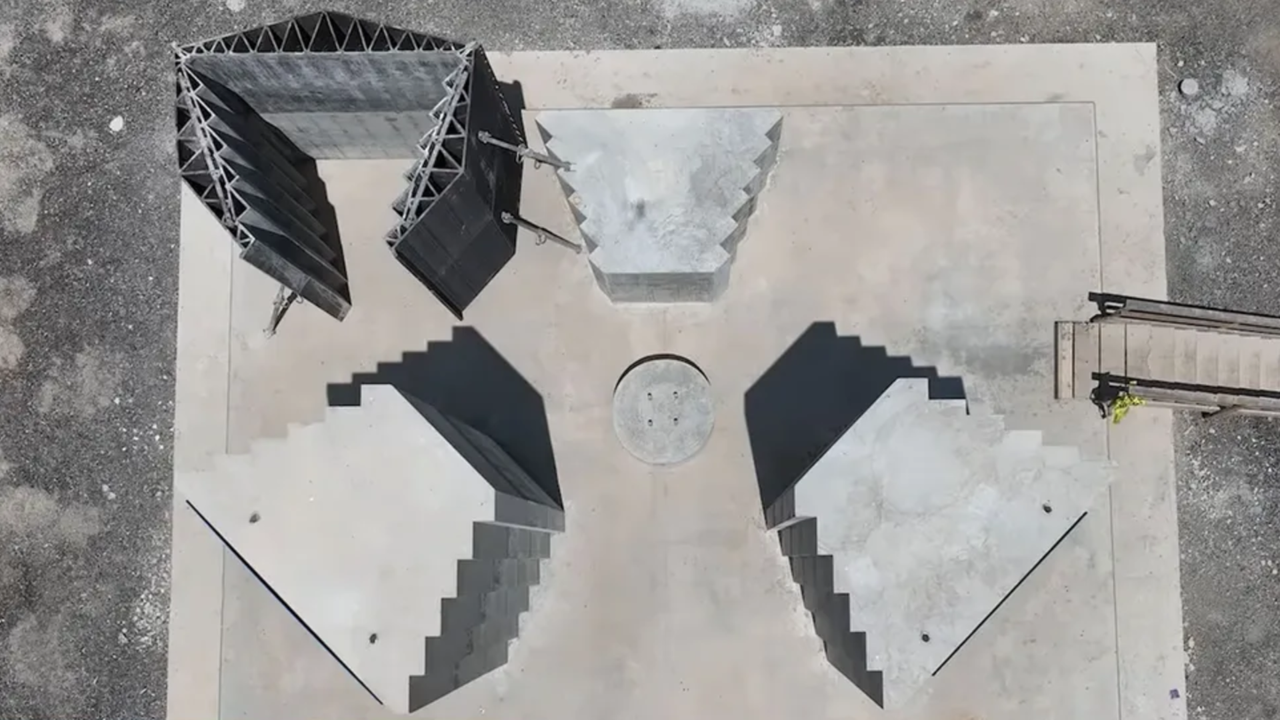
UK government signs £30 million deal to build the world’s first prototype fusion power plant by 2040
TechRadar
BBC
TechnologyJul 3, 2026 · 1 min
Thousands of fish killed in park pollution mystery
BBC

AllAfrica
TechnologyJul 3, 2026 · 1 min
Ghana: Ghana Condemns Killing of Citizen in South Africa, Demands Justice
AllAfrica