BBC Sport
Beauty and brutality - six unforgettable Wales v Fiji games
ByGareth Rhys Owen
BBC Sport Wales
Every rugby supporter loves watching Fiji.
Ask the players, and they might tell you a different story.
From Waisale Serevi weaving through impossible gaps to Rupeni Caucaunibuca leaving defenders clutching at air, and from the raw power of Semi Radradra and Josua Tuisova to generations of fearless runners willing to attack from anywhere on the field, no nation has blurred the line between beauty and brutality quite like Fiji.
Former Wales captain Sam Warburton once described the 2015 Rugby World Cup meeting as the toughest match of his career. Wales won that day, but only after surviving an 80-minute collision with one of rugby's most unique teams.
The two nations have met only 15 times in official Tests, yet almost every meeting has produced a moment that has become part of rugby folklore.
Before Saturday's latest chapter (14:10 BST), BBC Sport looks back at six of the most unforgettable.
The shock
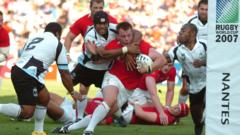
2007 Rugby World Cup: Fiji 38-34 Wales
Mention Wales v Fiji to supporters of a certain generation and they still wince.
Needing victory to reach the quarter-finals, Fiji produced one of the greatest wins in Rugby World Cup history to knock Wales out in Nantes.
At the time, it was regarded as one of the biggest shocks the tournament had ever seen.
Today, it feels rather different.
Fiji have beaten Wales twice since, pushed them to the brink in two more World Cups and now arrive in Cardiff as favourites. What felt extraordinary in 2007 has gradually become expected.
Ironically, one of the game's finest moments belonged to Shane Williams, whose breathtaking solo try looked more Fijian than Welsh.
The consequences were enormous. Gareth Jenkins lost his job as Wales head coach, while hundreds of Welsh supporters who had already booked flights and hotels for the quarter-finals travelled to Marseille anyway – this time to cheer on Fiji against South Africa.
Heartbroken by what had happened, many could not help but admire the team that had done it.
The great escape
2023 Rugby World Cup: Wales 32-26 Fiji
If 2007 was the biggest result, this may have been the greatest game.
For long periods in Bordeaux, Wales were hanging on.
By the final whistle they had completed an astonishing 248 tackles – the most ever recorded by any nation in a men's Test match.
Even that was almost not enough.
With Wales clinging to a six-point lead, Semi Radradra had one final opportunity. Had the last pass stuck, Fiji looked destined to score.
Instead, Wales somehow survived.
They topped the pool and reached the quarter-finals, but Fiji quickly proved their performance had been no one-off.
A week later, they beat Australia before pushing England deep into the quarter-final, eventually losing only after the favourites pulled away in the closing stages.
It was the tournament that confirmed Fiji were no longer simply dangerous outsiders. They were a genuine force.
Winning ugly
2024 Autumn Nations Series: Wales 19-24 Fiji
For decades Fiji terrified opponents with their brilliance.
This victory showed they could do something else.
They won ugly.
Reduced to 14 men for much of the contest after a red card, Fiji ground out their first victory in Cardiff.
It was controlled rather than chaotic.
Measured rather than magical.
For a nation once known almost exclusively for instinct and attacking flair, it felt like another significant step in their evolution.
Perhaps that is the biggest reason they arrive as favourites this weekend.
The collision
2019 Rugby World Cup: Wales 29-17 Fiji
Sometimes one passage of play tells the story better than an entire match.
Barely six minutes had elapsed in Oita when Fiji packed down five metres from the Welsh line.
The ball was whipped blind to Josua Tuisova.
Josh Adams barely had time to set himself.
Tuisova simply ran over him.
Josh Navidi came across to help. Navidi prides himself on winning collisions. This time, even he became a passenger on Tuisova's back as the giant centre powered over the try-line.
Two of Wales' toughest defenders had been brushed aside in one of the most extraordinary displays of power ever seen on a Rugby World Cup stage.
Wales eventually recovered to win 29-17, with Adams scoring a hat-trick as they battled through another ferocious contest before reaching the World Cup semi-finals.
Even now, mention Tuisova to Adams and it still brings a wry smile.
The love affair
1964: Wales XV 28-22 Fiji (not an official Test)
Strictly speaking, this was not an official Test. Wales fielded a Wales XV rather than awarding full international caps.
The score is almost beside the point.
Fiji's 1964 tour took them across Wales before continuing to France and Canada. They played Bridgend, Glamorgan & Monmouth, Western Counties at Stradey Park, Wales XV at Cardiff Arms Park and later Abertillery & Newbridge.
It was an era when touring sides spent weeks travelling the country rather than flying in and out for a single Test.
The enduring memory came after the final whistle in Cardiff.
Players and supporters gathered together on the Arms Park pitch, singing side by side in scenes that feel almost impossible to imagine today.
It is not remembered as one of the greatest matches between the nations. It is remembered because it captures something of what made rugby special in that era and why Welsh supporters first fell in love with Fiji.
Like father, like son
1995: Wales 19-15 Fiji
This was never the greatest Wales v Fiji contest.
Time has simply given it a different significance.
Neil Jenkins scored 14 of Wales' 19 points as Fiji continued the touring tradition that had become such a feature of visits to Wales, also playing clubs including Treorchy.
One of Fiji's try scorers that afternoon was Waisale Rayasi.
More than three decades later, another Rayasi now wears the white jersey.
His son, Salesi, has developed into one of the finest wings in world rugby with Bordeaux-Begles, joining Semi Radradra, Josua Tuisova and Jiuta Wainiqolo in a backline overflowing with game-breakers.
There may not be another nation in world rugby with quite so many players capable of deciding a Test match with a single touch of the ball.
Which is exactly why Fiji will arrive in Cardiff this weekend expecting to win.
View original source — BBC Sport ↗
Related stories

Sky Sports
SportsJul 3, 2026 · 1 min
Stanway joins Arsenal after Bayern exit
Sky Sports

CBC
SportsJul 3, 2026 · 1 min
StubHub sold ‘ghost tickets’ for World Cup months before real ones were issued, CBC finds
CBC

Portugal Resident
SportsJul 3, 2026 · 1 min
Gonçalo Ramos sends Portugal into World Cup last 16 with dramatic stoppage-time winner
Portugal Resident
ABC News
SportsJul 3, 2026 · 1 min
Live: Panthers and Rabbitohs meet without Origin stars in top-eight clash
ABC News