OnlineKhabar
From defending Susta to defending his identity
The scorching summer wind has intensified the heat at Maitighar Mandala. Protesters, seeking justice from the government against the injustices they have faced, are huddled in the limited patches of shade available along the roadside.
Amidst this, a group of people from Susta, a disputed territory of West Nepal, can be seen joining the agitation, carrying their land ownership certificates and other vital documents that establish their citizenship. Some of them have brought bundles of soil from Susta, as if to present the very essence of their land to the capital city.
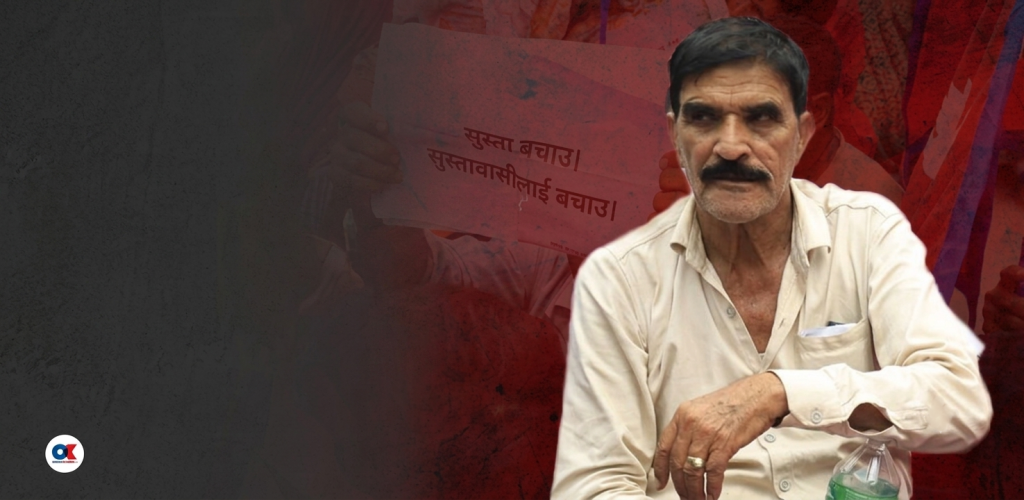
Among this group of protesters is an elderly man. Despite his body being well past eighty, it still bears the scars of bullets.
These scars are not mementoes of a personal vendetta; they are the enduring evidence of a struggle to protect Nepal’s border. Four decades ago, he braved bullets against his own chest to safeguard the soil of Susta.
Yet today, as he reaches the twilight of his life, he is fighting a different battle, not for the protection of a border, but to prove his identity as a Nepali and to ensure that his own state hears the voice of its citizens.
Carrying this plea, he has dragged his elderly body all the way to Maitighar Mandala, standing once again on the streets. His name is Munna Khan.
While the bullet scars on his chest have long since faded, Munna Khan’s struggle has not aged. Truth be told, this is not the age for him to be still proving his nationality. It is not the time for him to be shouting for the right to live with dignity within the geography of his own country. This is not his desire, either.
“Even today, we are forced to live with our chests bared to guns. Yet, we are the ones who must live as non-citizens of this country. Why this double standard?” he asks the government.
The people of Susta arrived in Kathmandu on June 30. Exhausted by the persistent harassment from the Indian SSB, they have come here to bring their grievances to the government’s attention.
Prior to this, on June 28 in Butwal, the ‘Save Susta Campaign’ and the ‘Save Susta Youth Campaign’ held a joint press conference to announce their protest programs. Representatives of these campaigns stated that they have been forced to resort to decisive struggle due to the government’s persistent neglect.
According to them, despite repeated requests for an appointment with the Prime Minister’s secretariat, their pleas have remained unheard.
Just as ordinary people have an inherent connection with their geography and its cultural elements, Khan is no exception.
According to Munna Khan, their organised settlement in Susta dates back to the year 1964 A.D. At that time, under the leadership of Kishore Gurung, the late King Mahendra had distributed land in the border region to former soldiers and police personnel.
“My grandfather was in the police service,” he says. “Because of that, the government of that time had granted him one and a half bighas of land.”
In 1972 A.D, that land underwent a formal survey and measurement.
While the years that followed passed relatively normally, the devastating flood of 1977 A.D. inflicted a wound upon the history of Susta that would never fully heal.
The catastrophic flood swept away the entire settlement. At that time, approximately 480 households, composed of former military and police families, as well as the Musahar and Muslim communities, resided there.
After being rendered homeless by the flood, the displaced families were resettled in four different locations; Triveni, Saguwa Mari, Patheya Gala, and Pharsaiya. In this way, the calamity forced the residents of Susta to scatter across various regions.
Munna Khan expresses the profound pain of the aftermath, noting that the most severe problem to emerge was the lack of citizenship. Because they lack citizenship, about 80 households in the area have been deprived of their fundamental rights as state subjects, forced to endure the stigma of being identified merely as “Sustabasi” (residents of Susta) rather than recognised as full citizens.
In 1981 A.D., he approached the local administration, led by the then-Bada Hakim (District Administrator) Kajiman, to request permission to return to Susta. Driven by the conviction that Susta was sovereign Nepali territory and that they must reside there to defend the land, 36 households began resettling in the area.
During the process of surveying the land at that time, they began to face relentless pressure and inducements from the Indian side. The Indian authorities pressured them to renounce their Nepali identity, dangling the promise of Indian Aadhaar cards, banking facilities, and land ownership deeds in an attempt to make them accept Indian citizenship.
Munna Khan and his community, however, flatly rejected these overtures. Instead of accepting the Indian flag, they stood firm in their resolve to preserve their existence while carrying the flag of Nepal.
“Our nationality is what we hold most dear. Our land is worth far more than any temptation offered to us,” he says.
He had to pay a heavy price for taking such a stand. He recounts the incident where his father was arrested and imprisoned by the Indian authorities. Following this event, his family became the target of a continuous cycle of oppression and intimidation from the Indian side.
Around 1983 A.D., while he was ploughing his fields, Munna Khan’s tractor and vehicle were attacked by the Indian side. He recalls how the driver and his assistant were taken into custody and the vehicle was set on fire while they were working the land.
The most terrifying event that followed occurred on the evening of Sunday, September 15, 1983, when an armed group of about 28 to 30 people opened fire indiscriminately. During the ensuing clash, Munna Khan managed to seize a rifle and strike back at the attackers in self-defence.
In the process, he was struck by six bullets. Three people from his side lost their lives in the incident, and two others were critically injured. His own brother-in-law was among those killed.
“Despite all my efforts, I could not save everyone’s life,” he recalls.
The harrowing scars of the bullets are still visible on Munna’s body. His age and the physical wounds he has endured have made him a representative figure for those living on the fringes of geography, bearing the brunt of neglect from both their own country and the neighbouring land.
His son, Salam Khan, who is also present at the protest, says, “We are the ones standing guard at the border, yet it is our nationality that is repeatedly put to the test. We are trapped in a double bind.”
Following that incident, security arrangements in Susta were significantly tightened, with at least 120 armed security personnel deployed to the area. To ensure a permanent security presence, Munna Khan himself donated one bigha of his own land for the establishment of a police station, which currently operates as a well-equipped facility. Today, the situation in the region has improved greatly, and infrastructure has been solidified.
Through the ‘Save Susta Campaign,’ they had presented a seven-point demand to the state, primarily emphasising the need for bridges, schools, roads, and river embankments. According to Khan, four of those seven demands have been met, but the state must take special initiatives to fulfil the remaining three.
Munna Khan articulates the discrimination and the agony of statelessness he has endured at the hands of the state with poignant depth. Although he met all the qualifications to receive citizenship as early as 1976 A.D., he remained deprived of it. He did not receive his land ownership certificate until 1979 A.D. While his two sons have obtained citizenship, he himself remains stateless.
Munna Khan, who dedicated himself to the struggle for the protection of his land, was even hailed as a “living martyr” by former minister Kamal Thapa at the time. However, the state’s indifference regarding the issue of his citizenship has left him deeply distressed.
Munna Khan’s two sons, who attained higher education, faced a harrowing childhood due to the volatile conditions in Susta. The fact that the Indian side once abducted his son directly from school clearly illustrates the extent of the repression his family has faced.
Now in the twilight of his life, he wishes to pass on the struggle for Susta’s future and rights to the next generation. His resolve to rise above personal interest to protect the country’s land and existence remains as firm as ever.
Munna has spent his long life consumed by the struggle for Susta. His personal dreams were overshadowed by the battle for the region, a reality his loved ones have reminded him of from time to time.
“There are people who ask me what I have gained by obsessing over Susta all these years. It is not that this question doesn’t pain me,” he says to Onlinekhabar.
Munna has arrived in Kathmandu for such protests seven or eight times already. Yet, he remains astonished that the government has failed to heed his voice. He has observed the state’s insensitivity from up close. Nevertheless, he expresses hope in the new government compared to those of the past.
“For the previous governments, we were merely votes. But we have hope that this new government will understand our problems. We only wish for them to engage in a dialogue with us about our issues before we are sent back,” he says, expressing his expectation for a conversation with the government.
View original source — OnlineKhabar ↗
Related stories
OnlineKhabar
PoliticsJul 3, 2026 · 1 min
Sarada Dangol’s mission to keep dapha alive
OnlineKhabar
OnlineKhabar
PoliticsJul 3, 2026 · 1 min
Kathmandu, July 3 The price of gold and silver has increased in the domestic market today, the last trading day of the…
OnlineKhabar
OnlineKhabar
PoliticsJul 3, 2026 · 1 min
500 million released for compensation to poultry farmers affected by bird flu
OnlineKhabar
ABC News
PoliticsJul 3, 2026 · 1 min
China's latest activities near Taiwan indicate new strategy
ABC News