Indian Express
UPSC Essentials daily subject quiz : Environment and Geography MCQs (Week 169)
UPSC Essentials brings to you its initiative of subject-wise quizzes. These quizzes are designed to help you revise some of the most important topics from the static part of the syllabus. Attempt today’s subject quiz on Environment and Geography to check your progress.
🚨 Click Here to read the UPSC Essentials magazine for June 2026. Share your views and suggestions in the comment box or at [email protected]🚨
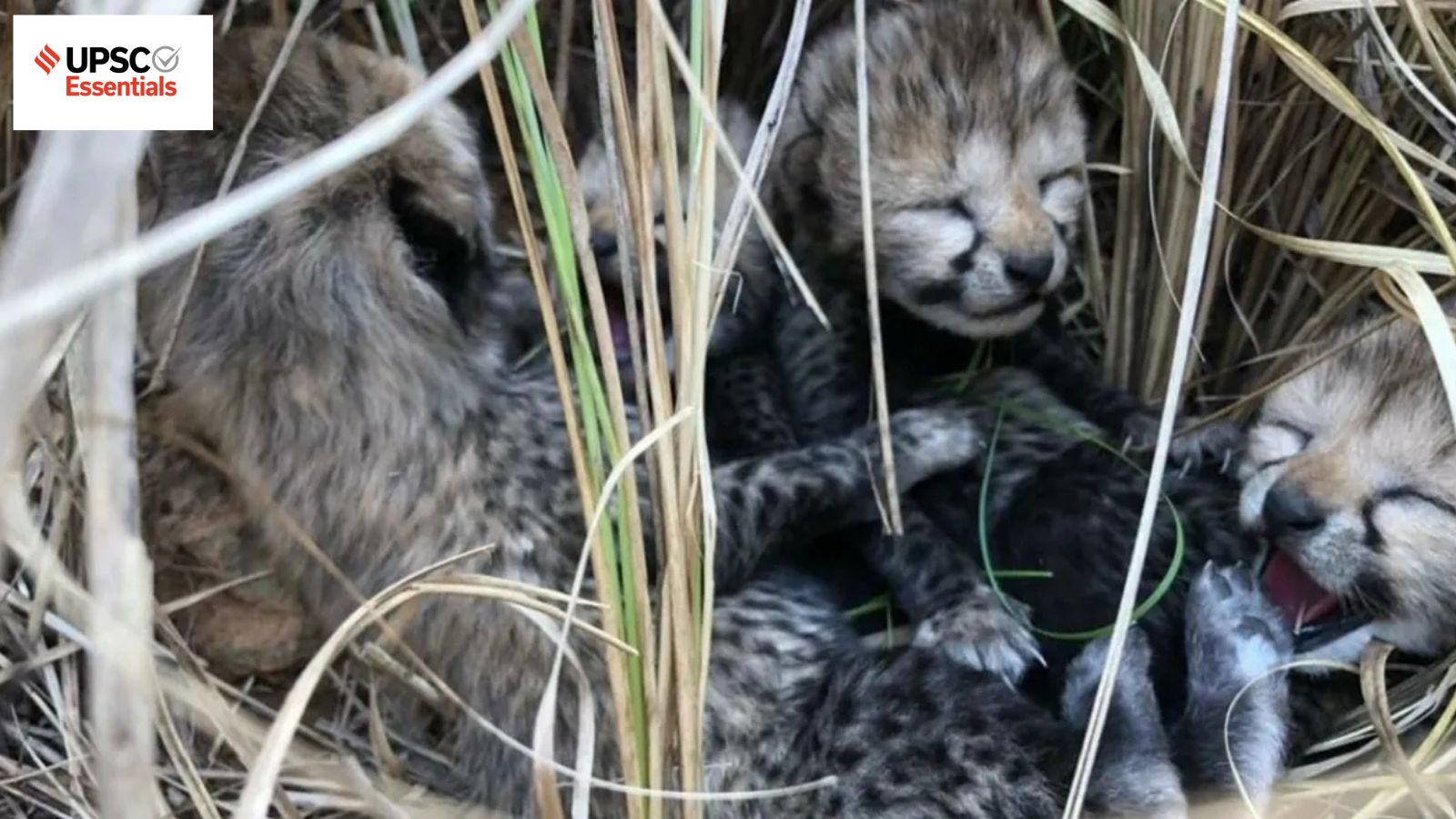
1. The Project Cheetah saw the introduction of African cheetahs, which was the first intercontinental translocation.
2. The Project Cheetah was initiated in 2023.
3. The population of Cheetahs has declined compared to the number of cheetahs translocated.
4. In India, only the Kuno wildlife division is a habitable zone for Cheetahs.
How many of the statements given above are correct?
(a) Only one
(b) Only two
(c) Only three
(d) All four
Relevance: Project Cheetah has remained in the news due to the translocation of additional cheetahs, successful breeding, and the expansion of cheetah habitats beyond Kuno. The topic is also important from the perspective of biodiversity conservation, habitat restoration, and India’s international conservation collaborations.
Explanation
Story continues below this ad
— Initiated in 2022, Project Cheetah saw the introduction of African cheetahs in Indian grassland and dry forest landscapes in Kuno through the first intercontinental translocation. Hence, statement 1 is correct and statement 2 is not correct.
— A founder population of 20 cheetahs – 8 from Namibia and 12 from South Africa – was imported for the project. From 20, the population has now grown to 53, comprising 13, 17 sub-adults, and 23 cubs. Along with Kuno, three cheetahs are also hosted at Gandhi Sagar Sanctuary in Neemuch and Mandsaur districts, Madhya Pradesh. Hence, statements 3 and 4 are not correct.
— Goats and cattle together make up 50%, while Chital (spotted deer) formed 42% alone of the detected kills by 19 free-ranging cheetahs under Project Cheetah in the Kuno National Park and wildlife division landscape, according to the latest Project Cheetah progress report. The report stated chital accounted for 42% of detected kills, followed by goat (30%), cattle (20%), Nilgai (2%), hare, sambar, chinkara, sheep, and wild pig (1% each).
Therefore, option (a) is the correct answer.
Story continues below this ad
QUESTION 2
Which of the following organisations has launched the Global Chemicals Monitoring Programme (GCMP)?
1. United Nations Environment Programme
2. World Bank
3. Global Environment Facility (GEF)
Select the correct answer:
(a) 1 and 2 only
(b) 2 and 3 only
(c) 1 and 3 only
(d) 1, 2 and 3
Relevance: The Global Chemicals Monitoring Programme (GCMP) was launched recently to support the implementation of the Stockholm Convention on Persistent Organic Pollutants and the Minamata Convention on Mercury. The topic falls under Environment and Ecology, particularly chemicals and waste management, pollution control, and international environmental agreements.
Explanation
— The UN Environment Programme (UNEP) and the Global Environment Facility (GEF) have officially launched the US$ 23.5 million Global Chemicals Monitoring Programme (GCMP). The initiative is intended to help evaluate the effectiveness of the Stockholm Convention on Persistent Organic Pollutants (POPs) and the Minamata Convention on Mercury; it aims to reduce global pollution while strengthening developing countries’ capacity to monitor hazardous chemicals and support evidence-based policymaking.
— The initiative is funded by the GEF and has a co-financing of $50 million. The GCMP is made up of six child projects: one global coordinating project and five regional programs centred on Africa, Asia, Pacific Islands, Latin America, and the Caribbean. Together, they will provide strong scientific evidence on chemical pollution, improve data to assist policy formulation, strengthen collaboration, and support long-term monitoring of POPs and mercury. By collecting trustworthy data on POPs and mercury, GCMP helps to improve understanding of the hazardous substances that people are exposed to through air, water, and food, particularly the most susceptible groups, such as babies via contaminated breast milk.
Therefore, option (c) is the correct answer.
(Source: http://www.unep.org)
QUESTION 3
Consider the following statements about the Strangler figs:
1. Strangler figs begin their life cycle by germinating in the soil and then climbing the host tree using tendrils.
2. Strangler figs reproduce only through vegetative propagation and do not produce seeds.
3. Strangler figs are found exclusively in tropical rainforests of South America.
How many of the statements given above are correct?
(a) Only one
(b) Only two
(c) All three
(d) None
Story continues below this ad
Relevance: Strangler figs were recently in the news due to studies highlighting their role as keystone species in maintaining tropical forest biodiversity and ecosystem resilience. UPSC can ask questions on unique ecological adaptations, such as epiphytes, parasitic plants, and species interactions in forest ecosystems.
Explanation
— Imagine a plant that doesn’t just grow beside a tree, but climbs onto it, wraps around it, and quietly takes over its entire life. No noise, no sudden collapse. Just a slow, silent takeover that ends with the host tree disappearing completely. ‘Strangler figs‘ begin life in the most unexpected way. Their seeds are dropped by birds or other animals onto tree branches, where they begin growing high in the canopy. At first, they behave like harmless hitchhikers, using the host tree only for support.
— But as they grow, they send roots down toward the forest floor. Once these roots reach the soil, the real transformation begins. The plant rapidly strengthens, thickens to produce trunk-like structures spreading both upward and downward at the same time. This sometimes results in large patches of strangler fig forest all originating from one plant. What started as a tiny passenger slowly became a powerful competitor.
— Over time, the host tree weakens under this pressure. Eventually, it dies, leaving the fig standing in its place, often as a hollow structure shaped around the tree it replaced.
Story continues below this ad
The hollow centre of strangler figs provides habitats for a number of animals including bats and birds (Image: Gemini)
— Strangler figs often start life as epiphytes. Birds and other animals disseminate their seeds, which germinate on high canopy branches. They do not climb with tendrils. Hence, statement 1 is not correct.
— Strangler figs reproduce sexually, producing fruits with seeds that are distributed by birds, bats, and other animals. Hence, statement 2 is not correct.
— Strangler figs grow in tropical and subtropical climates around the world, including Asia, Africa, Australia, and the Americas. They aren’t limited to South America. Hence, statement 3 is not correct.
Therefore, option (d) is the correct answer.
QUESTION 4
With reference to the ‘Rangelands’, consider the following statements:
Story continues below this ad
1. It covers more than half of the Earth’s land surface.
2. In 2026, Desertification and Drought Day was held under the theme “Rangelands: Recognise. Respect. Restore.”
Which of the statements given above is/are correct?
(a) 1 only
(b) 2 only
(c) Both 1 and 2
(d) Neither 1 nor 2
Relevance: UPSC can ask questions on ecosystems, biodiversity, land degradation, and international environmental observances. The topic is directly relevant to the Environment and Ecology syllabus, particularly ecosystem services, desertification, and sustainable land management.
Explanation
— Rangelands are among the world’s most widespread but often ignored ecosystems. They cover more than half of the Earth’s land surface and play an important role in food security, water cycles, biodiversity protection, and climate adaptation. Hence, statement 1 is correct.
Story continues below this ad
— Desertification and Drought Day, held in 2026, will focus global attention on rangelands. This year’s observance, themed “Rangelands: Recognise. Respect. Restore.”, urges for better recognition of rangelands’ economic, ecological, and cultural worth, respect for its traditional stewards, and increased investment in recovering degraded rangelands. Hence, statement 2 is correct.
Therefore, option (c) is the correct answer.
(Source: http://www.un.org)
QUESTION 5
Galaxy frogs are one of the rarest and most dazzling amphibians in the world that live exclusively under:
(a) rotten logs in Kerala’s Western Ghats
(b) mangrove swamps along the western coast of India
(c) leaf litter near perennial freshwater streams in the Eastern Ghats
(d) underground laterite soil and rocks in the evergreen forests of the North-eastern Himalayas
Relevance: The Galaxy frog was recently in the news after reports that several individuals had disappeared due to habitat disturbance caused by unethical wildlife photography. The topic is relevant under Environment and Ecology, especially biodiversity conservation and threatened species.
Explanation
— Galaxy frogs (Melanobatrachus indicus) are one of the rarest and most dazzling amphibians in the world that live exclusively under rotten logs in Kerala’s Western Ghats. However, the elusive species is now disappearing.
— The frogs are listed as vulnerable to extinction by the International Union for Conservation of Nature.
— Among major threats to these creatures are the conversion of forest areas to farm land, firewood collection and landslides. However, in recent years, photo tourism has emerged as a new danger to galaxy frogs, especially after they were designated as the flagship species of Kerala’s Mathikettan Shola National Park in 2021.
Therefore, option (a) is the correct answer.
Previous Daily Subject-Wise-Quiz
Daily Subject-wise quiz — History, Culture, and Social Issues (Week 159)
Daily subject-wise quiz — Polity and Governance (Week 169)
Daily subject-wise quiz — Science and Technology (Week 169)
Daily subject-wise quiz — Economy (Week 169)
Daily subject-wise quiz — Environment and Geography (Week 168)
Daily subject-wise quiz – International Relations (Week 168)
Subscribe to our UPSC newsletter and stay updated with the news cues from the past week.
Stay updated with the latest UPSC articles by joining our Telegram channel – IndianExpress UPSC Hub, and follow us on Instagram and X.
View original source — Indian Express ↗
Related stories

Rio Times
TechnologyJul 3, 2026 · 1 min
Brazil’s Central Bank Puts Dollar Stablecoins on a 24-Hour Leash
Rio Times

TechRadar
TechnologyJul 3, 2026 · 1 min
Breaking: Sony is launching a new RX10 bridge camera next week! Here's what we can learn from the shock teaser
TechRadar

TechRadar
TechnologyJul 3, 2026 · 1 min
Malaysia is cracking down on VPN misuse, but your VPN stays perfectly legal
TechRadar

Wired
TechnologyJul 3, 2026 · 1 min
Google DeepMind Unionization Talks Are Off to a Rocky Start
Wired