CNA
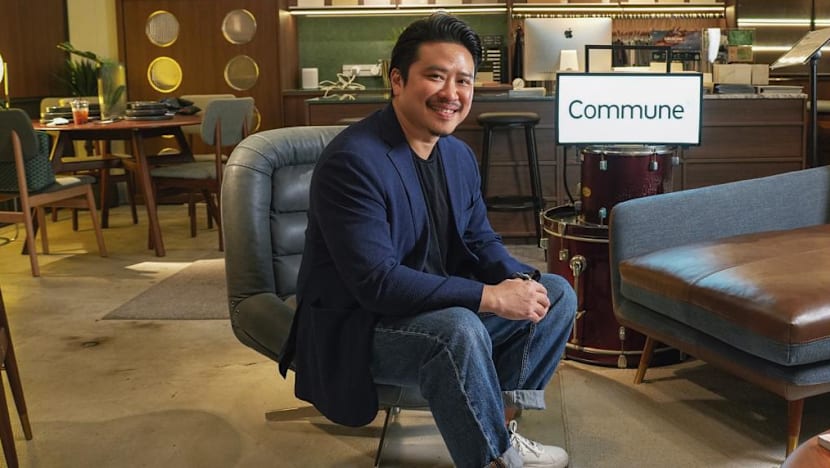
Julian Koh and the family story behind Singapore furniture brand Commune
Commune began as an extension of Koda, the Singapore family manufacturer that spent decades producing furniture for global brands.
That factory-floor legacy now shapes Julian Koh’s approach to design, from material choices to furniture made for contemporary Asian homes.
As Commune grows, the brand is looking beyond the showroom to build a wider ecosystem for homeowners, designers and interiors partners.
Long before Commune entered Singapore’s design vocabulary, there was Koda: a family enterprise shaped by timber, risk and the resilience of post-independence Asian manufacturing. Julian Koh’s grandfather, Koh Teng Kwee, was a design and technology teacher before trading the classroom for a small woodcraft workshop in Punggol. The family’s roots reach further back, to Wenzhou in China’s Zhejiang province, where an earlier generation had worked in furniture retail before looking south for a different future.
Koda’s first offerings were modest but exacting: jewellery boxes for Japanese clients, then speaker cabinets and, eventually, furniture. A folding director’s chair became an early calling card, taking the company from the humidity and sawdust of the workshop floor to international trade fairs, where foreign buyers began to recognise the discipline behind the craft.
The business faced its first serious test almost as soon as it began to grow. A fire gutted the factory in the mid-1970s, forcing a rebuild that would become part of the company’s institutional memory. By the 1980s, Julian’s father had joined, and Koda was manufacturing at scale, including for Ikea from around 1985. Those years delivered an unsentimental education in knock-down construction, export discipline and the quiet rigour that global retail demands.
THE INTELLIGENCE OF MAKING
Koda’s expansion mirrors a larger story of Asian production: Singaporean entrepreneurship, regional factories and an international clientele stretching from Europe and North America to Japan and Korea. Ikea brought volume, if not luxury margins. Later customers such as Crate & Barrel, Pottery Barn and Williams Sonoma brought sharper demands: more nuanced pricing, tighter product development and a closer reading of how homes were changing around the world.
The group mastered mixed-material furniture: wood against metal, leather against marble, upholstery against engineered precision. Its factory near Senai in Johor, Malaysia, took on craft-led work, while its Vietnam plant outside Ho Chi Minh City grew into the main production engine, drawing on a dense ecosystem of specialist partners.
For Julian, who leads design at Commune, the family advantage is orchestration: knowing which maker can handle a curve, which supplier can be trusted with a finish and which partner will deliver when a deadline turns unforgiving. In a design world newly enamoured of the phrase “supply chain”, Koda’s strength feels older and more intimate – a web of relationships, reputation and reliability built across decades.
That depth gives Commune an unusual backbone. Julian keeps his design team deliberately lean, supported by Koda’s larger R&D culture, where teams work through drawings, tolerances, materials and production refinements. The result is a brand that speaks the language of lifestyle without losing sight of how an object is made.
A DESIGNER FORMED BY FACTORY FLOORS
Julian grew up inside this choreography of making. Family life unfolded among materials, workers, canteen smells, deliveries and the repetitive, reassuring sounds of production. He remembers his grandmother stapling cushions. He remembers the factory as atmosphere: formative, physical, inescapable. “Sawdust in our blood,” he reflected.
At Temasek Polytechnic, that inheritance became discipline. Lecturers pushed him through machinery, joints, finishes, prototypes and critiques. He learned to think with his hands and to understand that a beautiful drawing is only the beginning of a difficult object.
Melbourne, where he pursued his design degree, widened the frame. The city – its cafes, thrift shops, music venues and ease of outdoor life – offered something less quantifiable. Julian began to understand furniture less as a product category than as part of a room’s total mood: an interplay of light, sound, temperature, scent and conversation. That sensibility now runs through Commune’s spaces, where a sofa functions as an invitation to inhabit a particular way of living.
COMMUNE AS ATMOSPHERE
When Julian returned to Singapore, he wanted the family business to step out from behind other people’s labels. He set out to build a Singapore-born interiors brand with manufacturing depth, emotional clarity and a clear point of view. The name carried the proposition neatly: furniture as a catalyst for gathering.
The pivot was far from obvious. The family understood factories. Retail meant rent, staffing, visual merchandising and the unpredictable theatre of walk-in customers. Julian first tested ideas in Indonesia, working across interiors and lifestyle concepts, before his grandfather encouraged the family to commit to retail in Singapore. Commune came together when Julian teamed up with his elder brother, Joshua, and their cousin, Gan Shee Wen, to launch the subsidiary; today, Joshua is its chief executive, while Shee Wen serves as chief operating officer.
Commune’s early showrooms pushed a deliberate atmosphere: dark walls, raw textures, industrial notes and carefully programmed music, closer in mood to a lived-in loft than a conventional furniture store. In pragmatic Singapore, where residents measure space precisely and weigh purchases by durability and price, the proposition was quietly daring. Commune asked customers to imagine not only what they might buy, but how they might live.
THE CHINA LESSON
China gave Commune its first encounter with scale. Around 2014 to 2015, the brand entered the market through trade fairs and franchise partners. The response was immediate: 10 stores were signed after an early show, and within a few years, its footprint had reached around 100 outlets. Julian took on the roles of designer, store planner, stylist and trainer simultaneously, learning the velocity and vulnerability of expansion in real time.
An early collection, inspired by wine barrels and a Melbourne cafe called Tusk, captured the moment precisely. Black metal bands, solid oak surfaces and a certain industrial confidence made the pieces speak directly to Asia’s design-conscious middle class: tactile, urban and recognisable without feeling generic.
The chapter grew complicated. As China’s economy softened, mall traffic weakened and franchisees grew wary of single-brand formats, Commune pulled back. The lesson was formative nonetheless. China taught the brand about retail discipline, franchise management and the delicate work of translating identity across cities, partners and cultural expectations.
A NEW GEOGRAPHY OF THE ASIAN HOME
Today, Commune maps its territory more selectively. Singapore remains the anchor; China is smaller than before. South Korea, Malaysia, Cambodia, the Middle East, India, Mexico and Japan each sit within a wider conversation about how Asian design brands travel – not as a single exportable aesthetic, but as interpreters of different domestic rituals.
Indian customers ask for colour, customisation and dining formats shaped by extended family life. The Middle East rewards scale and partnership. South Korea responds to a more edited rhythm of flagships and pop-ups. Mexico and Russia suggest another kind of opportunity altogether – evidence that contemporary Asian brands have moved well beyond predictable East-West narratives.
Back in Singapore, Julian is thinking beyond the furniture showroom. He wants to build a curated design ecosystem – a hub where homeowners and interior designers can discover furniture, flooring, wall coverings, lighting and audio from like-minded partners. His team is also developing a digital referral platform that allows designers and influencers to recommend products, complete purchases and earn commissions, translating the intimacy of personal recommendation into a scalable retail model.
DESIGNING FOR HOW ASIA LIVES NOW
Julian’s design language draws on emotion, craft and use. He notices the curve of a walnut edge, the cool temperament of marble, the way leather softens at the underside of an armrest and the proportions a dining table needs to feel generous inside a four-room HDB flat. He pursues the small decisions that determine whether a piece belongs naturally in daily life, rather than decorative flourish for its own sake.
Commune’s best work shows that rigour plainly: solid wood, considered joinery and careful finishing. Yet Julian pushes against the idea that good design should be reserved for larger private homes. He sees a larger opportunity in Singapore’s HDB households – design-aware owners who want furniture with character, intelligence and longevity, without the intimidation of luxury pricing.
He draws on Ikea’s discipline: how to make considered design attainable through careful sourcing, efficient production and clarity of purpose, while reaching for something with more material honesty. Customers may not always name the difference between walnut and rubber wood, but they understand proportion, comfort and finish. Julian’s task is to decide where material generosity matters, where the hand should remain visible and where restraint can make quality more democratic.
The most evocative idea on his horizon returns him to sound. Because Koda once made speaker cabinets, Julian is exploring furniture-adjacent speakers and audio objects in quality wood, holding them to the same standard he applies to tables, chairs and sofas. He is sourcing components, considering proportions and making drawings. The work is early, but the gesture is compelling. In a single object, cabinetry, light and sound might converge. The grandson would return to his grandfather’s material world, not through nostalgia, but through a vision of the contemporary Asian home in which design is seen, touched, lived with and heard.
Source: CNA/bt
Related stories

The Punch
WorldJul 4, 2026 · 1 min
EFCC arraigns siblings for alleged land fraud
The Punch
The Punch
WorldJul 4, 2026 · 1 min
Two rescued from Bauchi forest
The Punch
The Punch
WorldJul 4, 2026 · 1 min
Katsina arms traffickers bag 20-year jail term
The Punch
The Punch
WorldJul 4, 2026 · 1 min
Reputation more important than beauty in Nollywood — Uche Jombo
The Punch