Times of Israel
Rescued at Entebbe 50 years ago, former child hostage feels her experience resonating today
Ella Rosenkovitch was just five and a half years old when terrorists hijacked her family’s flight to Paris and diverted it to Entebbe, Uganda, on June 27, 1976.
But 50 years later, memories of the week she spent as a hostage before Israel’s legendary Operation Thunderbolt remain vivid — so much so that they motivated her to campaign for the return of Israelis kidnapped by Hamas on October 7, 2023.
“I was a small child at the time, and there are a lot of details that I only learned years later,” the 55-year-old Jerusalem resident told The Times of Israel in a telephone interview. “But I remember the most fateful moments very well.”
On the day of the hijacking, Rosenkovitch was on Air France Flight 139 with her parents and 10-year-old brother on a trip to visit her grandparents in Paris. Another brother, age 16, didn’t join the trip and remained in Israel alone. The flight, as expected, made a scheduled stop in Athens to pick up additional passengers.
But there, four terrorist hijackers — two Palestinians and two Germans — boarded the plane and forcefully diverted it, first to Libya and then to Uganda. Chaos erupted as the hijackers separated mothers and children from the rest of the passengers and moved them to the front rows of the aircraft, Rosenkovitch recalled.
Get The Times of Israel's Daily Edition
by email and never miss our top stories
By signing up, you agree to the terms
“I remember that I didn’t understand what was happening, so I asked my brother,” Rosenkovitch said. “He said he didn’t know, but I still remember the terrified look on his face.”
Her next memory is of the moment the hostages disembarked at Entebbe International Airport, after a refueling stop in Benghazi, Libya. Her mother cracked a dry joke that would be repeated for decades inside the family.
“She said, ‘Kids, we’ve landed in Africa. I’ve always wanted to visit Africa,'” Rosenkovitch recalled. “The way she said it sounded so wise and clever at the time.”
As the hostages were evacuated to a cavernous old terminal building at the airport, the hijackers announced their demands: $5 million and the release of 53 pro-Palestinian terrorists. If their demands were not met within three days, they said, they would start killing hostages.
Daily life as hostages
As negotiations dragged on, an uneasy routine emerged. The hostages slept on mattresses strewn out on the floor of the airport terminal, trying to remain calm as they awaited their fates. They were fed three substantial meals a day, with meat and rice and “the biggest bananas I’d ever seen,” Rosenkovitch said.
As Rosenkovitch tells it, she was the youngest of about 15 children and teenagers who were among the more than 250 hostages held in the cavernous old terminal building at Entebbe. She enjoyed playing with some of the French kids until they were released back to France on June 30 and July 1. After that, only a group of 106 mainly Israeli nationals remained in captivity.
“It was sort of a fun time, actually,” Rosenkovitch recalled. “Our parents worked very hard to keep the children calm and occupied, and to avoid showing fear. They organized activities and drawing activities for us, and put together a small library from the kids’ books we had.”
One young man, Jean-Jacques Mimouni, spent hours playing all sorts of games with the older kids, Rosenkovitch remembered. He would later be killed in the rescue operation.
Rosenkovitch recalled playing outdoors with a French girl named Sandrine, kicking around an empty Nescafé can and feeling, as a child, strangely liberated from everyday rules.
“My father told me that I asked him several times if we were going to do the same thing tomorrow, and that I was happy when he said yes,” she said. “That says a lot about how the parents managed to get us through this.”
But sanitary conditions deteriorated as the days passed, and by midweek, some hostages had become ill. Rosenkovitch didn’t have a change of clothes and wore the same dress for the entire seven days, she recalled.
Idi Amin, the Ugandan president who threw his support behind the hijackers, would come to visit the hostages on an almost daily basis.
“He was such a big man, wearing a uniform,” Rosenkovitch remembered. “He seemed terribly scary to me.”
A daring rescue mission
The hostages had no idea that four Israeli C-130 Hercules transport aircraft landed without lights at 11 p.m. on July 3, so they — and the entire world — were shocked by what happened next.
“I can’t forget waking up to gunshots that night,” Rosenkovitch said. “We were terribly scared and didn’t understand what was happening. We didn’t know it was the IDF, and we thought the terrorists had come in to finish us off.”
Rosenkovitch’s parents moved their mattresses on top of the kids to try to protect them from bullets. “It was only for a few seconds, but it felt like a long time,” she said. “I felt like I was suffocating under them.”
But then they heard shouts in Hebrew. “They yelled, ‘Lie down on the floor. Don’t get up, don’t get up.’ Then we realized that they had come to rescue us.”
What followed was chaos, Rosenkovitch recalled. The commandos ordered the hostages to run toward the waiting aircraft on the dark tarmac.
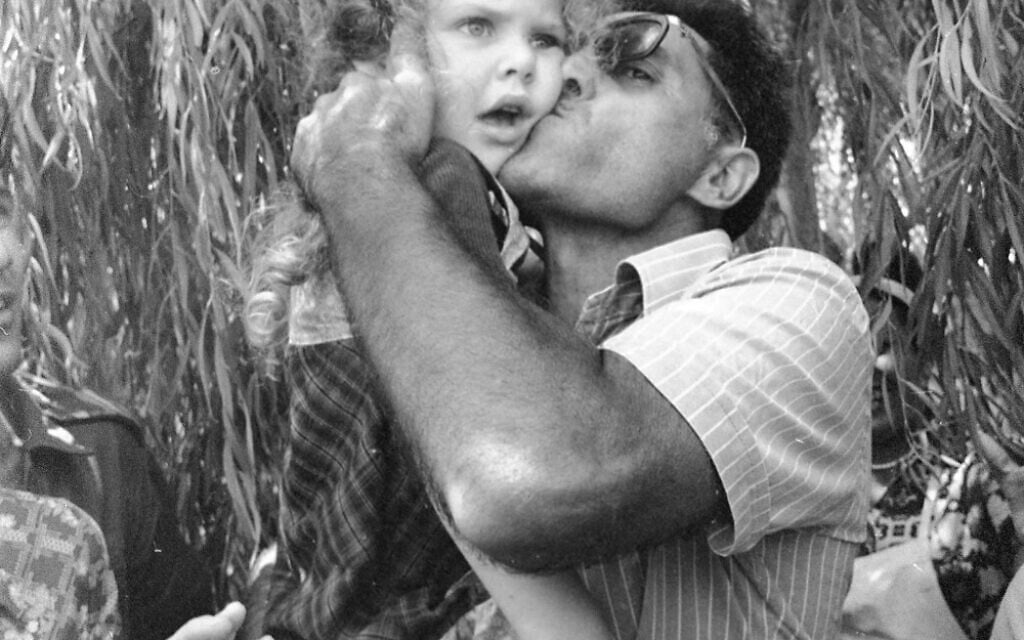
“I started looking for my sandals, but I couldn’t find a single one,” she remembered. “My father just grabbed me in his arms and we ran.”
Her next memory is of seeing fire on both sides of the airfield — she later understood that these were Ugandan Air Force jets that the IDF was destroying to prevent pursuit. The flight was a blur, Rosenkovitch said, and after a brief stop in Nairobi, Kenya, everyone fell asleep in exhaustion on the way home.
Out of the 106 hostages, three were killed, including Mimouni. One was left in Uganda, and approximately 10 were wounded. The entire operation lasted just 53 minutes, as the IDF took out seven hijackers, 45 Ugandan soldiers, and 11 Ugandan MiG jets.
Five IDF commandos were wounded during the operation, and one was killed — Yoni Netanyahu, the commander of the elite Sayeret Matkal unit and brother of current Prime Minister Benjamin Netanyahu. The successful rescue mission, carried out on the day the United States celebrated its bicentennial, astounded the world and quickly became the stuff of Israeli legend.
Living in the aftermath
Rosenkovitch has seen photographs and news footage of her plane’s arrival at Ben Gurion Airport, with the huge crowds and celebrations — but she doesn’t remember it. She was probably in complete shock at the time, she said.
But she does remember her arrival back home.
“The whole neighborhood is waiting for us outside,” Rosenkovitch said. “All of the neighbors were extremely concerned, and our entire entrance was filled with signs and greetings. The house was full of flowers. My brother came back to us after friends of our parents took care of him during this time.”
Then, Rosenkovitch’s father decided he needed closure on an unfinished matter. Four days after returning to Israel, her father insisted the family board another flight to Paris and complete the vacation terrorists had tried to destroy.
“I don’t know where he got the strength from, but he decided that we would fly to Paris again to visit as we had planned,” she recalled. “Four days later, we went back to France to see my grandparents, after everything we’d been through. We had an amazing trip, and then we returned to Israel and continued life as usual. There was no psychological therapy or counseling or anything like that, but it was an incredible healing process.”
Rosenkovitch is still in touch with some of the Entebbe children — now in their 50s and 60s — through a WhatsApp group they created in 2016 after attending events marking the 40th anniversary of the rescue.
Most of the children held at Entebbe went on to lead ordinary lives despite their ordeal, she said. Rosenkovitch built a career for herself in journalism, married, and raised a family.
But in recent years, something has shifted.
“The story of the hostages taken by Hamas on October 7, 2023, really affected me,” she said. “What we went through was nothing compared to what they went through, but I felt that Israel had to do everything to get them back.”
In January 2026, Israel retrieved the body of Ran Gvili, the last of the 251 hostages kidnapped to Gaza during the invasion. In all, 166 hostages were rescued or released alive, and the remains of 85 were returned, some of whom were dead upon their abduction.
Rosenkovitch joined rallies organized by the Hostages and Missing Families Forum and, despite her naturally reserved personality, even addressed demonstrators from the stage. Something inside her compelled her to speak out, she said.
“I was only five years old at the time, but lately, I think about my captivity all the time,” Rosenkovitch said. “After everything I went through, I believe the most important thing is that our country never gives up on you.”
View original source — Times of Israel ↗
Related stories

The Punch
WorldJul 4, 2026 · 1 min
UNIOSUN rejects Army position on assault claims, seeks legal action
The Punch
The Punch
WorldJul 4, 2026 · 1 min
Oyo APC gov candidate donates N25m to market fire victims
The Punch

Indian Express
WorldJul 4, 2026 · 1 min
Europe is getting hotter. And air conditioners are not the answer
Indian Express
The Punch
WorldJul 4, 2026 · 1 min
Iran’s supreme leader Khamenei’s funeral ceremonies begin
The Punch