Indian Express
Knowledge Nugget | July in History : 5 key events every UPSC aspirants must know
Take a look at the essential concepts, terms, quotes, or phenomena every day and brush up your knowledge. Here’s your UPSC knowledge nugget of important historical events from July for today.
Month-wise history events present an opportunity for aspirants to connect history-related news from a particular month with current affairs. The month of July marks the birth and death anniversaries of several prominent personalities, as well as significant events ranging from the passing of the Independence Act to the Kargil War. Understanding these personalities and their contributions, along with these historical developments, is important from the examination perspective. Here are five important historical events from the month of July.
Key takeaways:
#1 Simla Agreement
— The Simla Agreement emerged directly from the aftermath of the 1971 Indo-Pakistani War, a conflict that led to the creation of Bangladesh from East Pakistan.
— After the war, both Prime Minister Gandhi and President Bhutto publicly expressed a desire to usher in a new era of peace. On June 28, 1972, the two leaders met at the hill station of Simla. The agreement was signed on July 2, 1972.
— The Simla Agreement primarily deals with two things: how bilateral relations are to be conducted between the two countries, and the recognition of the Line of Control (LoC) as the de facto border.
— Its central provision declared that “the two countries are resolved to settle their differences by peaceful means through bilateral negotiations or by any other peaceful means mutually agreed upon between them. Pending the final settlement of any of the problems between the two countries, neither side shall unilaterally alter the situation and both shall prevent the organisation, assistance or encouragement of any acts detrimental to the maintenance of peaceful and harmonious relations;”
— These are not legally binding obligations, but contain what is commonly referred to as “best endeavour clauses” which both countries agreed to.
Story continues below this ad
#2 Indian Independence Act, 1947
— On July 5, 1947, the British Parliament passed the Indian Independence Act, based on the Mountbatten Plan, and it received royal assent on July 18, 1947. The Act was implemented on August 15, 1947.
— This act led to the creation of Pakistan and India on August 14 and 15, 1947, respectively. The act was passed by the Labour government of Prime Minister Clement Attlee, while the powerful Conservative Leader of the opposition, Winston Churchill, reluctantly accepted Indian independence.
— The Indian Independence Act provided that each dominion was to have a Governor-General responsible for the effective operation of the Act. The Constituent Assembly of each dominion was to exercise legislative powers, and the existing Central Legislative Assembly and the Council of States were to be automatically dissolved. Until a new constitution was adopted by each dominion, the governments were to function according to the Government of India Act, 1935.
— As per the Indian Independence Act, 1947, Pakistan became independent on August 14, 1947, while India gained its freedom on August 15, 1947. Muhammad Ali Jinnah was appointed the first Governor-General of Pakistan. In contrast, India requested Lord Mountbatten to continue as its Governor-General, reflecting a symbolic continuation of British oversight during the transitional period.
Story continues below this ad
#3 Death anniversary of Swami Vivekananda
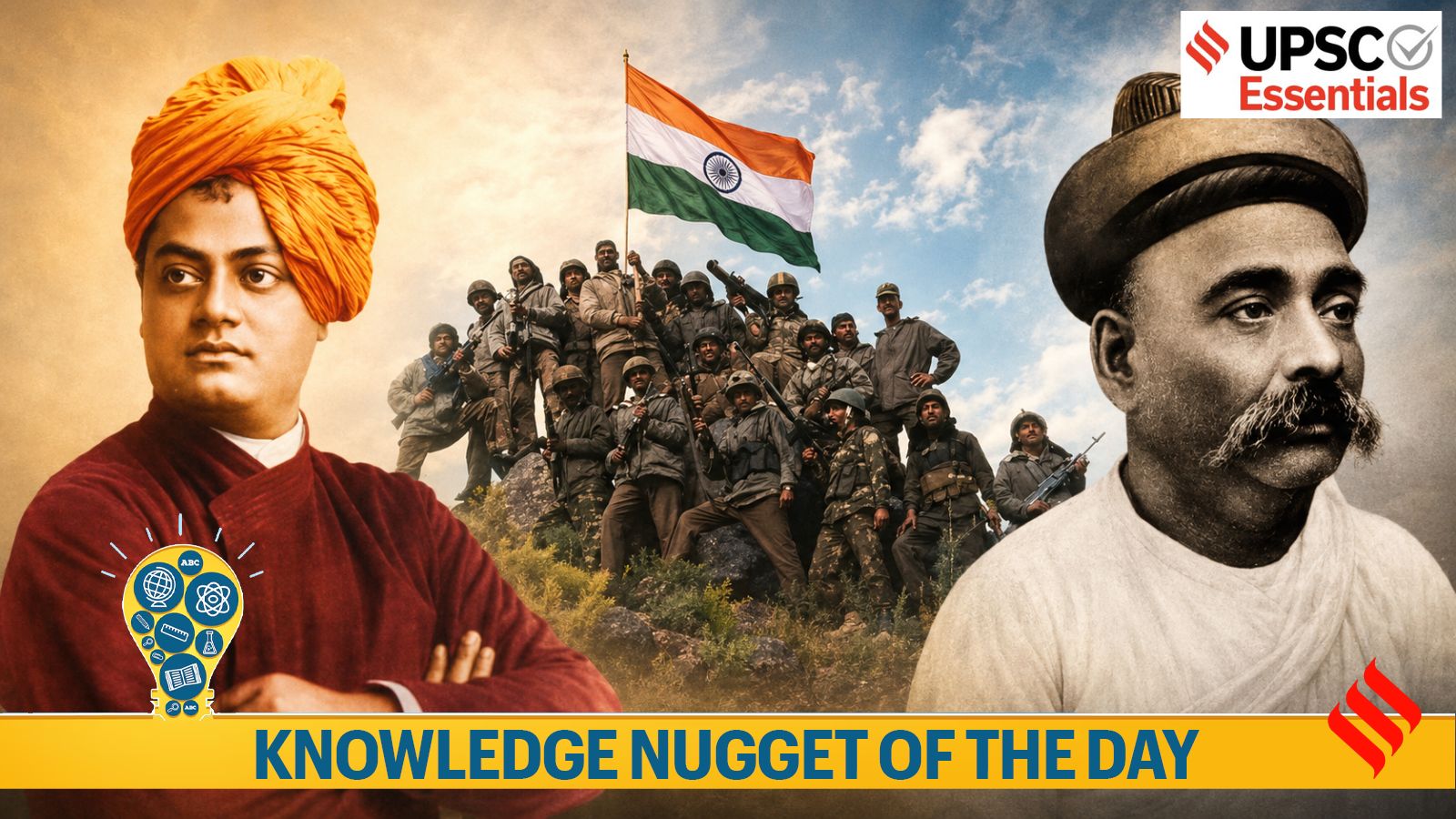
— ‘Arise! Awake! And stop not until the goal is reached, is one of the oft-repeated words of Swami Vivekananda, who died at an early age of 39 years on July 4, 1902. Born as Narendra Nath Datta, he acquired the name Swami Vivekananda when he became a monk.
— January 12 is the birth anniversary of Swami Vivekananda. He was born in Kolkata in 1863 as Narendra Nath Datta. In his honour, the government of India in 1984 declared his birthday as National Youth Day.
— Swami Vivekananda is known to have introduced the Hindu philosophies of Yoga and Vedanta to the West. From an early age, he nurtured an interest in Western philosophy, history, and theology, and went on to meet the religious leader Ramakrishna Paramhansa, who later became his Guru.
— After Ramakrishna’s death, Vivekananda devoted his life to the regeneration of Hindu society. He sought to reconcile the dualistic philosophy he inherited from his master with his belief in Advaita philosophy.
Story continues below this ad
— In 1893, he took the name ‘Vivekananda’ after Maharaja Ajit Singh of the Khetri State requested him to do so, changing from ‘Sachidananda’ that he used before.
— Vivekananda is especially remembered around the world for his speech at the Parliament of the World’s Religions in Chicago in 1893. The speech covered topics including universal acceptance, tolerance and religion, and got him a standing ovation.
— After coming back to India, he formed the Ramakrishna Mission in 1897 “to set in motion a machinery which will bring noblest ideas to the doorstep of even the poorest and the meanest.”
— In 1899, he established the Belur Math in Howrah, West Bengal, which became his permanent abode.
Story continues below this ad
— Before his death in 1902, Vivekananda wrote to a Western follower: “It may be that I shall find it good to get outside my body, to cast it off like a worn out garment. But I shall not cease to work. I shall inspire men everywhere until the whole world shall know that it is one with God.”
#4 Birth of Bal Gangadhar Tilak
— Bal Gangadhar Tilak, popularly known as Lokmanya Tilak, was born on July 23, 1856, at Ratnagiri, Maharashtra. Mahatma Gandhi called him “the Maker of Modern India”, and Jawaharlal Nehru described him as “the Father of the Indian Revolution”.
— A lawyer, scholar, and journalist, Tilak joined the Indian National Congress in 1890. Initially, his stance was not very different from that of the Congress, of demanding reforms and more rights for Indians, but not necessarily a total revolution.
— Tilak has authored several influential works. In 1881, Tilak, along with G G Agarkar, founded the newspapers ‘Kesari’ (in Marathi) and ‘Mahratta’ in English, and used them to spread nationalist resistance against British rule. He has also written Geeta Rahasya,Orion, The Arctic Home of the Vedas and many more.
Story continues below this ad
— In 1893, he started the new tradition of worshipping Ganpati as a community festival where patriotic songs would be sung and nationalist ideas would be propagated.
— To further the cause of nationalist resistance, Tilak started the Shivaji festival in 1896. The aim was to inspire nationalist ideas among young Maharashtrians.
— Along with Lala Lajpat Rai and Bipin Chandra Pal, Tilak became part of the Lal Bal Pal troika, which advocated complete freedom from the British as the goal, and the pursuit of unconstitutional means, including violence, to attain that goal.
#5 Kargil Diwas
— The Kargil Vijay Diwas, observed annually on July 26, commemorates India’s victory against Pakistan in 1999, and the sacrifices of her soldiers, who braved much more than just the Pakistani infiltrators to emerge victorious in Kargil.
Story continues below this ad
— The Kargil war commenced shortly after the signing of the Lahore declaration when the Pakistani army infiltrated the Indian side of the LoC and occupied the winter vacated posts of the Indian Army.
— Following the detection of the intrusions, the Indian Army launched its military operation – Operation Vijay – with an aim to ‘Contain-Evict–Deny’.
— Between mid-May and July, the Indian forces slowly recaptured critical positions from the Pakistanis, in the face of heavy casualties. The Army announced the complete withdrawal of all Pakistani regular and irregular troops from Kargil on July 26.
— As per official figures, Indian casualties at the end of the War stood at 527 dead, 1,363 wounded and 1 PoW (Fl Lt K Nachiketa, whose MiG-27 was shot down during a strike operation).
Story continues below this ad
— Kargil is located at the northern edge of the LoC, some 200 km northeast of Srinagar and 230 km west of Leh. Kargil town lies at an altitude of 2,676 m (8,780 ft), Dras lies at a height of 3,300 m (10,800 ft), and the surrounding peaks rise to altitudes of 4,800 m (16,000 ft) to 5,500 m (18,000 ft).
BEYOND THE NUGGET: American Declaration of Independence
July is important for the United States as well. This year, the United States is celebrating 250 years of independence on July 4, 2026.
1. It was the day when the Declaration of Independence, the document which marked the foundation of the US as a union of states liberated from Britain, was signed.
2. In June 1776, a committee comprising Thomas Jefferson, John Adams, Benjamin Franklin, Roger Sherman, and Robert R Livingston was elected to draft a statement justifying the assertion of independence, should the event arise.
3. The text itself was largely written by Jefferson, who had previously written ‘A Summary View of the Rights of British America’ in 1775. In this treatise, he wrote, “Single acts of tyranny may be ascribed to the accidental opinion of a day; but a series of oppressions, begun at a distinguished period, and pursued unalterably through every change of ministers, too plainly prove a deliberate and systematical plan of reducing us to slavery.” Ironically, Jefferson owned more than 600 slaves.
4. Nonetheless, the Declaration followed suit from this document. It was signed by 56 delegates, including the five-member committee that framed it, and these signatories would forever be identified as the United States’ founding fathers.
5. The British would formally recognise American independence after its defeat in the Revolutionary War in 1783. The US won with the support of Britain’s European rivals — France, Spain, and the Dutch Republic.
Post Read Question
Bal Gangadhar Tilak was associated with: (UPSC CAPF 2015)
1. Poona Sarvajinik Sabha
2. The Age of Consent Bill
3. Gaurakshini Sabha
4. Atmiya Sabha
Select the correct answer using the code given below:
(a) 1 and 2 only
(b) 1, 2 and 4
(c) 3 and 4
(d) 2 and 4 only
Answer Key
(a)
Subscribe to our UPSC newsletter. Stay updated with the latest UPSC articles by joining our Telegram channel – IndianExpress UPSC Hub, and follow us on Instagram and X.
🚨 Click Here to read the UPSC Essentials magazine for June 2026. Share your views and suggestions in the comment box or at [email protected]🚨
View original source — Indian Express ↗
Related stories

TechRadar
TechnologyJul 4, 2026 · 1 min
How to watch Australia vs Ireland: FREE streams, TV channels for Nations Championship 2026 game
TechRadar

Philippine Daily Inquirer
TechnologyJul 4, 2026 · 1 min
Luke Ishikawa Plowden bats for AI use in doing good with least harm
Philippine Daily Inquirer

The Verge
TechnologyJul 4, 2026 · 1 min
The Kuxiu D5 keeps Qi-compatible phones cool while also charging a watch and earbuds
The Verge

Straits Times
TechnologyJul 4, 2026 · 1 min
St Petersburg region hit by major Ukrainian drone attack, Russian officials say
Straits Times