Indian Express
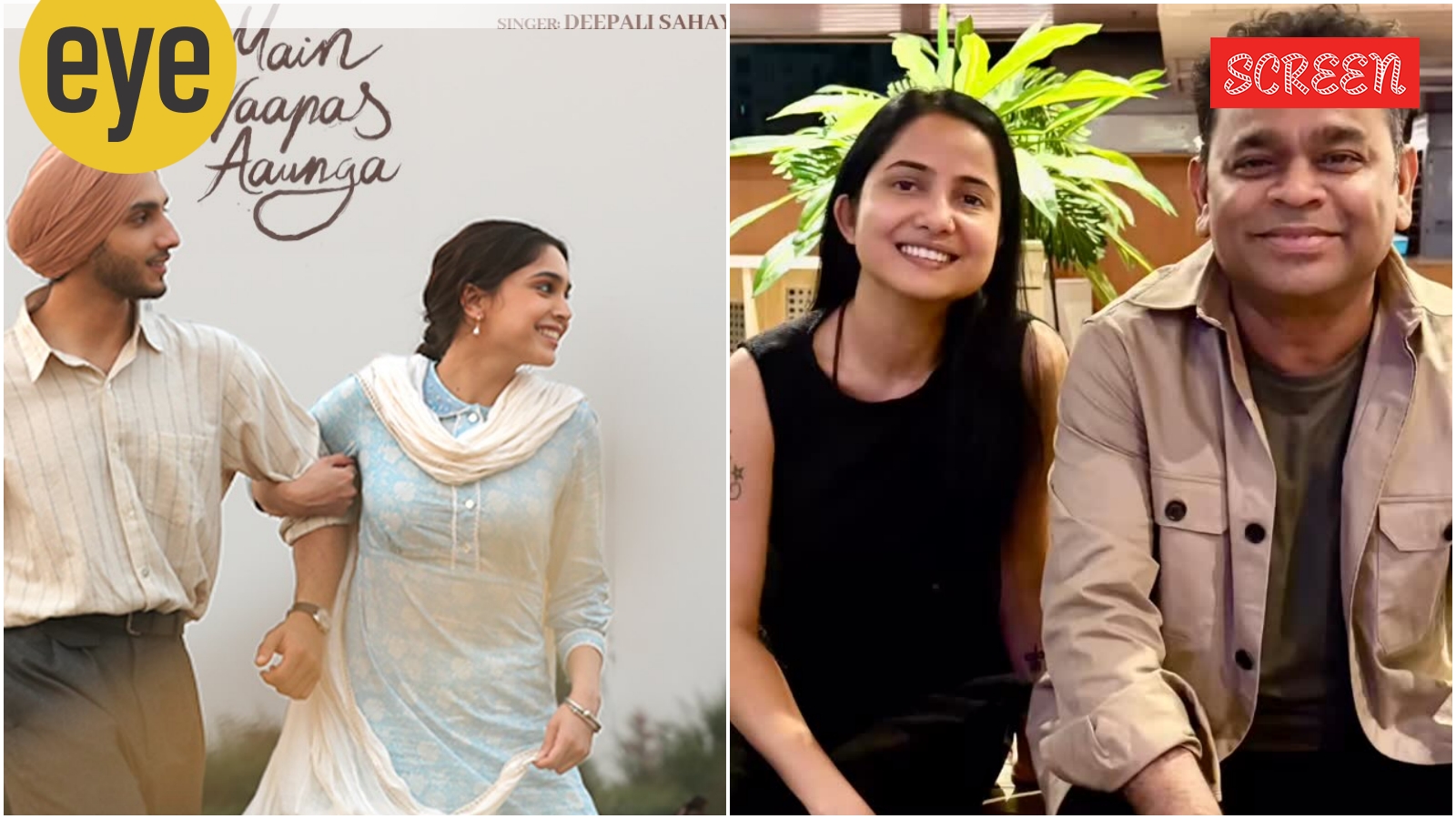
Meet Deepali Sahay, the Voice Behind Main Vaapas Aaunga’s ‘Tere Paas Main’
There is a wistfulness that moves through Tere paas main, composer AR Rahman and lyricist Irshad Kamil’s poignant ditty in Imtiaz Ali’s Main Vaapas Aaunga. But what makes the song compelling, especially in the increasingly forgettable Hindi film music landscape of today, is that it lingers after the fade-out: Still the hallmark of a great song.
Set to the serenity of oft-explored raag Yaman, the longing of two lovers is deftly anchored in the hope that, torn apart by Partition, they might just find each other one day. Even if logic suggests otherwise. With no catchy hook or a hard beat drop — a norm in the reverse-engineered songs of today — the emotional pull of Tere paas main has translated into much traction online, with listeners left misty-eyed in cinema halls.
At the centre of the song’s emotional landscape is 37-year-old singer Deepali Sahay, whose nuanced rendition has given the piece an emotional gravitas. The song has also reintroduced Mumbai-based Sahay to a national audience, in turn bringing long overdue attention to a musician who began her career two decades ago in popular reality show Indian Idol and made it to the Top 7. But Tere paas main has catapulted Sahay to another kind of fame: the song is inspiring numerous covers on social media.
“People dream of this. An artiste always craves warmth from her audience. But for a Bollywood fan like me, to be a part of this industry in itself is overwhelming. Then to be called in by Mr Rahman to sing… Believe me, I didn’t expect this. But I’m absolutely loving what has happened,” says Sahay, who acted in daily soaps besides promoting Bhojpuri folk music on her YouTube channel before an unexpected call from Rahman’s team on January 6, her birthday as well as Rahman’s.
The composer wanted “to try out” her voice. “He had followed me on Instagram. That’s what told me that he may have liked my voice,” says Sahay, who went to Chennai a month later and was briefed on the story of Ali’s Partition saga and the separation of two lovers before she recorded at the Oscar-winning composer’s home studio in Kodambakkam. “He sang and I repeated. Once the song was in me, he asked me to sing the way I wanted to sing it. He never asked me what I had done in life before this or if I had any recording experience. How empowering is it to hear a composer of his stature not have you ask any questions,” says Sahay.
For Mumbai-based Sahay, however, this moment of success has come after nearly two decades of pursuing music away from the glare of mainstream recognition. Growing up in Patna amid fierce academic competition, her joint family was sure that “ladki UPSC nikaalegi”. That Sahay was academically bright, helped. That she could sing was discovered by her mother, who thought that someone was singing on the radio when Sahay, only a toddler then, was crooning Aye malik tere bande hum, her school prayer in the next room. This led Sahay to a few music teachers in Patna, who taught her the basics of classical music. There was also the steady diet of golden oldies on the radio. Just before her 12th board exams, Sahay auditioned for Indian Idol. Her stint on the reality show gave her recognition and prompted a move to Mumbai to be a playback singer. A musician from the show’s band introduced her to composer Monty Sharma at Yash Raj Studios, a meeting she remembers as a dream come true. “But days later this musician wanted a foreign national to stay at my apartment for three months. I was expected to return the favour,” says Sahay, who decided to walk away from Bollywood. “I knew this was just the beginning,” she says. “If I agreed once, the compromises wouldn’t end there.”
At this point, she got an acting assignment, a Bhojpuri show, Badki Malkain. The money was good and Sahay didn’t want to refuse. But she was not taught Bhojpuri at home and “consciously kept away from my mother tongue”. “Even though elders spoke Bhojpuri, we were told it always had vulgar connotations due to raunchy cinema and music. I was asked to work on my spoken English by my progressive parents, get educated and leave Bihar,” says Sahay, who didn’t find anything lewd in the script. The show eventually became quite popular in Purvanchal and Bhojpuri-speaking parts of Bihar and Jharkhand. “I was really attracted to the language. It felt extremely sweet,” says Sahay, who also studied direction at Film and Television Institute of India (FTII).
It took Sahay about eight years to realise that while many artistes from Bihar had found success in Bollywood, few were working to reclaim Bhojpuri’s rich musical heritage, which was now overshadowed by sexually explicit songs. She turned to traditional Bhojpuri folk, hoping to “challenge the stereotypes surrounding it”. Through simple, self-produced videos, first with journalist Neelesh Misra’s Gaon Connection and later on her YouTube channel Bhojpuri Classics with Deepali Sahay, she began to revisit folk forms such as sohar, kajri, vivah geet and Chhat songs, while also introducing audiences to forgotten Bhojpuri film classics once sung by Lata Mangeshkar, Asha Bhosle and Manna Dey. “The idea was to restore the respect the language deserves. If I can talk in English and still relate to Bhojpuri, I was going to make people relate to it. I wanted to give it the dignity it deserved,” says Sahay.
It was one of her devi geet videos that eventually found its way to Rahman, who shared it with Kamil and Ali on WhatsApp, setting in motion a chain of events that bridged the gap between Sahay’s world and mainstream Hindi cinema. The result, Tere paas main, has made Sahay more than just a familiar name. It has made an audience understand that the voice behind one of the year’s most moving songs was nurtured by folk music and its storytelling traditions. Perhaps that is where Sahay draws her emotional depth for a composition that continues to resonate with the audience.
As for newer offers, Sahay eagerly awaits her next song.
On our radar is a new series that profiles artistes in the spotlight
View original source — Indian Express ↗
Related stories

The Punch
WorldJul 4, 2026 · 1 min
Peter Obi warns of worsening hunger crisis in northern Nigeria
The Punch

Euronews
WorldJul 4, 2026 · 1 min
Up to 42°C in Spain: nine regions on alert for extreme heat
Euronews
Indian Express
WorldJul 4, 2026 · 1 min
CBSE Class 10 Second Board Exam Result 2026 Live Updates: Marksheets expected soon at cbse.gov.in
Indian Express

Lovin Malta
WorldJul 4, 2026 · 1 min
Llandilo Named Australia’s Most Maltese Suburb, With 27.9% Claiming Maltese Ancestry | Lovin Malta
Lovin Malta