Indian Express
Around Town: How Chembur’s Nandu Vada Pav became Mumbai’s famous ‘Aunty Vada Pav’
It was in 1986 that Nandu Vada Pav was started. Four decades later, it has become Chembur’s go-to vada pav spot. In fact, it has also earned a moniker — Aunty Vada Pav after its co-founder Kalpana Nandkishore Purao.
“The official name is still Nandu Vada Pav, after my husband’s name Nandkishore who is affectionately called Nandu by everyone. Initially we both used to man this stall but in recent years, I am here more often than him and that’s why the name,” shared Kalpana, now 65. She was only 21, and a mother of a two-and-a-half-year-old daughter when her husband’s friend jokingly said, “Chal Nandu, tu apni vada pav ki gadi laga le (You start your own vada pav stall)!.” Until then, Nandkishore, now 65, was driving an autorickshaw and had a family of five to look after — himself, his parents, his wife, and their daughter. While he was able to keep the family afloat, it wasn’t yielding a lot. The kind friend also lent him Rs 2,000 to buy supplies and put together a stall.
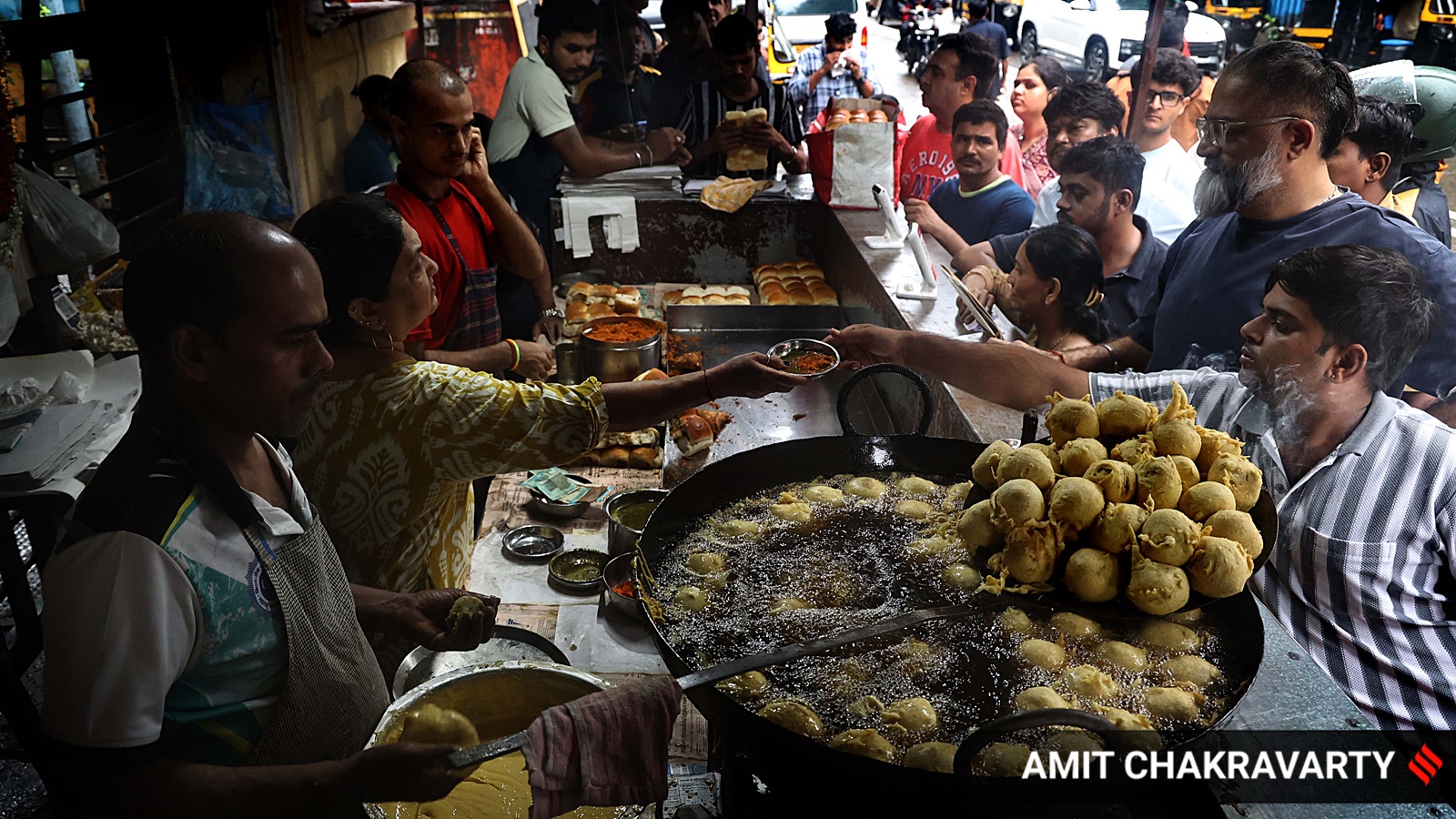
People queue outside Nandu Vada Pav on a very rainy evening in Mumbai. (Express photo by Amit Chakravarty)
“So we started a small staff here,” said Kalpana. By here, she means Chembur Gaothan, opposite the post office. Her home is in the same neighbourhood. A young Kalpana would do all the domestic chores needed to run her house, tend to her inlaws, her young daughter, cook all meals for them, and in between them, find time to boil potatoes, make the vada masala, two kinds of chutneys, make besan batter and be alongside her husband and her two brothers at the stall by 4 pm, where the vadas would be fried live, and then vada pav would be assembled. In 1986, a single vada pav was sold by them for 75 paisa. “We would sell about 30-50 ladis,” she recalled. Each ladi means 6 pavs. “Our families came to support us, and how. My father-in-law would go on cycle and buy all the supplies in the morning. My mother-in-law would peel all potatoes. My brothers came to help, sometimes manning the stall and whatever needed to be done,” she added.
It kicked off. One evening when we went, Kalpana could be seen wearing a kurta, a chanda bindi on her forehead and a smile that never leaves her face, opening a vada pav, slathering a runny green chutney, rubbing red dry chutney and handing it over to her staff to stuff a vada, which is constantly being fried in a kadai nearby. When we tried to talk, she politely told us that it is just not possible, and instead gave us her number. On the phone, she told us that they set up their stall at 5 pm and shut around 9 pm when the stock gets over and in those four hours, they don’t have any breathing space. She admits it’s a good problem to have.
It’s Kalpana’s daily presence that led to people starting to refer to it as ‘Aunty Vada Pav’. (Express photo by Amit Chakravarty)
She now has a team of 15 people, and about six of them come as early as 10 am to start preparing for the day. On a daily basis, around 150 kgs of potatoes is purchased for vadas. “On some days, we use all of it, on other days we use most of it,” she shared, adding that almost all her vendors have remained the same — ladi pav from a bakery in Bandra, besan from a vendor near by and so on.
A lot of vada pav’s wala secret sauce is usually the chutney, and they are quite secretive about it and why not, it’s the trick of their trade. But not Kalpana. When asked about her chutneys, she has no hesitation in sharing the ingredients. “The green chutney is made from green chillies, coriander, tamarind, sugar and salt. And, the red dry chutney is made from besan bundi, red chilli powder, garlic and salt,” she said matter-of-factly.
She now has a team of 15 people, and about six of them come as early as 10 am to start preparing for the day. (Express Photo by Amit Chakravarty)
When asked if monsoon is her peak season, she smilingly adds that for them everyday is season. “We don’t have a relax day,” she said, adding that her customers come from not only Chembur but also Borivali, Thane, Dadar and every other corner of this city. “In fact, they also support me a lot. When there was a gas crisis, I was arranging cylinder from every possible place, from Alibaug to Bhayandar, Panvel and paying as much as Rs 10,000 for them. My customers were the ones who told me to not think and increase the price as needed, assuring that they will be here queuing for it.”
It now sells at Rs 25 a piece.
Story continues below this ad
Kalpana admits that today, she has more than she needs. They husband-wife duo is now 65, and take frequent trips, mostly to religious places, Vaishnav Devi being their annual pilgrimage. As for the future of Nandu Vada Pav, she said: “We are running till we can. When we can’t, I have a nephew who has been with me since early on and my daughter, they will carry forward the legacy.”
View original source — Indian Express ↗
Related stories

TechRadar
TechnologyJul 4, 2026 · 1 min
American soccer fans turn to VPNs to dodge the World Cup's hydration break ads
TechRadar

TechRadar
TechnologyJul 4, 2026 · 1 min
‘You fix it by making the secure option just as fast and frictionless as the risky one’
TechRadar
Indian Express
TechnologyJul 4, 2026 · 1 min
Mumbai declares afternoon holiday for schools, colleges amid red alert
Indian Express
Indian Express
TechnologyJul 4, 2026 · 1 min
Jodhpur gets a new airport terminal as Modi launches Rs 28,840 cr UDAN scheme. What this means
Indian Express