Times of India
How High Altitude Pseudo Satellites will give India's military eyes in the sky for weeks
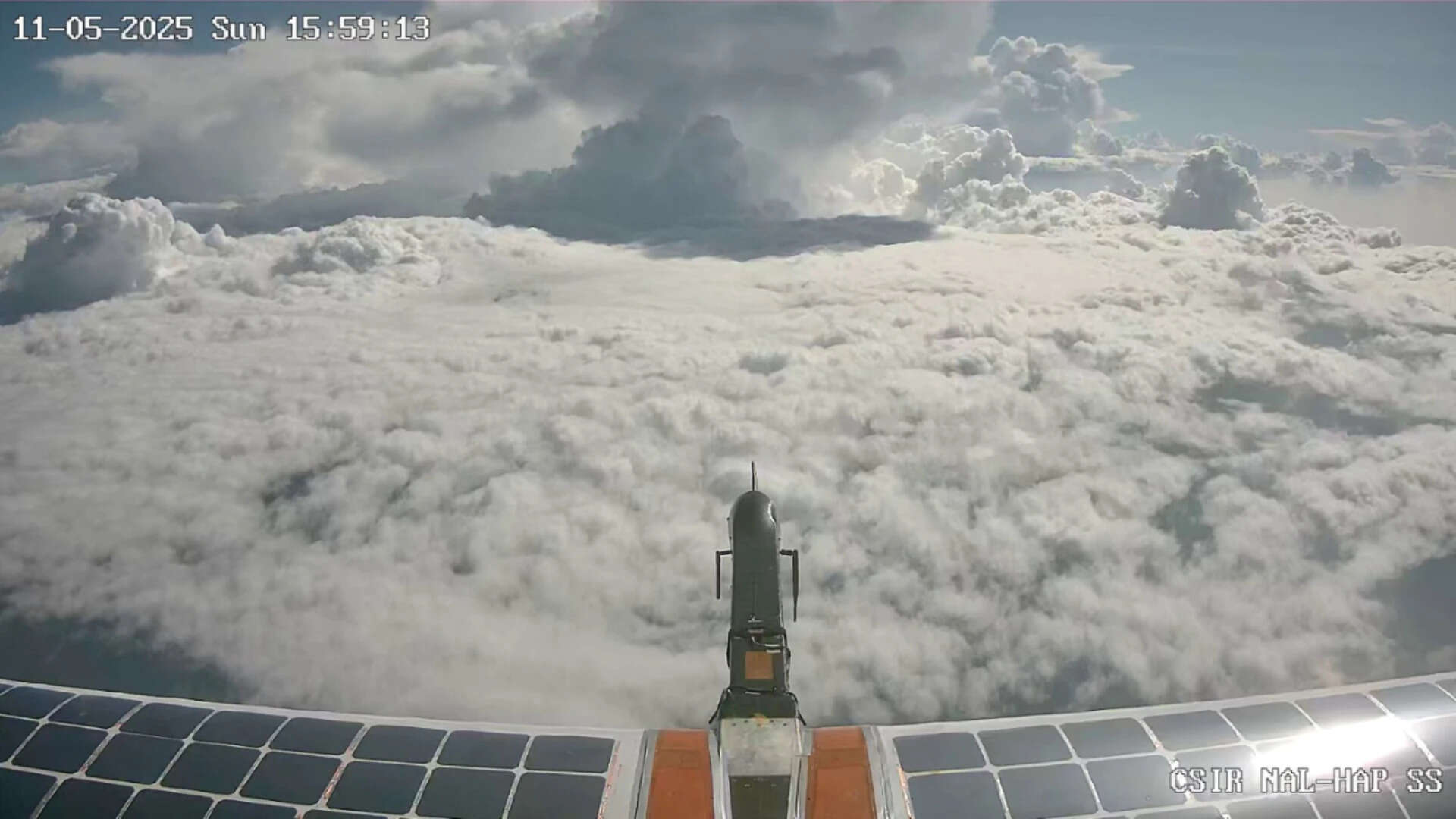
National Aerospace Laboratory's high-altitude pseudo-satellite flying above the clouds. (Image credit: NAL)
NEW DELHI: The Defence Acquisition Council (DAC), chaired by defence minister Rajnath Singh, has cleared the procurement of High Altitude Pseudo Satellites (HAPS) for the Indian Air Force. The move is expected to significantly enhance the armed forces' intelligence, surveillance and reconnaissance capabilities.HAPS is an Unmanned Aerial Vehicle (UAV) designed to operate at an altitude of around 20 km (65,000 feet). According to the National Aerospace Laboratories (NAL), this altitude is above both commercial airline flight paths and most weather systems. HAPS combines the persistent surveillance capability of a geostationary satellite with the mobility and flexibility of an aircraft, effectively bridging the gap between the two.Operationally, a single HAPS can provide continuous optical, infrared and signals intelligence coverage over a 500 km radius for weeks, far exceeding the revisit cycles of satellites and the endurance limits of conventional patrol aircraft.India has already demonstrated indigenous capabilities in this field. On May 3, 2025, DRDO conducted the maiden trial of its Stratospheric Airship Platform, reaching an altitude of 17 km.
Around the same time, CSIR-NAL's solar-powered fixed-wing demonstrator completed a flight lasting more than 10 hours at 7.6 km. A full-scale stratospheric flight to 20 km is targeted for 2027.Globally, Airbus' Zephyr has set the benchmark by completing a 67-day continuous flight in April 2025. Such extended endurance is made possible by lightweight, solar-powered aircraft equipped with highly efficient solar panels mounted on their wings and supported by battery systems.Unlike traditional lighter-than-air balloons and airships, which have struggled with station-keeping because of wind and solar heating, heavier-than-air solar-powered UAVs offer greater stability. The aircraft under development by CSIR-NAL uses solar energy during the day and batteries for night operations.The full-scale NAL HAPS is expected to have a wingspan of more than 30 metres, wider than an Airbus A320, while weighing only about 150 kg, roughly the weight of a motorcycle.
The ultra-lightweight design is essential because the aircraft relies entirely on solar energy for propulsion and payload operations.The engineering challenges remain significant. Operating at stratospheric altitudes and low airspeeds requires exceptional aerodynamic efficiency. The lightweight airframe presents aeroelasticity challenges, while the propellers must perform efficiently from sea level to the stratosphere, where air density is only about 7% of that at sea level.The aircraft must also withstand temperatures as low as -85°C and extremely low atmospheric pressure, placing considerable demands on avionics, payload systems and batteries.Despite these challenges, NAL's subscale demonstrator has already completed an 11-hour flight at 25,000 feet, demonstrating the feasibility of scaling up the technology.
View original source — Times of India ↗
Related stories
South China Morning Post
TechnologyJul 4, 2026 · 1 min
Drug traffickers using social media to hire Thai airline staff as couriers
South China Morning Post

ZDNet
TechnologyJul 4, 2026 · 1 min
I found 4 Bluetooth gadgets that are highly functional - and cheap
ZDNet

ZDNet
TechnologyJul 4, 2026 · 1 min
You can get 4 of the newest AirTags for just $89 right now - here's why I recommend them
ZDNet

The Guardian
TechnologyJul 4, 2026 · 1 min
As auto costs rise, will the US miss the golden age of electric vehicles?
The Guardian