Times of Israel
Mourners chant ‘death’ to America and Israel as Iran begins days-long Khamenei funeral
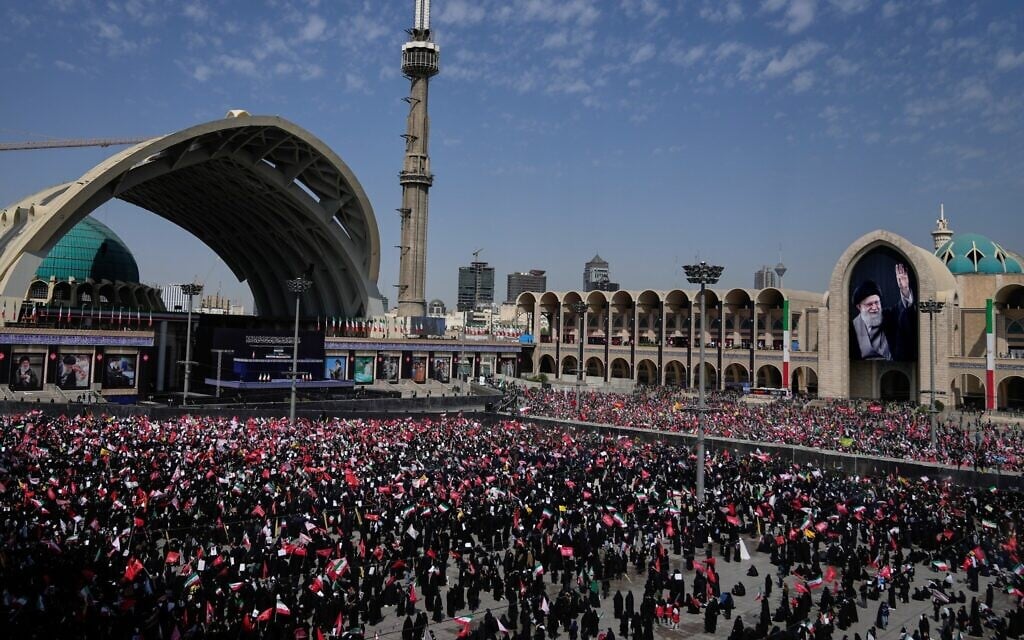
Massive crowds gathered as Iran began a days-long funeral Saturday for the late supreme leader Ayatollah Ali Khamenei, with many calling for “revenge” and “death to Israel,” months after an airstrike killed him at the start of the war.
Authorities unveiled the casket containing Khamenei’s body in a glass case at the Grand Mosalla in Tehran, Iran’s capital. Mourners wept at the sight, with some chanting: “Our word is one! Revenge! Revenge!” and “We will kill, we will kill he who killed our Imam.”
Some carried banners and red flags, a symbol of revenge in Shiite Islam, while billboards across the city bore Khamenei’s image. Crowds of men rhythmically beat their chests in mourning, a common practice at Shiite funerals.
“We have come not for the funeral but for revenge,” a eulogist at the event chanted. “We’re never going to give up your blood, which is the reddest line.”
“We must rise up and, God willing, avenge the blood of our leader,” said Hamidreza Shabani, an 18-year-old student.
Get The Times of Israel's Daily Edition
by email and never miss our top stories
By signing up, you agree to the terms
“I am here to say goodbye to my beloved leader Ali Khamenei,” said a weeping Hananeh Mousavi, 27, who attended the funeral alongside her mother. “I never expected to see such a day. I wish I had died before this tragedy.”
An outdoor stage set up at the Grand Mosalla resembled the stage where Khamenei once gave his speeches at a husseiniyah, or Shiite congregation hall, at his compound in downtown Tehran.
That site was destroyed in the Israeli airstrike that killed Khamenei and some of his family at the start of the Iran war on February 28. The caskets of his dead family members sat beneath his, which had his black turban atop it, identifying him as a direct descendant of the Prophet Muhammad.
Some mourners carried portraits of Iran’s new supreme leader Mojtaba Khamenei, who has succeeded his father but remained out of public sight.
Also seen among the crowds was the yellow flag of the Iran-backed terror group Hezbollah, which has been battling Israeli forces in southern Lebanon since the regional war broke out.
Hezbollah is part of the Iran-aligned “Axis of Resistance”, a network of terror proxies across the Middle East that is opposed to Israel and the United States.
Iran’s government expects to see millions flood the streets of the capital in scenes reminiscent of the burial of the late supreme leader Ayatollah Ruhollah Khomeini in 1989. Organizers sprayed water on the crowds and offered cold drinks to help those with the summertime heat.
“We attended the funeral to show that we are all committed to defending our country and religion,” said Ali Kazemi, who came from the northwestern city of Tabriz, some 530 kilometers (330 miles) away from Tehran.
A large turnout could provide a boost for Iran’s government, particularly as it tries to leverage its hold on the Strait of Hormuz in negotiations with the United States over a permanent end to the war, and as concern still lingers that Israel could attack yet again.
Khamenei, who was 86 at the time of his death, ruled Iran since 1989, and oversaw the expansion of its nuclear program and terrorist proxy network. Like other Iranian leaders, he was sworn to Israel’s destruction.
Funeral starts as US marks its 250th anniversary
Iran chose July 4, the 250th anniversary of the creation of the US, to begin the funeral.
While authorities did not acknowledge the timing, crowds at the ceremony in Tehran chanted: “Death to America!” and “Death to Israel!” — reprising chants that have been common in Iran since the 1979 Islamic Revolution and US Embassy takeover and hostage crisis.
“We knocked the hell out of Iran,” US President Donald Trump said in a speech at the same time in South Dakota in front of Mount Rushmore. “They want to settle so badly. We gave them a week off for a funeral.”
The American president was not forgotten in Tehran. In the crowd in Grand Mosalla, several mourners held a large flag that read: “#KillTrump.”
Khamenei’s body will be transported to cities in both Iran and neighboring Iraq. Authorities have shut down streets, airspace and daily life in Tehran for the mourning.
It remains unclear whether Iran’s new supreme leader, Ayatollah Mojtaba Khamenei, will appear at his father’s funeral. The late supreme leader appeared in 1989 at Khomeini’s funeral, weeping visibly, as he began his journey to lead Iran for decades with an iron fist while confronting the West. Mojtaba Khamenei’s late wife was one of the dead on display at the Grand Mosalla.
Israel’s repeated threats to kill Mojtaba Khamenei drew a warning from Iran’s joint military command Thursday, which told Israel and the US “to avoid any miscalculation” over the coming days.
Times of Israel Staff contributed to this report
View original source — Times of Israel ↗
Related stories

France 24
PoliticsJul 4, 2026 · 1 min
Trump speech at Mount Rushmore: Making it clear 'who's in and who's out', expert says
France 24
South China Morning Post
PoliticsJul 4, 2026 · 1 min
Hong Kong Legco chief urges higher standards after lawmaker’s drink-driving arrest
South China Morning Post

Al Jazeera
PoliticsJul 4, 2026 · 1 min
Thousands protest in Germany as far-right AfD party meets
Al Jazeera

Straits Times
PoliticsJul 4, 2026 · 1 min
Ukraine says Russia damaged more than 200 railway locomotives in 2026
Straits Times