Indian Express
AI hallucinated judgments: Why Supreme Court set aside a tribunal order
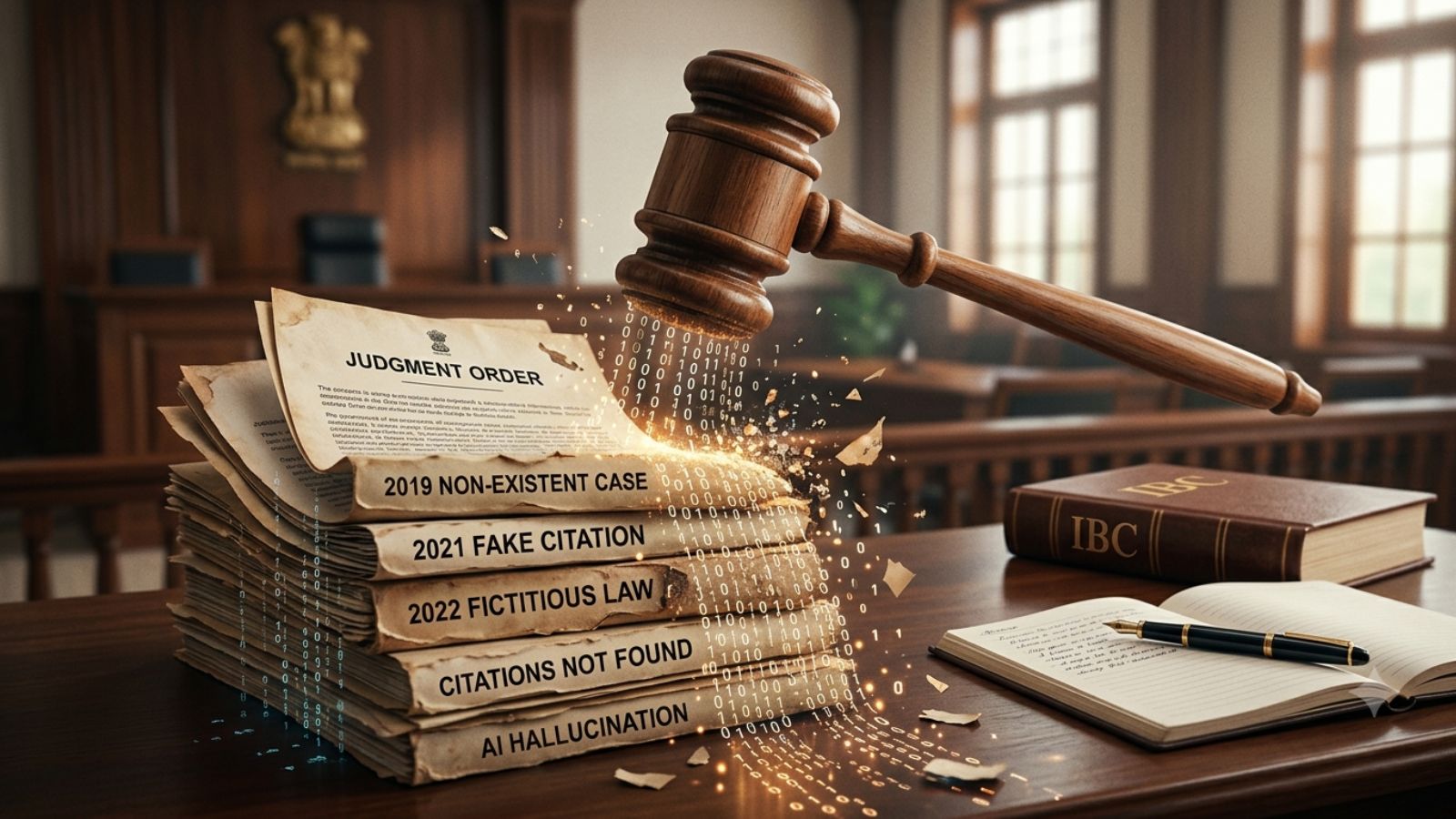
Six AI-hallucinated judgments formed the basis for the Supreme Court’s striking down of an order passed by the National Company Law Tribunal (NCLT) on Thursday.
Three of the cited judgments did not exist, while the remaining three either did not contain the propositions attributed to them or did not correspond to the context for which they were cited.
For instance, the NCLT order cited a 2019 judgment ICICI Bank Ltd v Urban Infrastructure Real Estate Ltd., which did not exist. Along with it, the 2021 case V S Dempo & Co Ltd v Reliance Communications Ltd and the 2022 case Sarbjit Singh v Union Bank of India were also found to be non-existent.
Two of the judgments, Everest Kento Cylinders Ltd v Union of India (2015) and Canara Bank v N G Subbaraya Setty (2018), were genuine, but the passages quoted from them are not found in the judgments themselves.
The sixth judgment, State Bank of India v M/s Shree Ram Urban Infrastructure Ltd, 2020 SCC OnLine SC 341, corresponded to a different case, namely M Subramaniam v S Janaki, and the quoted passage does not appear there either.
‘Takes away lifeblood of judicial determination’
The bench of Justices P S Narasimha and Alok Aradhe observed on July 2 that while the use of AI judgments could be “gratifying, even inspiring,” AI may eventually “infiltrate our intellectual work ethic and before long, render us dependent on its vast capabilities.”
They said that “for those in the province of adjudication and determination of disputes, this by-product of AI, i.e., the production of fake, non-existent, and hallucinated material and its utilisation as precedents in law, is like the release of methyl isocyanate in the province of law and justice: invisible, insidious, and catastrophic by the time anyone notices. It not only contaminates but takes away the very lifeblood of judicial determination.”
Story continues below this ad
Holding that a decision built on fabricated case law “is no decision at all,” the court said such orders must be set aside even if “an iota of fake or hallucinated material enters the decision-making process.”
What did the AI-hallucinated judgments say?
The six citations were relied upon by the NCLT while rejecting objections raised by Essel Infraprojects Ltd against insolvency proceedings initiated against it as a corporate guarantor.
One of Essel’s arguments was that a renewal-cum-reduction letter issued by Jammu and Kashmir Bank in 2017 renewed the loan on revised terms without mentioning the corporate guarantee, indicating that the guarantee had been relinquished. Rejecting this argument, the NCLT observed that “the said letter itself… states that all existing terms and conditions remain unchanged” and that the guarantee “remains valid and binding despite not being explicitly referenced in the renewal letter.”
For this reasoning, it relied on State Bank of India v. M/s Shree Ram Urban Infrastructure Ltd., quoting it as “the guarantor is bound by the terms of the guarantee as long as the underlying debt is valid and enforceable.”
Story continues below this ad
Essel had also argued that the bank’s subsequent decision to obtain a fresh guarantee from another group entity undermined its own position that the original guarantee remained operative.
The NCLT relied on Everest Kento Cylinders Ltd v Union of India, quoting it as holding that a corporate guarantee “does not invalidate the original guarantee when additional security is sought” and that “the primary obligation secured by the guarantee remains enforceable.”
Relying on this proposition, the NCLT held that “seeking additional guarantee does not invalidate the original Corporate Guarantee provided by the Corporate Debtor.”
The company’s principal defence was that its liabilities, including the corporate guarantee, had shifted pursuant to a Bombay High Court-approved demerger and amalgamation in 2014.
Story continues below this ad
Rejecting this, the tribunal relied on ICICI Bank Ltd v Urban Infrastructure Real Estate Ltd, quoting it as “a general corporate guarantee remains enforceable even if there is a restructuring of the corporate structure, provided the underlying debt is not discharged.”
The tribunal consequently held that the guarantee “will remain unaffected by the demerger & amalgamation.” No such judgment exists.
Essel further argued that the bank could not proceed against it while insolvency proceedings were already underway against the principal borrower and Pan India Infraprojects Pvt Ltd, the entity to which the mortgaged property had eventually passed under the restructuring exercise.
The tribunal relied on Canara Bank v N G Subbaraya Setty, quoting it as saying that “the rights of secured creditors over mortgaged or secured properties are not extinguished merely due to the transfer of such properties to another entity via amalgamation or restructuring.”
Story continues below this ad
Two other citations were relied upon to answer procedural objections. On Essel’s argument that the insolvency petition did not specify a date of default, the tribunal cited V S Dempo & Co Ltd v Reliance Communications Ltd, quoting it for the context that “its absence does not automatically invalidate an insolvency petition…The Court allowed flexibility in procedural aspects as long as the substantive requirements are fulfilled.”
On whether the bank official who instituted the proceedings was authorised to do so, the tribunal relied on Sarbjit Singh v Union Bank of India, quoting it as holding that a power of attorney holder with “general and extensive authority” may initiate proceedings under the IBC.
None of the six citations had been placed before the tribunal by either side. Jammu and Kashmir Bank, the financial creditor in the case, told the Supreme Court in an affidavit that its counsel had not cited any of the judgments and that the material appeared to have been sourced by the tribunal itself through its “own research.”
The NCLAT, hearing the appeal against the NCLT’s order, upheld the NCLT order without independently checking whether they existed.
Story continues below this ad
Background of the case
The case pertained to Essel Infraprojects Ltd, which had given a corporate guarantee in 2013 to secure a loan of Rs 200 crore extended by Jammu and Kashmir Bank to Pan India Utilities Distribution Company Ltd.
Under the guarantee, Essel Infraprojects had undertaken to repay the loan if the borrower defaulted. The company had also mortgaged 196 acres of land in Gorai village, Mumbai, as additional security.
After the borrower defaulted, the bank invoked Section 7 of the Insolvency and Bankruptcy Code and moved the NCLT to initiate insolvency proceedings against Essel Infraprojects as the guarantor.
While Essel Infraprojects did not dispute the debt or the default, it argued that its liabilities, including the guarantee, had been transferred through a scheme of demerger and a subsequent amalgamation approved by the Bombay High Court in 2014, and that it was therefore no longer liable.
Story continues below this ad
The NCLT rejected the defence and admitted the insolvency petition in 2024. The NCLAT upheld the decision in September 2025.
The Supreme Court directed the Bar Council of India to constitute a committee to examine the use of artificial intelligence in litigation, observing that it would amount to professional misconduct for an advocate to cite AI-generated authorities without verification. The parties have been directed to maintain status quo until the NCLT decides the insolvency petition afresh.
Previous case of AI hallucination
The same bench had encountered a similar situation in February 2026 in the case of Gummadi Usha Rani v Sure Mallikarjuna Rao. There, an Andhra Pradesh trial court relied on four AI-generated, non-existent judgments while rejecting objections to an advocate commissioner’s report. Although the high court had acknowledged the citations were AI-generated and merely recorded “a word of caution”, the Supreme Court took a far sterner view.
Calling the issue one of “considerable institutional concern”, the bench of Justices P S Narasimha and Alok Aradhe held that “a decision based on such non-existent and fake alleged judgments is not an error in the decision-making. It would be a misconduct and legal consequence shall follow.”
View original source — Indian Express ↗
Related stories

The Punch
WorldJul 4, 2026 · 1 min
Igboho’s security network rescues kidnapped Oyo woman, son in Kwara
The Punch
The Punch
WorldJul 4, 2026 · 1 min
NDDC donates relief materials to NCoS in Rivers
The Punch
The Punch
WorldJul 4, 2026 · 1 min
Critics politicising Lagos flooding, says commissioner
The Punch
The Punch
WorldJul 4, 2026 · 1 min
Police arrest 27-year-old suspected cultist in Lagos, recover firearm
The Punch