Indian Express
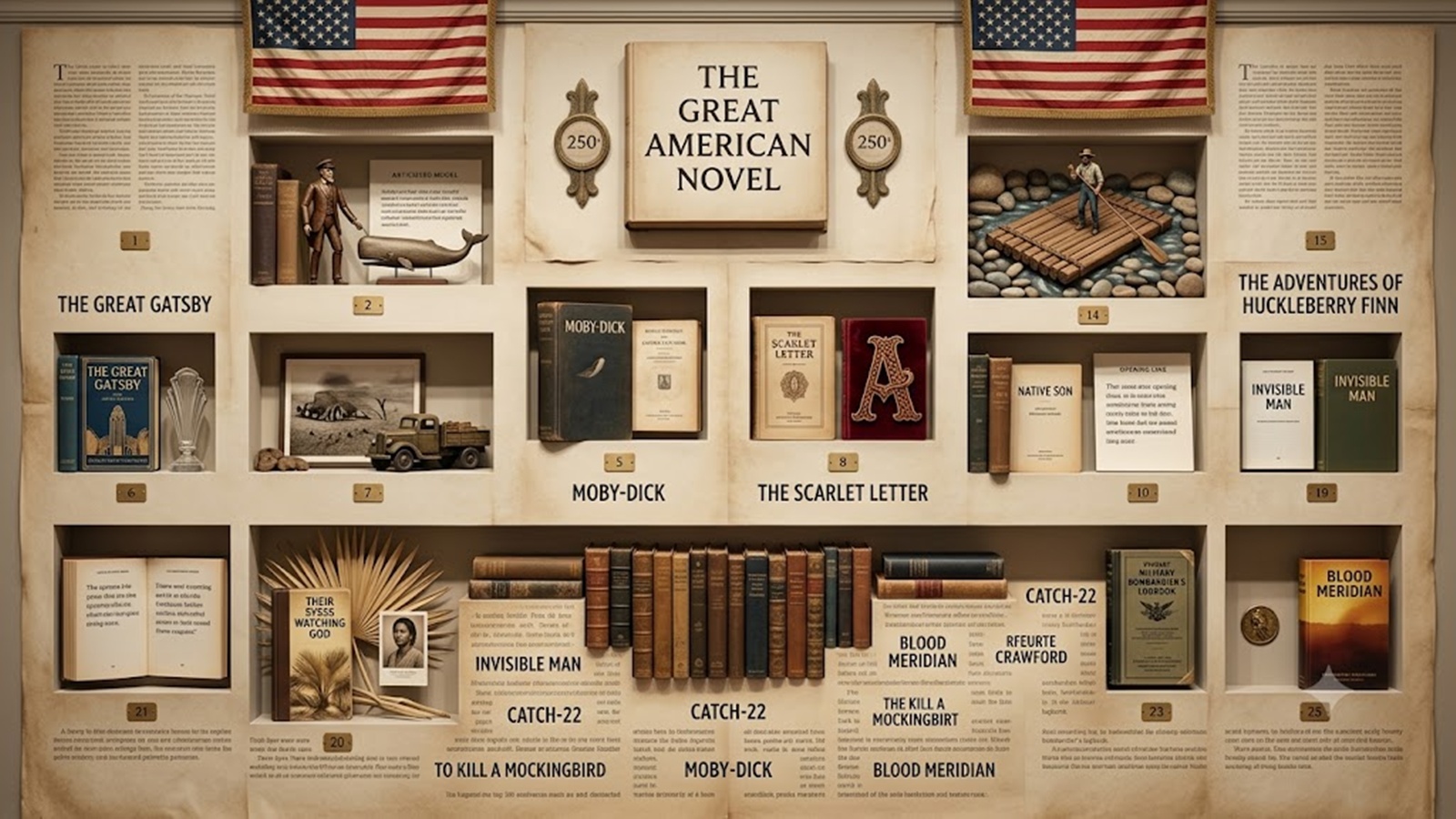
On its 250th, 25 novels that chase the white whale of a Great American Novel
America, which turns 250 this year, has has never agreed on much, but it has always been good at telling stories about itself. The Great American Novel has been an elusive idea that a single novel would somehow capture the experience of being an American, complete with its aspirations, contradictions and history. The phrase dates back to an 1868 essay by novelist John William De Forest.
Here are 25 novels, placed in no particular order, that were at one point or another in contention to catch the that white whale, which is the Great American Novel:
When one mentions the Great American Novel Moby-Dick invariably is the first book that comes to mind. A sailor named Ishmael joins a whaling ship whose captain, Ahab, is obsessed with hunting down one specific white whale that bit off his leg many years ago. It encapsulates America’s boundless ambition and self-destructive obsession, using the whaling industry as a metaphor for its global reach and capitalist hunger. Melville’s encyclopedic ambition, blending tragedy with digressive essays on whale biology, religion, and fate mirrors the country’s restless intellect. Through Ahab’s defiant, monomaniacal quest, the novel captures the American compulsion to conquer nature and fate itself, refusing to submit. Its tragic ending delivers a sobering counterweight to the national myth of progress, making it an eternal mirror.
2. The Scarlet Letter — Nathaniel Hawthorne (1850)
Set in a strict Puritan colony in the 1600s, the novel follows Hester Prynne, a woman forced to wear a red letter “A” on her chest as punishment for having a child outside marriage. It traces American guilt and public shaming straight back to their religious roots. Through Prynne, the novel offers an American archetype of the outcast who finds dignity through endurance. Its psychological depth and moral ambiguity established the template for American fiction’s preoccupation with sin, guilt, and the gap between private truth and public performance.
3. The Adventures of Huckleberry Finn — Mark Twain (1884)
A boy, Huck, fakes his own death to escape an abusive father and ends up rafting down the Mississippi River with Jim, a man escaping slavery. Twain writes the whole book in the voice and dialect of its characters, which helped establish American vernacular speech, the way people actually talked, as legitimate literary language. The river ties the story directly to the country’s geography and westward expansion, and putting a child’s moral awakening about slavery at the center gave it a weight that’s kept people arguing over its language, ending, and politics for more than a century.
4. The Great Gatsby — F. Scott Fitzgerald (1925)
Jay Gatsby throws lavish parties at his mansion, hoping to win back Daisy, a woman he loved years earlier who has since married someone else. Narrated by his neighbor Nick, the novel is barely 200 pages, and it still manages to take apart the American Dream, the idea that anyone can reinvent themselves and rise to become wealthy. It captures 1920s Jazz Age excess and class anxiety with a precision that has not aged, and it gave American culture one of its most lasting symbols in the green light at the end of Daisy’s dock, which Gatsby stares at from across the water. Short enough to be taught in nearly every American high school, it probably shaped more people’s idea of “serious literature” than anything else on this list.
5. The Grapes of Wrath — John Steinbeck (1939)
The novel documents the nation’s broken promise to its working class people. Set during the Dust Bowl, a 1930s environmental disaster that turned the Great Plains into unfarmable dust, the Joad family loses their Oklahoma farm and drives to California hoping for work. Steinbeck uses their journey to document that catastrophe in detail while arguing that people can hold onto their dignity even after the economy collapses around them. He blends journalism-style realism with a biblical, almost mythic structure, and the novel left behind economic and political language, “Okies,” migrant dignity, corporate greed, which is still recognisable to this day.
Story continues below this ad
6. Native Son — Richard Wright (1940)
Bigger Thomas, a poor young Black man in 1930s Chicago, accidentally kills a white woman and the novel follows the fallout. Wright refuses to make Bigger likable or easy to forgive, forcing readers into a direct reckoning with racism, poverty, and violence that most American novels of the time avoided entirely. It is not an easy read, but it opened the door for a generation of Black American novelists who came after, and it is still assigned in schools for the discomfort it evokes.
7. Invisible Man — Ralph Ellison (1952)
The novel’s famous opening line announces its central tragedy at the get go, of being invisible in a great nation that claims to see all. An unnamed Black narrator moves through a series of jobs and betrayals, in the South and then in New York, gradually realising that the people around him refuse to see him as an individual, hence the title. The novel opens with one of the most famous first lines in American fiction (“I am an invisible man”) and blends realism with surreal, almost dreamlike sequences while tackling Black identity head-on, refusing any tidy resolution. It won the National Book Award and still turns up on nearly every “best American novel” list compiled since.
8. Their Eyes Were Watching God — Zora Neale Hurston (1937)
Janie Crawford marries three times over the course of the novel, each marriage teaching her something about what she actually wants from life and love. Hurston writes it in the vernacular of Black communities in the rural South, treating that speech as genuine literary art rather than comic dialect, which was rare for the era. It took the literary establishment decades to catch up to how good the book actually is; now rediscovered, it is considered foundational and shaped generations of American women writers who followed.
9. Catch-22 — Joseph Heller (1961)
Set on a US Army Air Force base in World War II, the novel follows Yossarian, a bombardier trying to get out of flying more dangerous missions, only to keep running into a maddening bureaucratic rule that one can be excused from flying if one is crazy, but asking to be excused proves one is actually sane enough to fly. That rule is the “Catch-22” of the title, and the phrase entered everyday English because Heller found exact words for a kind of trap everyone eventually recognises. The novel’s absurd, circular logic captures a very American mistrust of institutions, and its tone went on to shape the satire in fiction and film.
Story continues below this ad
10. East of Eden — John Steinbeck (1952)
The novel follows two families in California’s Salinas Valley across generations, loosely retelling the biblical story of Cain and Abel through brothers who compete for their father’s approval. Steinbeck called it his best work, built around the Hebrew word “timshel,” meaning “thou mayest”, the idea that people can choose good over whatever they have inherited from their parents or their past. Set during the settling of California, it captures the shaping of the American frontier while making an argument about free will that Steinbeck considered central to everything he wrote.
11. Song of Solomon — Toni Morrison (1977)
Milkman Dead, a young Black man in Michigan, sets out looking for a stash of gold tied to his family’s history and instead uncovers a much deeper story about his ancestors, one that mirrors the buried history of Black America itself. Morrison blends myth, flight, and genealogy into a distinctly American epic, treating names, ancestry, and land as the country’s real obsessions. It won the National Book Critics Circle Award, launched Morrison’s wider recognition, and remains one of her most acclaimed novels.
12. Beloved — Toni Morrison (1987)
Sethe, a formerly enslaved woman living in Ohio after the Civil War, is haunted, literally, by the ghost of the daughter she killed years earlier to keep her from being taken back into slavery. It is probably the most common answer now if you ask critics to name the Great American Novel, apart from Moby Dick, as it confronts slavery’s psychological aftermath before anybody thought to do so, using an actual ghost to argue that the past refuses to stay buried. It won the Pulitzer Prize, helped secure Morrison’s Nobel Prize in Literature a few years later. It has topped critics’ polls for the best American novel of the past 25 years.
13. To Kill a Mockingbird — Harper Lee (1960)
Scout Finch, a young girl in 1930s Alabama, watches her father, a lawyer, defend a Black man falsely accused of assaulting a white woman, and slowly learns the gap between what the law says and what actual justice looks like. Lee uses a child’s plainspoken point of view to expose adult hypocrisy without flinching. It puts racial injustice inside a small-town American courtroom and became one of the most widely taught novels in the country’s schools, shaping how generations first learned about the Jim Crow South (the system of laws that enforced racial segregation after slavery ended).
Story continues below this ad
14. The Sound and the Fury — William Faulkner (1929)
The novel tells the story of the Compson family’s decline in the American South, splitting the narration across four different family members, including one, Benjy, who is intellectually disabled and experiences time out of order, which makes his sections deliberately disorienting to read. This technique, an early and defining use of “stream of consciousness” (writing that mimics a character’s raw, unfiltered thoughts as they happen), demanded readers work harder for meaning than most American novels had asked before. It’s still considered by many critics to be Faulkner’s technical high point.
15. Absalom, Absalom! — William Faulkner (1936)
The novel pieces together the rise and fall of Thomas Sutpen, a man who arrives in Mississippi determined to build a plantation dynasty from nothing, through the retellings of several different narrators who cannot agree on what actually happened or why. That disagreement is the whole point: a novel about how the American South mythologises its own history in order to survive it, and how the legacy of slavery poisons everything Sutpen tries to build. Set in Faulkner’s invented Yoknapatawpha County, a fictional stand-in for the whole region, it is frequently cited as the high point of Southern American literature.
16. The Catcher in the Rye — JD Salinger (1951)
Holden Caulfield, a teenager who’s just been expelled from prep school, spends three days wandering around New York City, avoiding going home and growing more furious at what he calls the “phoniness” of the adult world around him. The novel created the template for the alienated American teenage narrator and captured a specific postwar anxiety about conformity . Its voice and slang shaped how American fiction wrote young people for decades afterward, and it became one of the most banned and most assigned books in the country at the same time, a very American contradiction.
17. Slaughterhouse-Five — Kurt Vonnegut (1969)
Billy Pilgrim, an American soldier who survives the Allied firebombing of the German city of Dresden during World War II, becomes “unstuck in time,” jumping unpredictably between moments of his life, including an experience being abducted by aliens. Vonnegut based the Dresden bombing on his own experience surviving it as a prisoner of war, and he uses the science-fiction structure to process that trauma in an oblique manner rather than head-on. Despite being set in WWII, the book became a defining anti-war statement during the Vietnam era, and its refrain, “so it goes,” escaped the novel entirely to become part of everyday language.
Story continues below this ad
18. The Age of Innocence — Edith Wharton (1920)
Newland Archer, engaged to a proper young woman in 1870s New York high society, falls for her more unconventional cousin and spends the novel weighing desire against the crushing weight of social expectation. Wharton dissects that Gilded Age world (the late 1800s era of rapid American wealth and rigid social class), arguing that the real damage is compounding cost of following every societal rule for fear of a scandal. It was the first novel by a woman to win the Pulitzer Prize.
19. The Color Purple — Alice Walker (1982)
Told entirely through letters, mostly from a poor Black woman named Celie in the early 1900s South to her sister and to God, the novel follows Celie’s escape from an abusive marriage toward independence and self-worth. The letter format, called an “epistolary” novel, builds an intimacy that suits the hard subject matter, giving voice to a woman rarely centered in American fiction before it. The book won both the Pulitzer Prize and the National Book Award, opening wider room for Black women’s stories in the American literary mainstream.
20. Housekeeping — Marilynne Robinson (1980)
Two orphaned sisters are raised by their eccentric, transient aunt in a small, flood-prone town in Idaho, and the novel follows how each girl responds differently to a home life that never quite settles into normal. It’s less famous than most books on this list, but arguably the best-written one. Robinson treats a wandering, unconventional life as something valid rather than a failure to achieve stability. Widely admired by other writers, it is a counterweight to the louder, more self-consciously important entries on lists like this one.
21. Little Women — Louisa May Alcott (1868)
Four sisters, the Marches, grow up in Massachusetts during the Civil War while their father is away serving in the Union Army, and the novel follows each of their very different paths into adulthood. It gave America one of its first lasting portraits of girlhood, taking girls’ inner lives and ambitions seriously at a time when few novels bothered. Jo March, who wants to be a writer instead of settling into the marriage everyone expects of her, became an early American model of female ambition, and the book has stayed continuously in print for over 150 years.
Story continues below this ad
22. Blood Meridian — Cormac McCarthy (1985)
Loosely based on real historical events, the novel follows a gang of scalp hunters roaming the Texas-Mexico borderlands in the 1850s, killing for bounty money with almost no moral restraint. Readers and critics have been mesmerised with the beauty of the prose that describes the extreme violence. McCarthy confronts the brutal reality of westward expansion without romanticising it. It undermines the traditional mythology of the American frontier from the inside, and contemporary critics regularly cite it as a serious contender for the best American novel written since 1980.
23. A Tree Grows in Brooklyn — Betty Smith (1943)
Francie Nolan grows up poor in early 1900s Brooklyn, in a family stretched thin by her father’s drinking, and finds an escape in reading and education even as the family struggles to get by. The novel documents immigrant, working-class urban life. It is warmer than most books on this list without going soft on the hardship it describes. It became a touchstone for generations of American readers from working-class backgrounds who saw their own families reflected in it.
24. Middlesex — Jeffrey Eugenides (2002)
The novel follows a Greek immigrant family across three generations in Detroit, centered on Cal, a grandchild born intersex, whose story is only fully explained once the reader understands a genetic secret buried generations earlier in the family’s history. It tracks assimilation and identity alongside Detroit’s own rise as an industrial city and later decline, and it handles gender identity with a nuance well ahead of the mainstream conversation at the time it was published. It won the Pulitzer Prize and broadened what an American multi-generational family epic could look like.
25. An American Tragedy — Theodore Dreiser (1925)
A young man named Clyde Griffiths claws his way toward money and status, then commits murder to protect that climb once an inconvenient relationship threatens to derail it. Dreiser based the plot on a real 1906 murder case, grounding the story in actual social conditions rather than pure invention, and used it to directly indict the American obsession with class ascension at any cost. The title alone became shorthand for a certain kind of national morality tale, one that later American fiction and film kept returning to.
View original source — Indian Express ↗
Related stories

The Punch
WorldJul 4, 2026 · 1 min
NDDC donates relief materials to NCoS in Rivers
The Punch
The Punch
WorldJul 4, 2026 · 1 min
Critics politicising Lagos flooding, says commissioner
The Punch
The Punch
WorldJul 4, 2026 · 1 min
Police arrest 27-year-old suspected cultist in Lagos, recover firearm
The Punch

France 24
WorldJul 4, 2026 · 1 min
New wave of coordinated rebel attacks hits Mali
France 24