The Guardian
Delirium, despair, pride: with the fans on Cape Verde’s World Cup rollercoaster
Rotterdam knows how to script a football fairytale. Six players from the Cape Verde side who have lit up the World Cup were born here, nearly 5,000km from their parents’ islands. Five of them played against Argentina, the defending champions, in a bittersweet 3-2 defeat.
After last Saturday’sdraw with Saudi Arabia took Cape Verde into the last 32, the streets of Rotterdam were full of honking cars, flags streaming from the windows and people dancing. This is the city the locals call the 10th island of Cape Verde. The diasporas from Curaçao and Morocco have also set their own corners of Rotterdam alight during this tournament.
The Netherlands’ second city includes about 25,000 Kriolu, as Cape Verdeans here call themselves. One of them is Jeffry Fortes, the child of a dock-worker, like most of his compatriots. The cheerful, wiry 37-year-old is the right-back at the second-tier side Den Bosch and has played more than 400 games in the top two divisions of Dutch football.
It earned him 26 Cape Verde caps until his involvement ended abruptly in 2023 after a falling-out with the football federation’s board. “I’m not going to speak badly about them,” he says. “I’m their biggest fan now.”
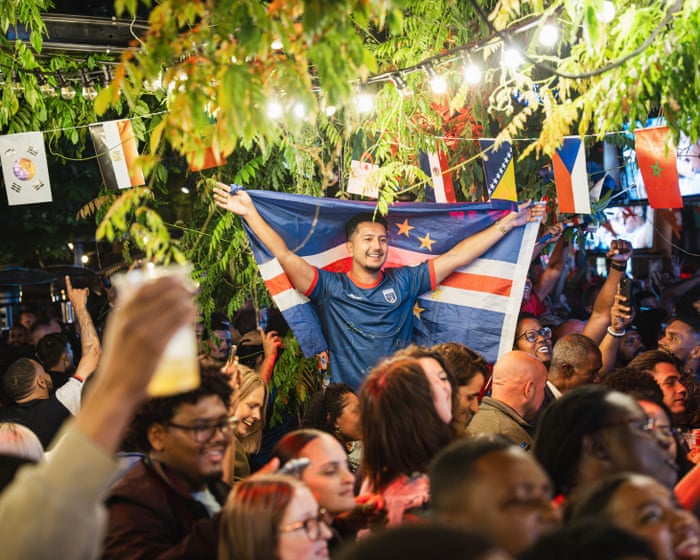
Fortes is accompanied by 1,600 other singing and dancing Cape Verdeans at the music venue Club Annabel, and is wearing a blue shirt bearing a picture of Amílcar Cabral, who led Cape Verde’s and Guinea-Bissau’s struggle for independence from Portugal.
“As a professional footballer it’s a disappointment to be on the sidelines,” he says. “But as a Cape Verdean, I’m prouder than ever. We can’t take this for granted. This is the biggest and best moment ever. No one in the world knew us. Now we’re in the spotlight.”
In the venue’s industrial-size beer garden are an African drum band, dancers and countless strings of small flags from World Cup nations. For the people here, it is Vozinha’s world and Lionel Messi is just living in it. For the first time at this World Cup, a hydration break is welcomed with cheers and applause. When Messi opens the scoring shortly after, there is a feeling of small disappointment in a big Cape Verdean party.
The celebration that greets the Rotterdam-born Deroy Duarte’s equaliser goes deeper than joy. This is disbelief and it flies through the air along with the islands’ popular liquors, grogue and pontche. Then Lisandro Martínez restores Argentina’s lead and the devastation shows how far Cape Verde have come.
The Rotterdam rollercoaster reaches top speed when Sidny Lopes Cabral – you can imagine where he was born – curls the ball past Emiliano Martínez from a near-impossible position. For a heartbeat there is silence. Then Cabral runs to his girlfriend in the stands and Fortes disappears in a sea of jumping Blue Sharks, the team’s nickname. Everything shakes like never before for this country.
When Diney Borges heads Argentina back in front, frustration takes over at Club Annabel. The smallest country to reach the knockout stage of the World Cup is gutted to be behind against the world champions, but Fortes makes no secret of his pride. That is shared at the end by the other fans, drained, but applauding under Rotterdam’s skyscrapers.
Fortes and a handful of his talented friends were among the first from the city to play for Cape Verde. Fortes made his debut in 2014 and along the way came a duel with Senegal’s Sadio Mané at the Africa Cup of Nations and a 2-0 friendly win over Portugal, with a young Bernardo Silva on the other side.
Fortes’s friend Tony Varela had caught Cape Verde’s eye four years earlier, as the country hunted for talent abroad. The former Sparta player, a coach at PSV’s academy, remembers how it used to be. “For an away game in Africa, we’d sometimes fly all the way up to Europe and back down again, just to save on flights. Most of our players were playing in the islands’ own league. That has completely changed. Now they play in Europe. We have professional chefs, video analysts, everything.”
The term legend has suffered from inflation, but Jerzy Rocha Livramento reserves it for Fortes and Varela without hesitation. Jerzy, known as Jerr, is a dreadlocked rapper in Broederliefde (Brotherly love), one of the biggest Dutch hip-hop groups of recent years. “They brought us where we are now. Some had to buy their own plane tickets. They did it purely out of love for Cabo and we’re thankful for that.”
Jerr is the brother and agent of Dailon Livramento, the striker whose four goals in qualifying helped carry Cape Verde to their first World Cup. Jerr was in the Sparta and Utrecht academies and their father was watched by Eusébio in Benfica’s youth ranks.
“In my head, I’m a footballer too,” Jerr says. “I still have nightmares about the youth coaches at Utrecht telling me I needed to lose weight. I was never meant to be an artist; it just happened. But nothing has ever come close to this, seeing us here.”
This means more to Cape Verde than meets the eye. “Our parents came here in the 60s looking for a better life and the country they left is still lagging behind,” says Jerr. “If you take on work there, you can’t even send an invoice by email. We all have families without proper doors and roofs on their houses.
“Hopefully this brings more tourists, investors and prosperity. Not the players from Portugal or anywhere else, but the boys from Rotterdam made this happen. They gave something back after our parents left the country.”
After hugs, tears and handshakes, Fortes heads home in the small hours. A pre-season friendly against a local amateur team is 12 hours away.
View original source — The Guardian ↗
Related stories

The Punch
SportsJul 4, 2026 · 1 min
World Cup: ‘They kick the crap out of me’, Messi jokes after Cape Verde clash
The Punch

ESPN
SportsJul 4, 2026 · 1 min
Serena (knee) pulls out of Wimbledon doubles
ESPN
ESPN
SportsJul 4, 2026 · 1 min
The world is watching -- and loving -- wiener dogs racing at the Starkville Derby
ESPN
The Guardian
SportsJul 4, 2026 · 1 min
South Africa v England: Nations Championship rugby union – live
The Guardian