CNA
This expat banker retired early to find purpose running a free bicycle repair shop in Balestier
When my Grab driver pulled up in front of the humble little shop unit in Balestier, he squinted at the LED signage out front.
"'Free Bicycle Repairs'," he read. "Free ah? How to earn money like that?"
He wasn't the only sceptic. Now and then, after Mr Philip Mehl finishes repairing a bicycle, the 56-year-old still encounters hesitation from customers who ask: "How much?"
"Free," he says. "That's why I call it Free Bicycle Repairs."
In a city like Singapore, which often appears on global lists ranking the most expensive cities to live in, the concept of anything worthwhile being offered for free seems surprising, to say the least.
Yet, on a bustling Balestier street, Mr Mehl operates his bicycle repair social enterprise entirely on a pay-it-forward model.
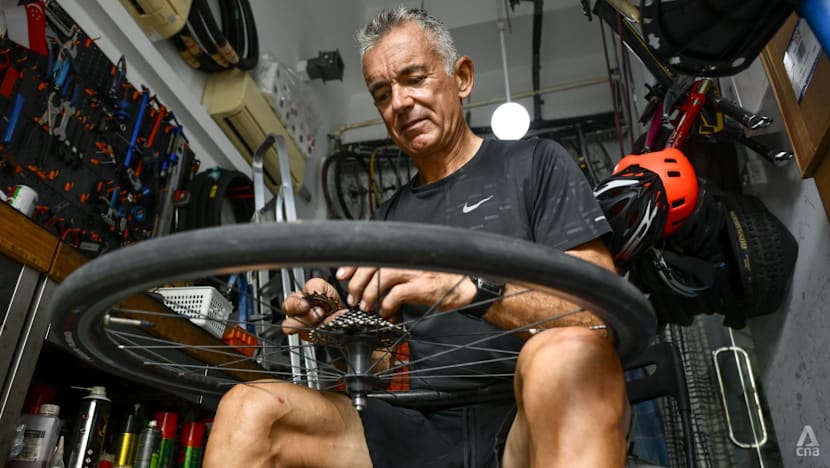
Five days a week, he is on his feet from 11am to 6pm, fixing bike after bike, his hands constantly caked in grease.
When the shop doors close, he sits down to spend hours on administrative work, carefully tracking in spreadsheets the bikes he touched that day and the repairs they needed, the parts he used, and every cent that's changed hands.
He usually sees a stream of people trickling in and out all throughout business hours, he told me. Each day, he fixes an average of 25 bikes, which works out to about three or four an hour.
We shifted around the small, cluttered unit looking for a good spot to snap some photos, but between the piles of tools, the worktable buried under spare parts, and the walls laden with bicycles and gear, it was not easy.
"I'm sorry, I'm just not (a very tidy) person," apologised Mr Mehl, but we didn't mind. We were in his domain, after all.
His "customers" fall into three main groups: the elderly who need their market bikes to stay active, children and teens who can't yet afford expensive repair services, and, most needfully, migrant workers who rely on their bikes to get to work.
His most regular customers at present: a group of teenage cyclists. It started with just two of them, but the more comfortable they got with Mr Mehl, the more of their friends they began bringing to his shop, even from other schools.
"They call me 'uncle' which I like," he said with a laugh. "It makes me feel part of the Singapore community."
While Mr Mehl poured much of his savings into launching the social enterprise, he told us that keeping the lights on boils down to community generosity. He never asks for money, but many people choose to pay anyway, even if it's just a few bucks.
A few days ago, a migrant worker needed a new tube that cost S$4 (US$3.10). Mr Mehl replaced it for free as usual, but the worker paid him S$5.
"For me, it wasn't about the extra dollar. It was the fact that he wanted to give more because he appreciated what he'd received and wanted to help someone else."
GROWING UP IN LONDON
Long before finding his way to Singapore, Mr Mehl was brought up in the United Kingdom by his stern, middle-class German immigrant parents. His father had fled to Britain in 1938 to escape the Nazis before World War II, while his mother moved there in 1955 in search of a better life, initially working as an au pair caring for children. They met in London, became British citizens and eventually married.
Mr Mehl learnt the value of hard work from his mum, a homemaker who was up and about all day long, handling daily chores such as cooking and cleaning and other tasks, such as making curtains and Mr Mehl's clothes from scratch.
His father was out of the house most days, pounding the pavement as a salesman – but when he was home, he kept a close watch and firm hand on Mr Mehl's doings.
"If I made a mistake, he made sure I never forgot it."
For instance, if young Philip had put too much food on his plate, he would be forced to sit at the table until the plate was clean, even if it took hours. And if he still couldn't finish it, the food would go straight into the fridge and reappear at the very next meal.
"It sounds brutal," he admitted. "But it teaches you not to waste food ... and to appreciate the value of money."
When Mr Mehl was just 11, his mother died of breast cancer. From that moment on, it was just him, his elder sister and his father managing the household.
He recalls being "massively" affected by the loss: "I cried for a day and then just shut it out, only dealing with it 20 years later."
Grappling with the tragedy led him to seek out distraction in the form of cycling, including racing. "I was angry, so I funnelled that energy into turning the pedals faster."
He recalls always being driven by an innate curiosity, often tinkering with old clocks and other household items. Eventually, he began teaching himself to maintain his own bicycles, armed with only basic household tools like screwdrivers and hammers.
This later set him on the path to studying mechanical engineering at the University of Bristol. In 1988, he secured a sponsorship from Ford Motor Company, enrolling in a "sandwich degree" that combined academic study with industry placements. Over the course of his four-year degree, he spent two years working for Ford, and even his summer breaks were spent on the job.
It was an incredible opportunity for an aspiring engineer to gain valuable practical experience in corporate engineering. It also made him realise one thing: being an engineer wasn't his calling.
For one thing, he bluntly joked, the pay "wasn't very good". More importantly, the nature of the job was too insular for his liking.
"Engineering felt like we were just working in the engine room, focusing on the machinery and rarely seeing the bigger picture," he said.
After rotating through a few different departments, he ended up on the marketing team and quickly discovered a love for how it allowed him to "engage with the outside world".
After graduating, he bypassed the traditional engineering route entirely and jumped straight into a two-year management trainee programme at consumer products multinational Unilever – a prestigious fast-track for future corporate leaders.
He threw himself into it heart and soul, clocking 60 to 70 hours a week at the office to learn all he could and climb the corporate ladder.
DISCOVERING SINGAPORE AND A DESIRE TO GIVE BACK
After completing the Unilever programme, Mr Mehl spent 10 years managing regional rebrands at multinational giants such as confectioner Mars and telco T-Mobile before landing the role of chief marketing officer at HSBC Bank.
He spent a decade there and then, in 2017, accepted a job offer from the largest bank in the United Arab Emirates, giving him his first opportunity to live and work abroad.
Almost two years into his Abu Dhabi-based tenure, he developed a keen interest in Asia. In 2019, he clinched a managing director role at Standard Chartered Bank and relocated to Singapore.
"I already had friends living here, and they all told me I'd love it," he said.
Upon arriving here, Mr Mehl knew that he did not want the typical expatriate experience, especially for those in banking and finance circles – shiny, glossy and comfortable.
Still an avid cyclist, he sought to escape the glamorous bubble of the Central Business District or tourist destinations such as Sentosa and Dempsey Hill by venturing on a bicycle into heartland neighbourhoods and blue-collar districts.
It was during these long rides that he noticed a completely different side of Singapore.
"You see a side of Singapore that's not so well-publicised. There's much more depth to Singapore than is sometimes portrayed."
Some years later, Mr Mehl decided he wanted to get off the corporate treadmill. He was partly driven to be the first among his friends to achieve the FIRE status – short for "financially independent, retire early".
More than that, he wanted to plot a path for his life that he could find more rewarding than simply "making shareholders richer".
He ran the numbers, calculated exactly how much money he would need with a healthy buffer, and set his goal: he would retire from banking in November 2024.
Upon retiring, he channelled his lifelong passion for bicycles and his mechanical skills into founding Free Bicycle Repairs.
Months of scouring for the right location brought him to his current Balestier unit – but he still needed to get the word out about his services somehow.
Drawing on his 30 years of marketing expertise, he built a website that was translated into four languages to reach as many people as possible.
But after years of observing his target audience – migrant workers – he took a more targeted approach, hitting the streets of Whampoa, Boon Keng, Little India and Farrer Park, using elastic bands to manually strap small business cards onto parked bicycles.
He also reached out to cycling groups on social media, catching the attention of the Singapore Cycling Federation, whose president personally donated hundreds of dollars' worth of bicycle parts to help support the business.
When he first opened the workshop, he noticed that many migrant workers seemed nervous and hesitant to approach or converse with him. He chalked it up to his identity as a white Western man, and tried to be as friendly and welcoming as he could.
"Over time, they came back. Then they brought their friends or fellow residents to spread the word," he said.
"For me, that's the clearest sign I'm doing a good job. If customers return and bring other people along as a recommendation, it's great that they feel there's someone on their side."
In many ways, Mr Mehl feels a strong affinity with Singapore's migrant worker population as he finds that his family background closely mirrors theirs.
"I make people laugh when I say I'm a migrant worker here in Singapore, because they don't see me that way," he said affably. "But my parents went to London for a better life, and I came to Singapore for a better life. It’s the same thing."
His father died in April 2017, but Mr Mehl's desire to honour his late parents' memory remains evident. Indeed, it seemed to me that he still sometimes thinks of himself as a son constantly yearning for a dad's approval.
"When you have an old-fashioned father … you spend your life pushing yourself, hoping one day he'll simply say: 'Son, I'm proud of you'. But he never did."
He paused here, a shadow crossing his face. "After my father died, many of his friends told me how proud he had been of me. I always wondered why he couldn't tell me himself."
Would his father have approved of his efforts today? I asked.
"He might have said I was crazy!" he said.
"But I might have said he was the best father he could've been, and I'm trying to be the best person I can be (to honour him)."
A LABOUR OF LOVE
Apart from fixing bicycles, Mr Mehl also takes in unwanted or discarded bikes from members of the public.
Over the past 18 months of running Free Bicycle Repairs, he's had more than 700 bicycles donated. He was able to give these a second life, repairing and passing them on to ItsRainingRaincoats (IRR), The Salvation Army and Migrant Workers' Centre – local initiatives supporting migrant workers and needy families.
IRR programmes officer D Deivanai told me that "countless" migrant workers have benefited from Mr Mehl's generosity.
"Many of our migrant brothers live in remote areas – for example, Tuas – where commuting can be challenging due to limited transport options. Philip's work means these bicycles that might have otherwise ended up as waste are transformed into essential, highly-appreciated items."
So far, Mr Mehl has zero regrets about starting Free Bicycle Repairs.
If anything, the "overwhelming" support he's received from the community makes him feel he should perhaps have taken the plunge earlier.
"I don't do this for people's appreciation but when it comes, the impact is huge. We never get it in corporate life, and that's a big miss," he said.
He ensures that every dollar he receives in tips and donations goes directly back into helping someone else. To date, he's been able to keep the workshop going thanks to such generosity from members of the public without relying too much on his savings, aside from rental and other operational costs.
He recalled a recent incident where a woman walked into his workshop and gave him S$300 in cash.
"I didn't even repair her bicycle. She simply said she liked what I was doing and wanted to support it."
On multiple occasions, people have even reached out to him via WhatsApp, asking to send in donations – some of whom he's never served or met. "I make it very clear that I don't keep any of that money."
Some encounters, however, have been met with scepticism. "It must be a scam," some would say to him, while others would ask: "What's the catch?"
When people asked how he could afford to do it, Mr Mehl joked that his business model is "to lose money".
He pays the rent and donates his time, while others often chip in to cover repairs for cyclists who cannot afford them. Having enjoyed a successful banking career and invested well, he says he is fortunate enough to keep the initiative going for as long as people want him to.
"I do it so I can help as many people as possible, especially those who are most in need."
With the enterprise hitting a steady groove, Mr Mehl has no intention of slowing down.
If anything, he is looking for ways to plant deeper roots here, and is currently applying for permanent residency.
He's hit his stride in his personal life, too, spending his free time with friends and now with a steady Malaysian girlfriend based in Singapore.
However, he's clear-eyed about not wanting children, wanting to avoid placing on a child the same pressure his father placed on him growing up.
"I'd want my son to be better than me – better at sports, better at school, better in business," he said candidly. "I'd encourage and give him all the resources, but I'd say: 'Look, I'm this, but I want you to be so much more'."
If Mr Mehl had his way, he would love to keep going with Free Bicycle Repairs "forever".
I enjoy this more than anything I've ever done in my working life. I don't want to put an end date on it.
"I enjoy this more than anything I've ever done in my working life. I don't want to put an end date on it."
But he's also mindful of his steadily advancing age and the physical toll of doing endless bike repairs day after day.
Continuing alone, he acknowledged, isn't sustainable for the grand vision he has in mind for the enterprise. Looking ahead, he hopes to grow the workshop further – upgrading to larger premises, for starters, to accommodate more bikes and tools.
With more space to work with, he would be able to take on volunteers passionate about sharing the load. This would free him up to explore another idea he's been toying with: teaching children and migrant workers to repair and maintain their own bikes.
He's already fielded more than one query from the community asking if he would be willing to take on interns and apprentices, but has had to turn them down due to space constraints.
"Perhaps, as I get older, I won't need to do every repair myself. Ultimately, I just want to promote cycling in Singapore, and this feels like a meaningful way to do that.
"I want to give (something back to) Singapore because Singapore has given so much to me."
Source: CNA
Related stories

The Punch
WorldJul 4, 2026 · 1 min
Igboho’s security network rescues kidnapped Oyo woman, son in Kwara
The Punch

Straits Times
WorldJul 4, 2026 · 1 min
Israel hasn't said who its soldiers abused. Two Gaza mothers think it's their son
Straits Times

Antara News
WorldJul 4, 2026 · 1 min
Govt-Meta joint team key to combating online gambling: Expert
Antara News
Times of India
WorldJul 4, 2026 · 1 min
America@250: The United States of Anxiety
Times of India