CNA
Drinks with colleagues? I once said yes to every workplace norm, but I've learnt to say no
Voices
After years of conforming to almost every workplace norm, former radio deejay Jillian Lim has learnt that setting boundaries doesn't necessarily make one a bad co-worker.
New: You can now listen to articles.
This audio is generated by an AI tool.
04 Jul 2026 09:30PM
One of my first jobs was as a waitress at 18. I was still in school, so my shifts were few and far between, but whenever I was on the closing shift, the rest of the staff would want to go out for drinks afterwards.
I often tried to decline, as I couldn't bring myself to spend basically my entire shift's earnings on one pint of beer. Not to mention the fact that I was still barely of legal drinking age at the time.
But it usually meant rolled eyes and disparaging snorts from my older co-workers.
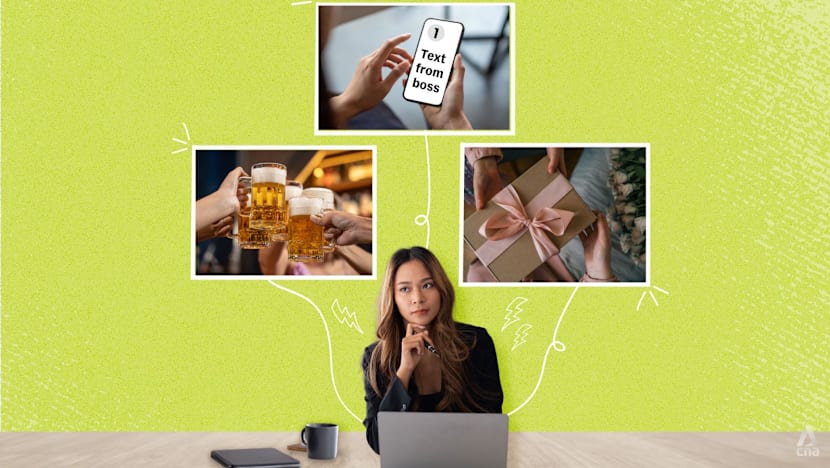
The office drinking culture may now be a relic of the recent past, but it was a strange norm. Everything seemed to revolve around it. The default move always seemed to be alcohol – to celebrate a big deal, commiserate over a loss, or if it was just a slow Thursday.
I often found myself unable to politely decline a drinking session without feeling I was losing the advantage of rapport-building with bosses.
Would my work really speak for itself if I never got that face time with upper management? Was drinking really the only way I could gain access to the inner circle?
Now, in my mid-30s, times have changed. Singaporeans are drinking less and less, most significantly Gen Z. There's less pressure now to participate in after-hours socialising that requires imbibing alcohol.
As a mother of two, it's somewhat of a relief. My oldest is now five years old – if she went on to enter the workforce as soon as I did and started drinking regularly with people twice or even three times her age, I'm not so sure I would feel comfortable with that.
But thinking back to the days of "office drinking culture" has me looking more closely at other everyday interactions in today's workplaces.
EVERYDAY OFFICE NORMS AND WHY WE PLAY ALONG
A friend recently joined a company where her general manager, a woman, addresses her only as "dear". It isn't just in casual text messages or face-to-face interactions, but also in work emails with other team members copied, and even in boardroom meetings.
Though my friend finds it undermining and condescending, she unwillingly accepts it so as not to rock the boat – after all, no one else in the company seems to have a problem with it.
Another office norm that still seems to be a favourite for social discussion: having lunch with colleagues.
I used to think of this as almost mandatory. How else would you bond and get to know everyone? I have also had the great fortune of meeting amazing people at work who have turned into dependable friends even outside the workplace.
Now, as a mother, working in an office is really a luxury for me. My lunch hour has become sacred. At home, mealtimes with my children always involved picky appetites or spilt drinks, as well as the constant coaxing and cajoling for "next mouth, come on, chew and swallow".
Lunch during an office workday means I get to eat what I want at the pace I want, listening to the podcast I want. I definitely need this for my sanity.
What I don't need is to drain my limited battery even further every single day by spending an hour making small talk with people I don't need to know very well just to be as efficient at my job. I'm not being snobby; I'm just trying to make it to the end of each day without losing my mind.
Another norm I've outgrown: being reachable and responsive 24/7.
I used to be all too happy to jump on this call and reply to that email at once, even at 10pm or later. Supervisors would text late at night: "Did you see the email? Can you reply?" and I would be on it right away.
I thought that's what I had to do to show that I cared, that I was a team player.
Honestly, I'm still struggling to let go of this one. I still find myself occasionally replying to work after hours – to some extent, I feel irresponsible if I don't.
But I'm learning to draw boundaries where I need to. Now, I refuse to look at my phone from 6pm to 9pm every evening, while my kids are having dinner, winding down and being put to bed. Sometimes I even turn my phone off entirely during those hours.
SHOULD ALL SPECIAL OCCASIONS BE SHARED WITH CO-WORKERS?
In an age where more and more young adults are opting for smaller nuptial celebrations (heard of a micro-wedding?), I'm about to say something that may shock everyone under the age of 30.
Back in the day, when you got married, you were expected to invite the boss to your traditional hotel banquet and, in most cases, have a whole table set aside for your colleagues.
I likely had the most budget-friendly wedding among my peers – we did it at a friend's bar for slightly over S$3,000 (US$2,320). About 300 family and friends popped in and out throughout the night, including all my husband's staff and everyone I worked with at the time.
Should I have gone with a traditional hotel banquet wedding, trust me, the big smashing celebration we wanted would have quickly turned into an intimate affair with just close family.
Another old norm that may deeply unsettle younger readers: As a child, I remember my mother, a teacher at the time, taking me along to more than one colleague's house to visit their newborn. Sometimes she even went straight to the hospital, a mere day or two post-partum!
In those times, such visits were both paid and received as a gesture of goodwill. In fact, the earlier you showed up post-birth, the better a friend you were.
It's not that I don't see the effort and intention in the gesture, but having gone through childbirth twice, I simply could not imagine anyone from my office seeing me in that state today. Certain boundaries need to be maintained in professional relationships.
Of course, the intensity and extent of such gestures greatly depend on what kind of industry and company you're working in.
In a regular office setting, if you’ve only been in the company for a handful of months and are asked to chip in for a baby shower present for Karen from marketing, it may be a little awkward – especially if you haven't even been introduced to Karen.
MUST WE BE A "FAMILY"?
I previously spent nearly two decades in media, largely working as a host and presenter.
In that environment, the chemistry I had with my co-hosts was paramount. It wasn't enough to simply get along; you genuinely had to like and take a healthy interest in each other to produce the best content.
In fact, many jobs seem to work best when the individuals in those roles develop strong trust and mutual reliance with their teammates – think of the police force or a firefighting unit, which often operate in high-pressure situations.
But we're not all police officers or firefighters, or even on-air presenters. What are the everyday stakes in a regular white-collar job that would require such intimate bonds with one's co-workers?
With many companies adopting remote or hybrid working policies, office norms have definitely changed. Workplace cohesion remains vital for employee engagement and productivity.
However, that does not mean we must accept and participate in every single practice offered up as a "norm".
Here's my take: Workplaces can have team spirit without trying to be a "family".
We don't need to have lunch with our colleagues daily or – heaven forbid – watch them nurse their newborn. It may make us better friends, but it won't necessarily make us better teammates.
What matters more is making an effort to understand their needs and concerns, and communicate openly about how we can work together to achieve shared goals.
If that requires sitting down to the occasional lunch with colleagues every now and then, so be it. But it shouldn't mean having to say "yes" to everything, either.
Jillian Lim has nearly two decades of experience in broadcasting, and is now pursuing her degree in business marketing.
Source: CNA/ml
Related stories

The Punch
WorldJul 4, 2026 · 1 min
Igboho’s security network rescues kidnapped Oyo woman, son in Kwara
The Punch

Straits Times
WorldJul 4, 2026 · 1 min
Israel hasn't said who its soldiers abused. Two Gaza mothers think it's their son
Straits Times

Antara News
WorldJul 4, 2026 · 1 min
Govt-Meta joint team key to combating online gambling: Expert
Antara News

Times of India
WorldJul 4, 2026 · 1 min
America@250: The United States of Anxiety
Times of India