Indian Express
Khashaba Jadhav: Olympic trailblazer whose story is at the centre of a legal battle in Pune
5 min readPuneJul 4, 2026 07:21 PM IST
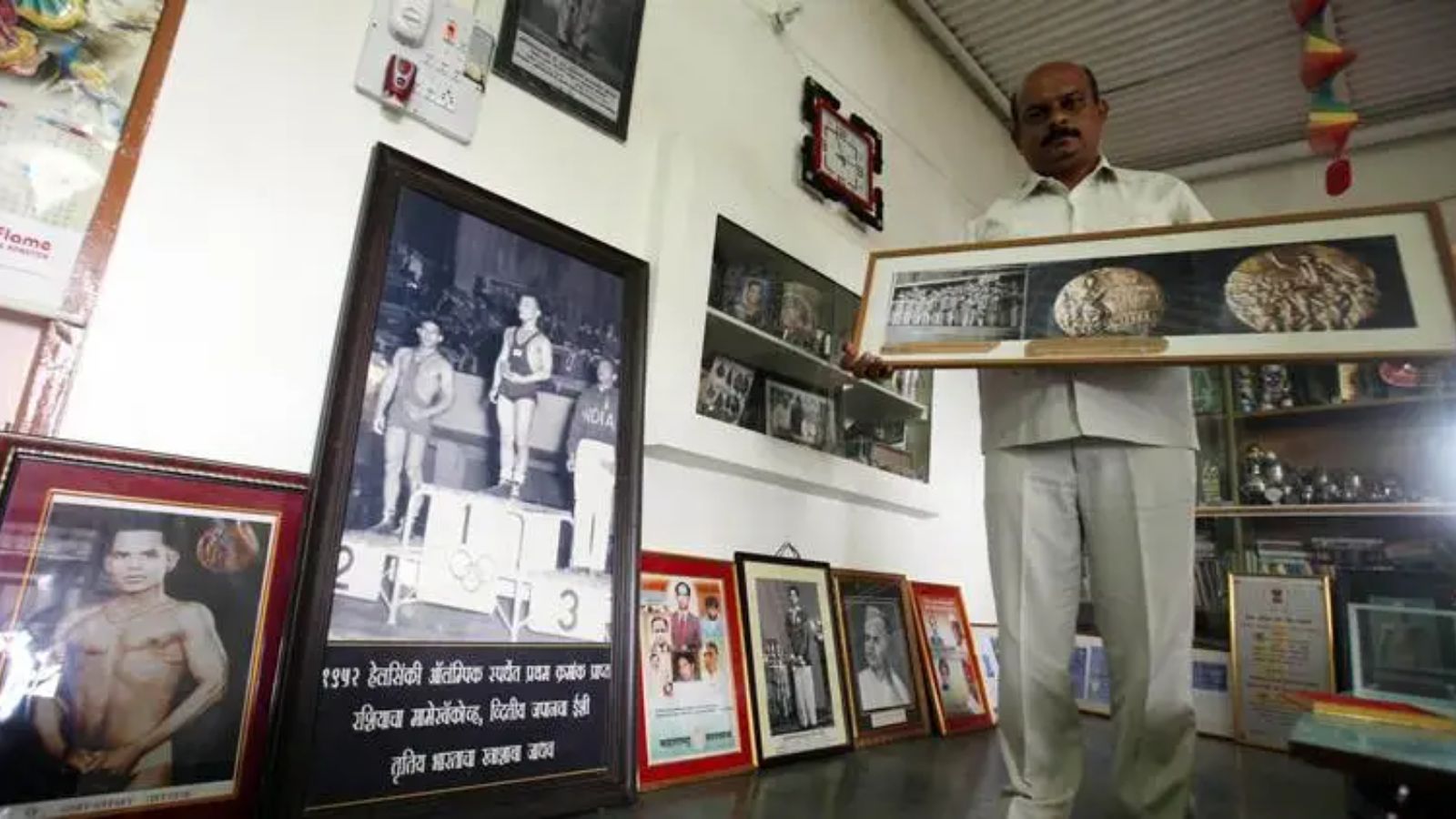
In search of glory: At Ranjit Jadhav’s home, Olympic Niwas, are preserved the trophies and medals the wrestler won through his career. (Source: Express file photo)
At the 1952 Summer Olympics in Helsinki, Finland, history stood on the victory podium in the freestyle bantamweight wrestling event. While Shohachi Ishii of Japan won the gold medal and Rashid Mammadbeyov of the Soviet Union took silver, standing beside them was wrestler Khashaba Dadasaheb Jadhav, popularly known as the “Pocket Dynamo”, who became independent India’s first individual Olympic medallist.
Since 1900, when Norman Pritchard won two silver medals in athletics, India had won Olympic gold only in men’s field hockey, a team sport. At the 1948 London Olympics, the Indian hockey team won the country’s first Olympic gold after Independence. Jadhav would remain independent India’s only individual Olympic medallist for 44 years, until Leander Paes won a bronze medal in tennis at the 1996 Atlanta Olympics.
Long before Indian athletes began returning from the Olympics with medals across disciplines, Jadhav stood alone. His feat has been documented in Sanjay Dudhane’s 2001 book, Olympicveer Khashaba Jadhav. Today, a film based on Jadhav’s life, Khashaba, directed by Nagraj Manjule, is at the centre of a copyright dispute before a Pune court, with Dudhane alleging that passages from his book have been used in the film’s teaser without his permission. The allegations are part of pending court proceedings and are yet to be adjudicated.
A legacy of wrestling
Jadhav was born on November 15, 1926, in Goleshwar village near Karad in Satara district. His father, Dadasaheb Jadhav, was a wrestler who introduced his son to the local akhada at a young age. Though less than 5 feet 5 inches tall, Jadhav was exceptionally quick and agile. Speed, rather than the brute strength commonly associated with wrestling, became his trademark.
The 1948 London Olympics were Jadhav’s first exposure not only to the world’s best wrestlers but also to mat wrestling. He finished sixth in the flyweight category. Having trained in traditional akhadas, he began learning mat wrestling on rough coconut-husk mats available in India. Many wrestlers, even today, consider it remarkable that Jadhav rose to international prominence despite such limited resources.
The road to Helsinki four years later was equally difficult. Jadhav reportedly struggled to secure selection despite defeating reigning flyweight champion Niranjan Das. His place in the Olympic squad was confirmed only after repeated selection bouts and the intervention of Maharaja Yadavindra Singh of Patiala, a wrestling enthusiast.
Financing the trip was another challenge. As government assistance was delayed, supporters from his village and his principal at Rajaram College in Kolhapur helped raise funds for his journey to Finland.
Story continues below this ad
According to a Government of India account, “At Helsinki, Jadhav had to fight seven bouts in all in the 52 kg freestyle event. In the first five, he met opponents from Europe and the Gulf countries and took barely five minutes to dispose of them. In the sixth round, his opponent was the famed Shohachi Ishii of Japan. Ishii’s novelty of the ankle hold surprised Jadhav, but when he counterattacked, Ishii attempted rolling fouls which were penalised, giving Jadhav the win.”
The account adds: “Unfortunately, Jadhav’s next bout was scheduled soon after this exhausting contest. This was officially not permissible, but since there was no Indian official to lodge a protest, he had to wrestle again within half an hour. Fatigued, Jadhav faced Rashid Mammadbeyov and was defeated, settling for the bronze medal.”
A forgotten hero
A Government of India report states: “Like most talented individuals in developing countries, Jadhav was largely forgotten. A principal reason… was that in India cricket dominates and all other sports invariably take a backseat.”
The fanfare that greets champions today was absent when Jadhav returned from Helsinki. “No newspaper interviews. Television had not yet arrived in India. There was a small felicitation for him at Mumbai’s Shivaji Mandir auditorium in Dadar. Interestingly, there was also a cavalcade of 101 bullock carts from Karad to his village,” a Press Information Bureau report notes.
Story continues below this ad
Jadhav joined the Maharashtra Police as an inspector in 1955 and retired as an Assistant Superintendent of Police in 1983. “After this glorious moment, he slid into oblivion and, despite serving in the state police, was living in poverty until he died—almost certainly a broken man—in a road accident in 1984,” the report says.
He was posthumously conferred the Arjuna Award in 2000, 16 years after his death. Jadhav’s achievement was not matched for 56 years, until wrestler Sushil Kumar won a bronze medal at the 2008 Beijing Olympics.
© The Indian Express Pvt Ltd
Dipanita Nath is a Senior Assistant Editor at The Indian Express, based in Pune. She is a versatile journalist with a deep interest in the intersection of culture, sustainability, and urban life.
Professional Background
Experience: Before joining The Indian Express, she worked with other major news organizations including Hindustan Times, The Times of India, and Mint.
Core Specializations: She is widely recognized for her coverage of the climate crisis, theatre and performing arts, heritage conservation, and the startup ecosystem (often through her "Pune Inc" series).
Storytelling Focus: Her work often unearths "hidden stories" of Pune—focusing on historical institutes, local traditions, and the personal journeys of social innovators.
Recent Notable Articles (December 2025)
Her recent reporting highlights Pune’s cultural pulse and the environmental challenges facing the city during the winter season:
1. Climate & Environment
"Pune shivers on coldest morning of the season; minimum temperature plunges to 6.9°C" (Dec 20, 2025): Reporting on the record-breaking cold wave in Pune and the IMD's forecast for the week.
"How a heritage tree-mapping event at Ganeshkhind Garden highlights rising interest in Pune’s green legacy" (Dec 20, 2025): Covering a citizen-led initiative where Gen Z and millennials gathered to document and protect ancient trees at a Biodiversity Heritage Site.
"Right to breathe: Landmark NGT order directs PMC to frame norms for pollution from construction sites" (Dec 8, 2025): Reporting on a significant legal victory for residents fighting dust and air pollution in urban neighborhoods like Baner.
2. "Hidden Stories" & Heritage
"Inside Pune library that’s nourished minds of entrepreneurs for 17 years" (Dec 21, 2025): A feature on the Venture Center Library, detailing how a collection of 3,500 specialized books helps tech startups navigate the product life cycle.
"Before he died, Ram Sutar gave Pune a lasting gift" (Dec 18, 2025): A tribute to the legendary sculptor Ram Sutar (creator of the Statue of Unity), focusing on his local works like the Chhatrapati Shivaji statue at Pune airport.
"The Pune institute where MA Jinnah was once chief guest" (Dec 6, 2025): An archival exploration of the College of Agriculture, established in 1907, and its historical role in India's freedom struggle.
3. Arts, Theatre & "Pune Inc"
"Satyajit Ray, Ritwik Ghatak were not rivals but close friends, says veteran filmmaker" (Dec 17, 2025): A deep-dive interview ahead of the Pune International Film Festival (PIFF) exploring the camaraderie between legends of Indian cinema.
"Meet the Pune entrepreneur helping women build and scale businesses" (Dec 16, 2025): Part of her "Pune Inc" series, profiling Nikita Vora’s efforts to empower female-led startups.
"How women drone pilots in rural Maharashtra are cultivating a green habit" (Dec 12, 2025): Exploring how technology is being used by women in agriculture to reduce chemical use and labor.
Signature Style
Dipanita Nath is known for intellectual curiosity and a narrative-driven approach. Whether she is writing about a 110-year-old eatery or the intricacies of the climate crisis, she focuses on the human element and the historical context. Her columns are often a blend of reportage and cultural commentary, making them a staple for readers interested in the "soul" of Pune.
X (Twitter): @dipanitanath ... Read More
Click here to join Express Pune WhatsApp channel and get a curated list of our stories
Tags:
Olympics
pune
View original source — Indian Express ↗
Related stories

The Punch
SportsJul 4, 2026 · 1 min
World Cup: ‘They kick the crap out of me’, Messi jokes after Cape Verde clash
The Punch

ESPN
SportsJul 4, 2026 · 1 min
Serena (knee) pulls out of Wimbledon doubles
ESPN
ESPN
SportsJul 4, 2026 · 1 min
The world is watching -- and loving -- wiener dogs racing at the Starkville Derby
ESPN
The Guardian
SportsJul 4, 2026 · 1 min
South Africa v England: Nations Championship rugby union – live
The Guardian