Indian Express
UPSC Weekly Current Affairs Quiz (June 28 – July 04) : 10 key questions with detailed answers for Prelims 2027
As UPSC CSE Prelims 2027 is still ahead, building a strong foundation alongside regular current affairs preparation is essential. UPSC Weekly Quiz is a current affairs–based quiz on relevant topics from the past week, curated for aspirants of competitive examinations. Attempt the weekly quiz every Saturday and review the detailed answers with explanations to strengthen conceptual clarity and exam readiness.
🚨 Click Here to read the UPSC Essentials magazine for June 2026. Share your views and suggestions in the comment box or at [email protected]🚨
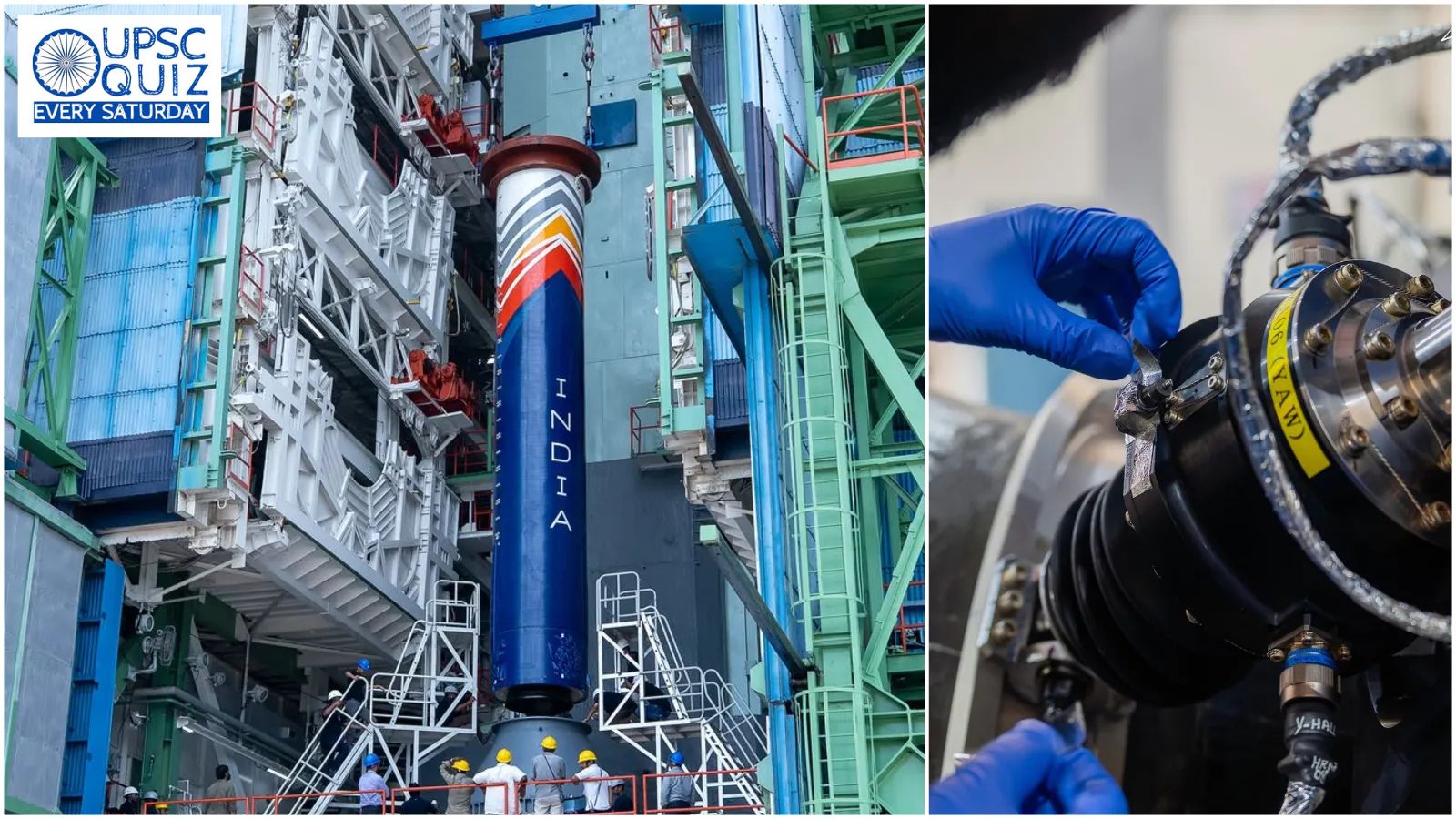
1. Vikram 1 is India’s first private orbital rocket under ‘Mission Aagaman’.
2. Vikram 1 has an all-carbon composite structure with solid fuel boosters.
3. It has a 3D printed liquid engine.
4. It can carry up to 350kg till low Earth orbit.
Which one of the following conclusions based on the above statements is correct?
(a) There are four correct statements.
(b) There is only one correct statement, that is statement 2.
(c) There are two correct statements, that include statement 1.
(d) There is no correct statement.
Why this question for UPSC Prelims 2027?
Story continues below this ad
Mission Aagaman marks the launch of India’s first privately developed orbital rocket, a landmark event in India’s space sector reforms. UPSC can ask statement-based questions on major developments in India’s space programme and private sector participation in strategic technologies.
Explanation
— Vikram 1, India’s first private orbital rocket is ready for its first test flight under ‘Mission Aagaman’. It is scheduled for launch between July 12- August 4, 2026 from Satish Dhawan Space Centre, Sriharikota. Hence, statement 1 is correct.
— Developed for carrying smaller satellites, Vikram 1 has an all-carbon composite structure with solid fuel boosters, and a 3D printed liquid engine. Manufactured entirely in India, it can carry up to 350kg till low Earth orbit, and up to 260 kg to the sun-synchronous orbit (SSO). An SSO is a near-polar orbit where a satellite passes over any given point on Earth’s surface at the same exact local mean solar time every day. Hence, statements 2, 3 and 4 are correct.
— According to the description on Skyroot’s website Vikram 1 is an “on-demand launch vehicle for rapid, precise, and customisable small satellite deployments”.
Therefore, option (a) is the correct answer.
Story continues below this ad
QUESTION 2
With reference to the Employees’ Provident Funds Scheme, 2026, consider the following statements:
1. For contract workers, the concept of ‘principal employer’ has been introduced in the scheme for the first time.
2. The scheme will replace the Employees’ Provident Funds Scheme, 1952.
3. In cases where the PF payment is made by the contractor, the ultimate responsibility for contributions will be with the principal employer.
Which one of the following conclusions based on the above statements is correct?
(a) All three statements are correct.
(b) There are two correct statements, that include statement 1.
(c) There is only one correct statement.
(d) There is no correct statement.
Why this question for UPSC Prelims 2027?
Story continues below this ad
The Employees’ Provident Funds Scheme, 2026 is a newly notified social security reform replacing a long-standing framework, making it highly relevant for current affairs-based questions. The scheme introduces new concepts and compliance provisions that are well-suited to UPSC’s statement-based Prelims questions.
Explanation
— The Centre has notified the Employees’ Provident Funds Scheme, 2026, replacing the Employees’ Provident Funds Scheme, 1952. The Ministry of Labour and Employment’s move is part of the implementation of the Code on Social Security, 2020, with the new scheme coming into effect from June 29. Hence, statement 2 is correct.
— The recent decisions taken by the retirement fund body, the Employees’ Provident Fund Organisation (EPFO), regarding partial withdrawals and streamlining of withdrawal categories have been incorporated into the new scheme, along with an explicit mention about mandatory and voluntary contributions above the statutory wage ceiling.
— For contract workers, the concept of ‘principal employer’ has been introduced in the scheme for the first time. This is in line with the provisions of the labour codes. Hence, statement 1 is correct.
Story continues below this ad
— The EPF Scheme, 2026 states that the employer will be required to pay both the employer’s contribution and the employee’s contribution, in the first instance, along with administrative charges or other fees for an employee directly employed by the employer or through a contractor (not registered independently), within 15 days of the close of every month.
— In cases where the PF payment is made by the contractor, the ultimate responsibility for contributions will be with the principal employer. Hence, statement 3 is correct.
— The new EPF Scheme, 2026 incorporates those changes by allowing members to withdraw funds in case of illness of self and family members, up to 100% of the eligible member balance, after completion of 12 months of total membership of the Fund.
— The 100% eligible member balance means withdrawal of 75% of the total funds as 25% is mandatory minimum balance requirement. The full 100% amount can be withdrawn after remaining unemployed for one year.
Therefore, option (a) is the correct answer.
QUESTION 3
Consider the following statements:
Story continues below this ad
1. Insolvency proceedings cannot be used to shield assets allegedly linked to money laundering.
2. The moratorium under the Insolvency and Bankruptcy Code extends to proceedings under the Prevention of Money Laundering Act.
3. The moratorium under Section 14 of the IBC extends to all criminal and penal proceedings against the corporate debtor.
How many of the statements given above are correct?
(a) Only one
(b) Only two
(c) All three
(d) None
Why this question for UPSC Prelims 2027?
It tests the interplay between economic laws, insolvency resolution, and anti-money laundering regulations, which are important areas in governance and economy. The topic is well-suited to UPSC’s preference for statement-based questions on contemporary judicial interpretations and regulatory frameworks.
Explanation
Story continues below this ad
— The National Company Law Appellate Tribunal (NCLAT) recently held that insolvency proceedings cannot be used to shield assets allegedly linked to money laundering. Hence, statement 1 is correct.
— It said that the Insolvency and Bankruptcy Code (IBC), the law meant to help creditors recover dues, was never intended to become “holy ganges” that could wash away a corporate debtor’s “sin of criminality” under the Prevention of Money Laundering Act (PMLA).
— Section 14(1) (a) of the IBC bars “the institution of suits or continuation of pending suits or proceedings against the corporate debtor including execution of any judgment decree or order in any court of law,” once an insolvency resolution begins. This moratorium exists to freeze the debtor’s position in order to deal with the creditors collectively rather than through individual recovery.
— The NCLAT held that the moratorium under Section 14 applies primarily to civil debt-related proceedings and does not bar criminal or penal proceedings arising under public law statutes. Hence, statement 3 is not correct.
— The NCLAT clarified that the IBC moratorium does not extend to proceedings under the PMLA involving alleged proceeds of crime, as the two statutes operate in distinct spheres. Hence, statement 2 is not correct.
Therefore, option (a) is the correct answer.
QUESTION 4
With reference to the disputed regions and countries associated, consider the following pairs:
1. Nagorno-Karabakh region – Georgia-Armenia
2. Limpiyadhura – India-China
3. Northern Territories – Japan-China
How many of the pairs given above are correctly matched?
(a) Only one pair
(b) Only two pairs
(c) All three pairs
(d) None of the above pairs
Why this question for UPSC Prelims 2027?
Territorial disputes and geopolitical flashpoints are recurring themes in UPSC Prelims, especially when linked to contemporary international developments. The question tests conceptual clarity in political geography and international relations through UPSC’s preferred matching format.
Explanation
— Japanese Prime Minister Sanae Takaichi arrived in New Delhi on Wednesday (July 1) for the 16th India-Japan Annual Summit and a three-day visit. It comes shortly after she shared an updated vision for a “Free and Open Indo-Pacific” (FOIP), a framework Japan first underlined in 2016, and recent shifts in the country’s pacifist defence policy.
— Japan has realised that it faces a multiplicity of threats in its immediate neighbourhood. Firstly, Tokyo faces a direct danger from North Korea’s acquisition of nuclear weapons, a threat that has escalated since their last test in 2017, as well as their missile development. Secondly, Japan remains entangled in an older territorial dispute with Russia over the so-called ‘Northern Territories’. Thirdly, Japan is confronting the phenomenal economic and military rise of China. Beijing’s use of economic leverages and its coercive maritime practices in support of irredentist claims over the Senkaku islands in the East China Sea have prompted Japan to review its passive defence posture. Hence, pair 1 is not correctly matched.
Note: Limpiyadhura is a disputed territory between India and Nepal, while Nagorno-Karabakh region is a disputed region between Azerbaijan and Armenia. Hence, pairs 2 and 3 are not correctly matched.
Therefore, option (d) is the correct answer.
QUESTION 5
With reference to the Indian Ocean Dipole (IOD), consider the following statements:
1. It is an ocean-atmosphere interaction confined to the Indian Ocean.
2. In a positive IOD, the eastern Indian Ocean warms relative to the west.
Which of the statements given above is/are correct?
(a) 1 only
(b) 2 only
(c) Both 1 and 2
(d) Neither 1 nor 2
Why this question for UPSC Prelims 2027?
The Indian Ocean Dipole is a recurring topic in climate science and monsoon studies, areas frequently tested by UPSC. UPSC often frames statement-based questions on climate phenomena by testing the direction and nature of ocean-atmosphere interactions.
Explanation
— This year, India’s monsoon season opened in June with a rainfall shortfall of roughly 40% against the nationwide long-period average. Central, eastern, and north-eastern states were the worst hit, with over three-quarters of districts in these regions reporting deficient or no rain.
— This steep rainfall deficit has evoked concerns, particularly with strengthening El Niño conditions. But meteorologists said that a lesser-known natural phenomenon, called the Indian Ocean Dipole (IOD).
— The IOD is an ocean-atmosphere interaction confined to the Indian Ocean, playing out between the Indonesian and Malaysian coastline in the east and the African coastline near Somalia in the west. This phenomenon oscillates between three phases: positive, negative, and neutral. Hence, statement 1 is correct.
— In a positive IOD, the western Indian Ocean warms relative to the east, pushing moisture-laden winds towards east Africa and the Indian subcontinent and boosting rainfall in those regions, while bringing drought-like conditions to Indonesia and Australia. Hence, statement 2 is not correct.
— A negative IOD reverses this pattern, cooling the west and warming the east. In a neutral IOD, there is no significant difference between the eastern and western sides and thus, no specialised impact on regional climatic conditions.
Therefore, option (a) is the correct answer.
QUESTION 6
With reference to the battery management system (BMS), consider the following statements:
1. It tracks the state of a battery.
2. It eliminated variations in the performance of individual battery cells to allow them to work uniformly inside a battery pack.
3. Recently, India banned applications that were used to connect to nearby e-rickshaws via Bluetooth and disable their battery management systems.
4. It stores electrical energy and serves as the main energy source of an electric vehicle.
Which one of the following conclusions based on the above statements is correct?
(a) There are four correct statements.
(b) There is only one correct statement, that is statement 2.
(c) There are two correct statements, that include statement 1.
(d) There are three correct statements.
Why this question for UPSC Prelims 2027?
The question is based on a recent government action related to e-rickshaw safety and battery management systems. UPSC can ask statement-based questions on emerging technologies that appear in current affairs.
Explanation
— The government directed Apple and Google to take down at least three apps over reports of them being misused to remotely switch off some e-rickshaws amid cybersecurity concerns and passenger safety risks. Hence statement 3 is correct.
— The move follows the circulation of videos on social media showing individuals connecting to nearby e-rickshaws through Bluetooth and disabling their battery management systems or BMS while the vehicles were in motion. The apps that have been directed to be blocked include BAT-BMS, Lossigy, and Epoch Li-ion. At least a couple of them are of Chinese-origin.
— A battery management system (BMS) essentially tracks the state of a battery, with the primary aim of eliminating variations in performance of individual battery cells to allow them to work uniformly inside a battery pack. This system is incorporated in an electric vehicle (EV) powered with a large-capacity lithium ion battery, and plays a key role in extending the battery’s service life and ensuring its safe use. Hence statements 1 and 2 are correct.
— The battery pack stores electrical energy and acts as the main energy source. The BMS is an electronic control system that monitors and manages the battery. Hence statement 4 is not correct.
Therefore, option (d) is the correct answer.
QUESTION 7
The Defence Acquisition Council (DAC), which oversees acquisition proposals for the Armed Forces, works under the chairmanship of:
(a) Defence Minister
(b) Defence Secretary
(c) President
(d) Prime Minister
Why this question for UPSC Prelims 2027?
The Defence Acquisition Council (DAC) has been in the news due to recent approvals of major defence procurement proposals and initiatives related to military modernisation. UPSC can ask questions on the composition, functions, and chairpersons of important constitutional and statutory bodies, councils, and committees.
Explanation
— The Defence Acquisition Council (DAC) on Friday cleared a range of acquisition proposals worth about Rs 52,000 crore for the Armed Forces.
— The proposals include Anti-Unmanned Aerial Vehicles (Anti-UAV) Electronic Warfare System named ‘Akash Tarang’, Medium Range Surface-to-Air Missile (MRSAM) Weapon System, the latest Verba Very Short Range Air Defence System (VSHORADS) developed in Russia, Jet-Based Kamikaze Drone System for the Army, Naval Shipborne Unmanned Aerial System (NSUAS) for the Navy and Fixed-Wing Based High Altitude Pseudo Satellite (FW-HAPS) for the Indian Air Force, among others.
— The DAC is the key defence body that grants Acceptance of Necessity (AoN) on all big-ticket capital procurements. The AoN is the first step in the defence procurement process. However, obtaining an AoN does not always lead to a final order.
— The Defence Acquisition Council (DAC) is chaired by the Union Defence Minister of India.
Therefore, option (a) is the correct answer.
QUESTION 8
With reference to the greenhouse gas emission intensity (GEI), consider the following statements:
1. GEI targets under India’s carbon market framework are applicable only to the iron and steel sector.
2. GEI is calculated as the amount of product output generated per unit of greenhouse gas emitted.
Which of the statements given above is/are correct?
(a) 1 only
(b) 2 only
(c) Both 1 and 2
(d) Neither 1 nor 2
Why this question for UPSC Prelims 2027?
India’s compliance-based carbon market and sector-specific emission intensity targets represent an important recent policy development in climate governance. The topic links environmental policy, climate change commitments, and economic regulation, all of which are recurring UPSC themes.
Explanation
— The Centre has again issued a draft notification to set greenhouse gas emission intensity (GEI) targets for the intensive iron and steel sector and to align them under India’s carbon credit trading system (CCTS).
— The Ministry of Environment, Forest and Climate Change (MoEFCC), which issued the draft on June 26 and made it public on July 2, has set emission reduction targets for 255 industrial units, including the sector’s giants such as JSW Steel, Tata, Steel Authority of India, and Arcelor Mittal, among others.
— Draft targets for the iron and steel sector were already issued on June 23, 2025, along with aluminium (second aluminium), petroleum refinery, petrochemical, and textile sectors. While final targets for other sectors were notified in January 2026, MoEFCC has issued a revised draft for the iron and steel sector with marginal changes to the targets, but without any explanation for the fresh draft. Hence, statement 1 is not correct.
— GEI is the amount of greenhouse gas (GHG) emitted per unit of product output, such as the quantum of gases released while producing cement. The CCTS was launched in 2023 to create a framework that incentivizes emission reduction through a market-based mechanism, and to help achieve India’s climate action goals. Hence, statement 2 is not correct.
Therefore, option (d) is the correct answer.
QUESTION 9
The ‘Kente extension integrated coal block’ was recently in the news. It is located in:
(a) Chhattisgarh
(b) Maharashtra
(c) Jharkhand
(d) Telangana
Why this question for UPSC Prelims 2027?
The Kente Extension coal block has been in the news due to environmental clearance granted in the ecologically sensitive Hasdeo-Arand forests, a recurring topic in environmental governance and conservation debates.
Explanation
— In Chhattisgarh’s Hasdeo-Arand forests, the Environment Ministry has accorded environmental clearance for mining in the Kente extension integrated coal block ,with a projected production capacity of 9 million tonnes of coal per annum.
— The environmental clearance (EC), issued on June 24, comes close on the heels of the in-principle forest clearance granted for the integrated open cast mining and washery proposal. The ministry’s sectoral expert appraisal committee on coal mining had recommended EC for the project in January 2025. The grant of final EC, though, was linked to the in-principle forest approval, which was issued on June 9.
— This is the third major coalfield that has been granted clearance in the Hasdeo forests. Parsa and Parsa East Kente Basan (PEKB) open cast mines are already operational in the forests — once earmarked as a no-go zone for mining to protect forests and wildlife.
— The Kente extension coal block, spread over 1,760 hectares in Surguja district, was allotted to Rajasthan Rajya Vidyut Utpadan Ltd in 2015. The Adani Group is the mine developer and operator. Coal extracted from this mine will be transported to Rajasthan to feed the Chhabra and Suratgarh coal plants.
Therefore, option (a) is the correct answer.
QUESTION 10
Ships from which of the following countries have to cross the Gulf of Aden to reach out to the Indian Ocean?
1. Eritrea
2. Djibouti
3. Somalia
4. Kenya
Select the correct answer using the codes given below:
(a) 1 and 2 only
(b) 1, 2 and 3 only
(c) 2 and 3 only
(d) 1, 2, 3 and 4
Why this question for UPSC Prelims 2027?
The Gulf of Aden and the Bab el-Mandeb Strait have remained in the news due to maritime security challenges, disruptions to global shipping routes, and geopolitical developments in West Asia and the Horn of Africa.
Explanation
— Indian Navy commanders promptly responded to a piracy attack on a merchant vessel in the Gulf of Aden, ensuring the safety of 21 crew members on board, including one Indian national.
— According to the Navy, INS Trikand, a stealth frigate deployed for missions in the Gulf of Aden, quickly intervened during the piracy attempt on the MV Golden Arsenal, a bulk carrier registered under the flag of St Vincent and the Grenadines. The merchant vessel was transiting from Aden, Yemen, when it reported an attempted pirate attack approximately 300 nautical miles east-northeast of Djibouti. INS Trikand, which was on a mission in the area, was directed to intercept the merchant vessel.
— Eritrea is on the Red Sea. To enter the Indian Ocean, ships must first transit via the Bab el-Mandeb Strait and the Gulf of Aden.
— Djibouti is located at the Gulf of Aden’s entrance, and ships going for the Indian Ocean pass through it.
— Somalia has a vast coastline on the Indian Ocean that is accessible without crossing the Gulf of Aden.
— Kenya has direct access to the Indian ocean.
Therefore, option (a) is the correct answer.
Previous Weekly Quiz
UPSC Weekly Current Affairs Quiz (June 21 – June 27)
UPSC Weekly Current Affairs Quiz (June 14 – June 20)
UPSC Weekly Current Affairs Quiz (June 07 – June 13)
UPSC Weekly Current Affairs Quiz (May 31 – June 06)
UPSC Weekly Current Affairs Quiz (May 24 – May 30)
UPSC Weekly Current Affairs Quiz (May 17 – May 23)
Subscribe to our UPSC newsletter and stay updated with the news cues from the past week.
Stay updated with the latest UPSC articles by joining our Telegram channel – IndianExpress UPSC Hub, and follow us on Instagram and X.
View original source — Indian Express ↗
Related stories

Dawn
TechnologyJul 4, 2026 · 1 min
Digital pizzas? Corporations ridicule PlayStation over ending game disc production
Dawn

TechCrunch
TechnologyJul 4, 2026 · 1 min
Alibaba reportedly bans employees from using Claude Code
TechCrunch
Times of India
TechnologyJul 4, 2026 · 1 min
China threat sparks alarm: Taiwan launches biggest reserve military overhaul in decades
Times of India

The Verge
TechnologyJul 4, 2026 · 1 min
White House deletes thousands of web pages about energy conservation as heatwave slams US
The Verge